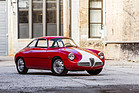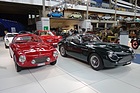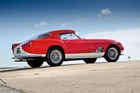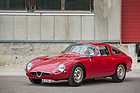






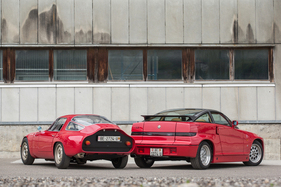
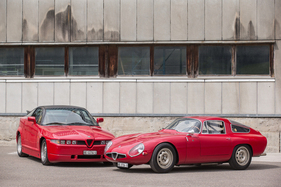
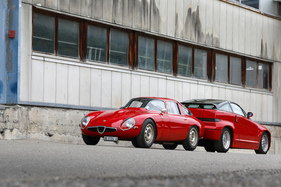
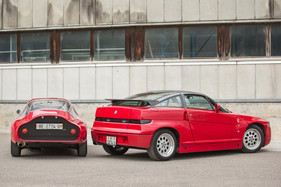
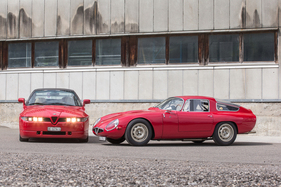
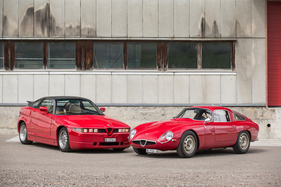
They are both red, equipped with two seats, sporty and eye-catching. And they come from the same car manufacturer. Even the "Carrozzeria" is the same.
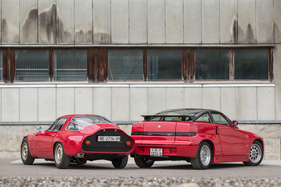
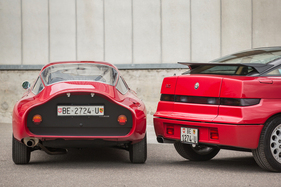
Nevertheless, the Alfa Romeo Giulia TZ1 and the Alfa Romeo SZ - the "Z" stands for Zagato - are fundamentally different. So off we go for a comparison drive.
Featherweight
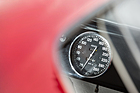
In the TZ1, the lightweight door with its delicate handle leads into a narrow cockpit with a huge rev counter in the center behind the steering wheel. The speed display is located to the right above the gearshift and was probably of little importance to buyers at the time. The displays for water temperature, oil pressure and oil temperature, which are distributed around the steering axle, were of greater interest.
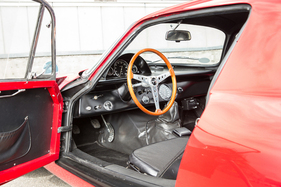
All-round visibility is good, the seats offer good lateral support and the pedals and gearshift are positioned just right. The side windows are designed as sliding windows, the crank mechanism is not needed.
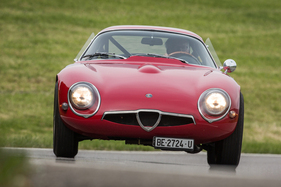
The engine is started with the ignition key and the twin-camshaft four-cylinder engine with a displacement of 1.6 liters immediately gets going. It is not a quiet performer and the combustion cycles are not acoustically dampened by layers of insulation. The clutch separates cleanly, the five relatively short-ratio gears can be changed precisely and with little resistance. Thanks to a kerb weight of just 650 kg, the 112 hp is sufficient for very sporty forward progress, while the four disc brakes can easily slow the car down again.
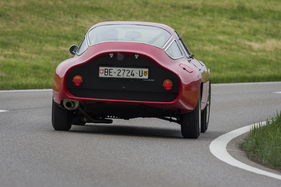
The TZ1 is certainly not a quiet performer, nor is it trimmed for excessive suspension comfort. The fun on winding roads, which can be a little narrower thanks to a width of only 151 cm, is boundless, and the sensitive steering and low seating position contribute a lot to this. But the TZ1 was of course designed for success on closed roads.
For the fast lap
At the end of the 1950s, success in motor racing was very important to Alfa Romeo, which is why the company once again sought out Elio and Ugo Zagato when developing the new Alfa Romeo Giulia. From 1959, a sports car was developed in parallel at Zagato, which was to ensure racing victories with technical components from the Giulia. A low weight was just as important as low air resistance. In 1962, a prototype was shown at the Turin Motor Show which, thanks to its tubular steel frame and aerodynamically shaped aluminum body, met the development specifications.
However, a great deal of work was still needed before it went into "series production", as the racing sports car was only able to impress with a refined body and rear end as well as modified suspensions. 100 examples of the coupé designed by Ercole Spada were to be built in order to secure homologation in the GT class.
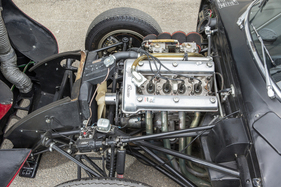
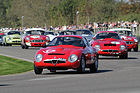
From October 1963, the sports car could be ordered for DM 28,950 or CHF 29,850, a lot of money for a spartanly equipped car. But the "Tubolare Zagato" was not intended for the road at all; the race track was its preferred battlefield. Class victories at the Targa Florio, Le Mans and Sebring proved that the concept was right.
But because the competition did not sleep, Porsche, for example, came onto the market with the even more uncompromising 904 GTS, Zagato also had to sharpen up. The TZ1 was followed by the TZ2 with an even flatter body, lower weight, more power and no compromises for possible road use. After 12 examples, which were built in addition to 112 TZ1s in Udine, it was finally over.
Today, the TZ1 and TZ2 are among the most sought-after Alfa classics and are welcome starters at classic car races and events.
For the fast journey
Let's take a seat in the Alfa Romeo SZ, which is over 25 years younger. The fact that this wedge-shaped coupé was not intended for the racetrack is evident from the interior design with fine carpets and lots of leather. And the hood alone seems to be almost as heavy as the TZ1, or so it seems when we want to take a look at the Busso six-cylinder before the start.
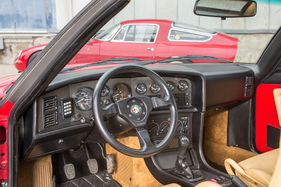
The all-round visibility is better than expected and the handling of the now 36-year-old coupé makes no unusual demands. The car is again started with the key to the right of the steering wheel and the melodic baritone of the three-liter V6 engine is immediately heard. The controls are easy to reach, although the pedals are slightly offset to the left.
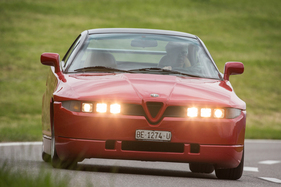
Thanks to power assistance, steering is easy. There is no lack of comfort, as the side windows can be lowered electrically. Nor is there a lack of storage space for a long weekend, although luggage has to be stowed in the interior behind the two seats, as there is actually no room for it in the trunk next to the spare wheel.
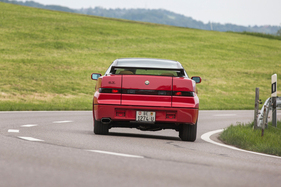
Handling and performance give no cause for criticism, the fast ride is tailor-made for the coupé. One would even like to hear a little more from the engine.
Lighthouse project
The "Experimental Sportscar" (ES) with a displacement of three liters (30) was created as a flagship for Alfa Romeo. It was also intended to revive the collaboration with Zagato. However, the design development was primarily driven by Fiat/Alfa Romeo, with Frenchman Robert Opron designing the progressive and eye-catching exterior of the car together with Antonio Castellana at Fiat.
Even if the coupé didn't look like it, the drag coefficient of 0.30 was still impressive, supplemented by an invisible "ground effect" thanks to the corresponding design of the underbody, which allowed lateral accelerations of up to 1.6 g.
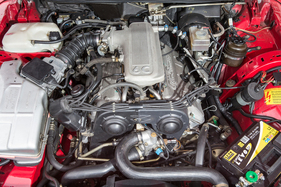
Technically, the ES 30 and externally also called SZ sports car was based on the Alfa Romeo 75, from which the engine, gearbox and chassis elements were taken. The body consisted of a metal skeleton, which was covered by hand with plastic elements produced at OPAC in the Zagato factory in Terrazzano di Rho.
The Alfa Romeo SZ was unveiled at the 1989 Geneva Motor Show, and the unusual bodywork divided the Alfa fan community. No wonder the ES 30 was also called "il mostro", meaning monster.
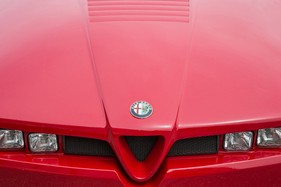
1000 units were to be produced, primarily for the American market, and with a base price of DM 102,000 or CHF 81,500, the coupé was the most expensive production Alfa to date.
The SZ was not much faster than the TZ1; the magazine "ams" clocked 7.5 seconds for the 0 to 100 km/h sprint and 235 km/h top speed. The weighed 1360 kg reduced the forward dynamics a little, without having to be dissatisfied, especially as the handling and driving behavior were convincing.
Just over 1000 units were actually built until 1991, followed by 278 significantly more expensive convertible versions called RZ between 1992 and 1993, which could also be ordered in colors other than red.
TZ1 from 1963 versus SZ from 1989
The technical data shows the differences between the two incomparable sports cars:
| Alf a Romeo Giulia TZ1 | Alfa Romeo SZ (ES 30) | |
|---|---|---|
| Built from/to | 1963-1965/7 (TZ2) | 1989-1992/3 (RZ) |
| Engine position | Front | Front |
| Engine construction | In-line four-cylinder | V6 |
| Cooling system | Water cooling | Water cooling |
| Mixture preparation | Carburetor | Injection |
| Displacement cm3 | 1570 | 2959 |
| Power (hp) | 112 | 207 |
| at rpm | 6500 | 6200 |
| Max. Torque (Nm) | 132.4 | 245 |
| at rpm | 4200 | 4500 |
| Number of gears | 5 | 5 |
| Transmission | Rear | Rear (transaxle) |
| Front suspensions | Trapezoidal wishbone | Wishbone |
| Rear suspensions | Triangular control arm | DeDion rigid axle |
| Brakes | Discs | Discs |
| Tires | 155-15 | 205/55-16 / 225/50-16 |
| Weight (kg) | 650 | 1360 |
| Power-to-weight ratio (kg/hp) | 5.8 | 6.6 |
| 0 - 100 km/h (s) | approx. 7 | 7.5 |
| Top speed (km/h) | > 200 | 235 |
| Consumption liters/100 km | 13.7 | |
| cW (drag coefficient) | 0.3 | |
| Length (cm) | 395 | 406 |
| Width (cm) | 151 | 173 |
| Height (cm) | 120 | 131 |
| Wheelbase (cm) | 220 | 251 |
| Original price | DM 28'950 / CHF 29'850 | DM 102'000 / CHF 81'500 |
| Production | 112 (+12 TZ2) | approx. 1000 (Coupés) |
And then there was the TZ3
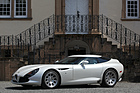
The Alfa Romeo SZ was not the end of the Alfa Zagato story, as the TZ3 appeared in 2010 to mark Alfa Romeo's 100th birthday. However, this was based on a Dodge Viper, but was visually very similar to the TZ1/TZ2, even if it was closer in character to the ES 30/SZ.
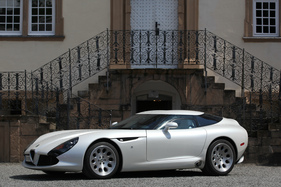
"Z" for Zagato can and could mean very different things, but all the sports cars described here were and are certainly attractive, each in their own way.
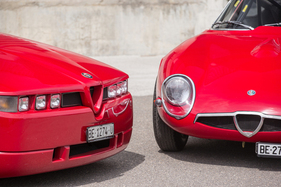
And the comparison between the TZ1 of the sixties and the SZ of the late eighties in particular shows how the automotive landscape and design have developed in around 30 years.
The Alfa Romeo Giulia TZ1 and Alfa Romeo SZ portrayed in this report will go under the hammer on May 30, 2026 at the auction of the Oldtimer Gallery on the occasion of Swiss Classic World . Interested parties in Lucerne will therefore have the choice of which of the two sports cars they want to give priority to. But it would be best to own them both ...