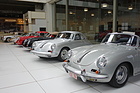
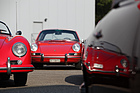
Isn't it strange? In the shadow of the everlasting 911, there is a second, somewhat less conspicuous Porsche scene. The importance of the 356 cannot be overestimated. After all, the original Porsche was launched shortly after the end of the Second World War in the Austrian town of Gmünd, in the Malta Valley, marking a long overdue step by the Porsche design office towards becoming an automobile manufacturer. Despite the austere post-war period, the first fifty-two hand-built aluminum coupés and convertibles were sold to men and women.
With the move to the former company headquarters in Stuttgart, the Porsche 356 production was successfully set up for distribution throughout the world in cooperation with the Reutter body factory. The 356 remained in the range for another 15 years before the 911 finally replaced it.

The author, a 356 fan
Some may still remember the cover of the first issue of Motor-Klassik in the late summer of 1984. Alongside a 300 SL and a BMW 507, a Porsche 356 also vied for the favor of the targeted readership. Dirk-Michael Conradt, the car in the cover story, looked back 30 years to the German economic miracle. In the first issue, the three German sports cars embodied the new classic standard that the magazine wanted to spread among the German readership.
Conradt - the newly appointed editor-in-chief - had invented the new magazine concept during his time at auto, motor und sport with plenty of inspiration from the UK and adapted it for the local market.
In this, his first report, Conradt's fascination with the 356 shines through. While Mercedes and BMW boasted engine capacity and car mass, it was the compact performance of the 356 Porsche that Conradt emphasized. "Porsche favors driving machines - without glamour, without effects. As with few other sports cars, the body design of the 356 (and subsequently also the 911) is subordinate to function. Under such circumstances, the result is naturally not a show-off and ostentatious car for show-offs, but a sports machine for active drivers that is limited to the essentials." What's a 300 SL or a 507 when you can drive a 356 with a Fuhrmann engine down the country road?
Driving pleasure for connoisseurs
The consistent classification of that time is currently contrasted with the subtitle of Conradt's latest 356 work. His conclusion from 1984 sounded more sporty: Driving pleasure yes, but enjoyment more for a fringe group of sports drivers? The first chapter of the book contains a more than 30-page photo series as an introduction to this enjoyment.

Numerous photos from the Porsche archive show the 356 in various scenes, mostly images from the press archive or the customer magazine Christophorus - an above-average number of ladies behind the wheel of rather underpowered 356s underline the ease of early Porsche driving. "The 356 is as carefree to drive as it looks: easy to handle, light on its feet, requiring little effort from arms and legs".
Almost like a Beetle, you spin the thought to its conclusion. The author thus distinguishes the 356 from contemporary sports cars from Germany and abroad, which had to be forced around the next corner with a lot of braking or clutch effort and a firm grip. "Like few cars of its era, a Porsche 356 conveys the feeling of unshakeable solidity (...)." There is no doubt that Conradt has not given up his attitude towards the 356 since 1984. Even the merciless crash landing with his first 356 purchase described in the foreword, in which the restoration threatened to end in a bottomless pit, cannot have changed this: "A barn find as a borderline experience", is how he describes his first folding windshield, which a Swiss enthusiast ultimately breathed new life into.
Twelve chapters for a model evolution
Conradt divides his 250-page work into a total of twelve chapters. It begins with the origins of the brand, includes models and technology and ends with the movers and shakers, celebrities and motorsport. The texts in each chapter, which are always rather concise but still worth reading, are followed by an extensive photo series on the respective chapter topic.
The pictures illustrate the chapter topic in a more or less broad sense, with the captions alternating between meaningful and irrelevant.

Some pictures have found their way into the book more because of their design than because of the message they convey. This results in a layout in which the insertion of relevant images to accompany the text has been sacrificed in favor of a textual chapter introduction and a purely pictorial section at the end.
In principle, the question arises as to whether it would not be both more creative and easier to understand if the images were more clearly evaluated and illustrated in the continuous text instead of dividing each chapter into text and image sections. In any case, the various thematic chapter approaches succeed in getting to the bottom of the wealth of variants and facets as well as the long history of the model on a broad level and presenting it in many different ways.
Standard work yes or no
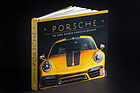
The blurb reads like this: "Dirk-Michael Conradt, former editor-in-chief of Motor-Klassik, is one of the most intimate connoisseurs of Porsche 356 history." the spine praises the book. "Conradt combed through the archives and came across fascinating details about the development of the 356, which he traces in this book."
Porsche connoisseurs and 356 fans will sit up and take notice. After all, this is not the author's first attempt at a 356 book. Is there something new to be found? Whether the blurb should ennoble the author or the book, or both, remains to be seen. Nevertheless, this raises the question of whether a standard work can be acquired here?

Let's keep it short: Compared to other publications on the 356, there are no really new insights to be found. Standard works are characterized by the in-depth research work in the archive mentioned above. Of course, this also includes interesting pictures, but a flood of images cannot replace textual content. In most cases, the true standard works on automobiles are not written by automotive journalists, but by followers and fans of a brand or model. They often just write a book, meticulously compiling years of accumulated knowledge into a compendium, and then leave behind a milestone.
Conradt moves through his texts in a more journalistic manner: always worth reading, indeed pleasing in some places, but lacking any references to archive sources or further open questions. In some chapters, the opposite can even be said. While Karl Ludvigsen, Jacques Mertens and Wolfgang Pyta, for example, have used different approaches in the last ten years to shed light on the development of the company and its first model, Conradt tends to stick to the PR narrative from Stuttgart and does not do justice to the importance of Ferry Porsche's sister Louise Piëch for the company, especially at the beginning in Austria and thus also in Stuttgart.
The early development of the Gmünd models is also told only superficially and in many details ambiguously and not beyond doubt. It could be better. It is therefore not surprising that the early Gmünd models are only touched on in passing or that some captions are succinctly worded, while the specialist wonders why there is no clear caption. It would go too far at this point to go into any more detail: However, the reviewer comes to the realization that a tricky and sometimes international research was probably dispensed with.

The sometimes superficial style continues in the "Production" chapter. There is not always a clear distinction between the exact shares of Porsche and Reutter, the bodywork supplier from which the Porsche team had rented.
The author's "intimate connoisseurs" and readers will quickly turn up their noses. Mind you, it's not just the blurb that gives the impression that this is a standard work. The foreword also proves that he wanted to create a reader with recourse to archive results. Of course, it could be argued that many readers would not even notice this "curmudgeonly approach". Correct, we would argue, but it is precisely for these results that we would buy such a book. Even if we are complaining at a high level here: of course Conradt's knowledge is also convincing in many places, especially in the meticulous review of the model evolution, which for most readers may make up for accepting some of the shortcomings of the 356 in other places, because most readers will probably not even notice them.
Conclusion
On over 250 pages, the Porsche 356 is honored from its roots in Austria to the garages of celebrities all over the world. Pleasantly written, richly illustrated and comprehensively approached, it is noticeable, however, that the details are not always so "intimate", which cannot remain hidden from the 356 specialists.
It is precisely because of the spread out number of chapters that a chapter on the subject of design is missing. It appears several times in passing, e.g. in the bodywork chapter, but the consistent elaboration of model development from a design perspective would provide significantly more background information on the 356.

Nevertheless, a book on the Porsche 356 has been created whose author focuses on the brand and model with great passion and puts it on a pedestal accordingly. Anyone who wants to find out more about the Porsche 356, its development, the company and more is well served by this book. The price of just under €40 is just about right in view of the rather bland layout and the high proportion of pictures.
Even though the author speaks of a reader's book in the foreword, at the end there is a 1:5 aspect ratio of text to image (without appendix), which underlines the book's image-heavy nature. But more would actually have been more. More content, more layout, more book.
As it is, it remains a comprehensive, attractively annotated illustrated book, with clear texts, many tables, tips and a detailed technical appendix, which anyone who wants to know more about the 356 - even in the absence of alternatives - cannot do without. After all, the 356 is always overshadowed by the 911, even when it comes to reading.

Bibliographical information
- Title: Porsche 356 Driving pleasure for connoisseurs
- Author: Dirk-Michael Conradt
- Language: German
- Publisher: Motorbuch Verlag
- Edition: 1st edition 2020
- Format: Hardcover, 240 x 270 mm
- Scope: 256 pages, 350 photos and illustrations
- ISBN: 978-3-613-04262-9
- Price: EUR 39,90
- Buy/order: Online at amazon.de, online at Motorbuch-Verlag or in a good bookstore