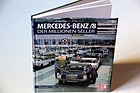
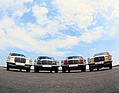
The introduction of the Mercedes W 114/115 models, commonly known as the /8, also marked the end of the post-war era at the traditional Daimler-Benz AG group. The /8 was consistently designed as a new model series below the previous luxury class models. Until then, Daimler had only had a model series for saloons in its range, from which the lower-priced and low-performance entry-level models could then be derived - with a few tweaks to the bodywork. Three years after the introduction of the W 109, Daimler surprised everyone in 1968 with the /8 as a completely independently developed model series. A step that was also to pay off for the company, as Michael Rohde points out in the subtitle of his monograph "Mercedes-Benz /8: Mercedes for millions.

Another Mercedes book
The /8 book by Michael Rohde is basically not a new book. On the contrary, even though it is a first edition in this form, it is a very thoroughly revised third edition of the out-of-print editions from 20 years ago. A facelift, one can anticipate, which has paid off. In particular, access to the minutes of the board meetings on the subject of the W 114/115 simply has to enrich such a monograph with facts that would otherwise remain under the secret lock and key of an automobile company.
The /8, a true 68
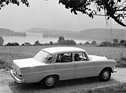
Of course, the /8 had predecessors in the form of the "Ponton" and the "Heckflosse". However, these were based on the higher-positioned 6-cylinder vehicles and were rather slimmed-down four-cylinder entry-level variants in the illustrious circle of Mercedes drivers. But that came to an end in 1968.

Daimler opted for an independent model series in the upper mid-range, which was only logical in view of the S-Class already introduced in 1965 if it did not want to lose any buyers down the range. The S-Class (W 116) launched a few years later then marked the gap between the luxury class and the mid-range even more clearly, without which Mercedes would never have achieved such growth rates. Measured against comparable competitors such as the large BMW models (E3) or the NSU Ro 80, and even the Audi 100, the /8 was the least revolutionary of the 68 models. However, it more than turned the Mercedes business model upside down.
200 pages /8 book
The book on the W 115/115 by Michael Rohde covers the facets of the successful Daimler-Benz model in over 200 pages. The author stays clearly focused on the vehicle. No Mercedes epic as an introduction, no predecessor or successor debate. This is a /8 book. That's it. This has clear advantages. Rohde, a proven /8 expert, has a lot to convey: Development, typology, model variants, engine derivatives, special models, tuning and extras. You have to keep at it. Especially when 20% of the book is designed as a buying guide. 40 pages, which the book lacks at all other corners and ends.
Stuttgart's star shines
Rohde, unmistakably a fan of the brand with the star and a supporter of the /8 community. This has clear advantages; he gets straight to the point in the ten chapters of the book. Without a lot of fuss, the reader is given an explanation of the term "/8" and its resolution, learns about the misunderstandings surrounding the type designation W114/115 and the assignment to 4- or 6-cylinder models, and receives countless, meticulously researched background information on the vehicle, which testifies to the author's proven expertise.

However, things sometimes move too quickly for the reader. A certain amount of previous knowledge of Mercedes is necessary to be able to follow the explanations from the very first reading. What was it like with the 250cc engines? What was the difference in horsepower between the sedan and the coupé? And was the coupé engine installed in the saloon after all or not, or was it replaced by the 280? You don't want to read everything three times and this is the first time you've missed a thorough table in the appendix.

The technical data for the individual versions cannot replace a tabular comparison. Even in his effusive comments on the /8, the author does not hold back. Where praise can be given, praise must be given, where criticism should be given, critical discourse is unfortunately lacking from time to time. One example is the comments on the engines. The 4-cylinder petrol engines are praised in the highest terms as the ultimate of their time, even if their design still has to hark back to the late 1940s. Here the author needs to be confronted with the reality at Daimler. In the 1960s, Mercedes relied heavily on the Wankel engine and thus neglected the development of reciprocating pistons, which then had an impact on the Mercedes engine range for almost a decade. Compared to BMW, modern four-cylinder engines were only introduced during the production of the W 123.
The Mercedes for the petit bourgeoisie
At just under two million vehicles, /8 production reached almost the same number of units as all post-war Mercedes-Benz cars before it. Seen in this light, the vehicle was the first important and correct step for Mercedes towards becoming a volume supplier. Although Rohde formulates this realization as an example in the subtitle of the book, unfortunately there are no more real insights in the book. The /8 was not a revolutionary car, but it was the most German answer to the Federal Republic of Germany. Away from the Beetle, the Nazis' idea of popular motorization, towards the "we are who again" mentality of the broad population of West Germany. Savings were no longer made on the export Beetle but on the 200 D. As bland as the idea may be today, it was true back then, as other manufacturers had to painfully learn.

It's a shame that the author doesn't give this line of thought any space in his book. However, he does sing the praises of the cab industry in many places. Not without good reason, because Mercedes cultivated this market and the cab owners were grateful for it. In the 70s and 80s in particular, station forecourts were parking spaces for the Mercedes /8 and W 123 series, and this was to remain the case until the E-Class had its bonanza effect.
Bottom line
The author presents a monograph that is clearly focused on the model, which comes at the price of the purchase advice part of the book by foregoing the clean formulation of many exciting details. A book that was given access to the board minutes during its research can and should see this as an opportunity to provide more background knowledge. In this book, for example, there is a complete lack of focus on exports: intentions, strategies and models are completely excluded. Other topics are only touched on. Exuberant formulations sometimes lack the necessary distance despite all the technical and exciting content. The one or other factual error shows that even type specialists do not always get everything right in the book. The rich and convincing visual material is sometimes subtitled a little too flippantly. Instead of conveying additional content, the nimbus of Mercedes is ridden around in platitudes. This is all the more regrettable, precisely because the author knows his stuff and could have put some real additional information briefly and crisply under the picture at this point.
What remains is the impression that a pragmatist has provided very detailed and good buying advice with a lot of background information on Mercedes' first million-seller. Anyone considering buying a /8 is well served by this book. However, if you are looking for in-depth and, above all, conclusive information on the W 114/115, you should first take a look at the book in a bookshop to avoid disappointment later on.
This should not be a reason not to buy the book. Because in many places there are flashes of expertise and detailed knowledge. The best example: the focus on the differentiation between the various model maintenance series and their differences alone can be an exciting chapter in a monograph. And it is here too, although it is only comprehensible with a certain amount of prior knowledge. The one or other additional comparative picture would convey much more in the admittedly complex Mercedes /8 variety.
Anyone who spends € 39.90 on a monograph wants to take an in-depth look at a particular model. And in this respect, the book is somewhat reminiscent of the Mercedes /8 of its time. You get a very good, solid basic model, but the extras are not included.

Bibliographical information
- Title: Mercedes-Benz /8 "Mercedes for millions"
- Author: Michael Rohde
- Language: German
- Publisher: Motorbuch Verlag, 1st edition 2016
- Format: 235 x 265 mm, hardcover bound in dust jacket
- Scope: 208 pages, 222 color photos, 100 black and white photos
- ISBN: 978-3-613-03910-0
- Price: € 39,90
- Buy/order: Online at amazon.de, online at Motorbuch Verlag or in relevant bookstores


_RM.jpg)