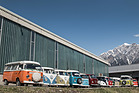
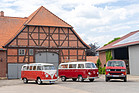
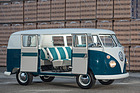
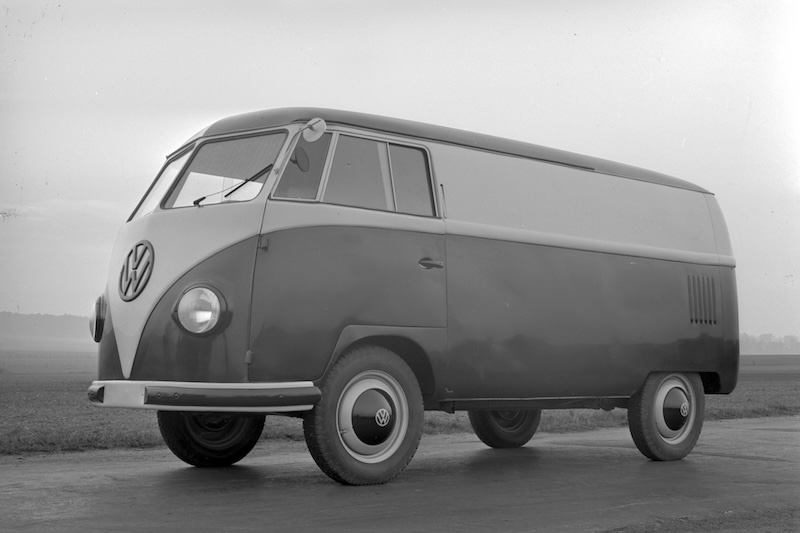
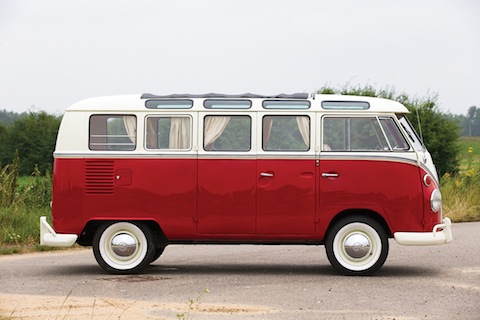
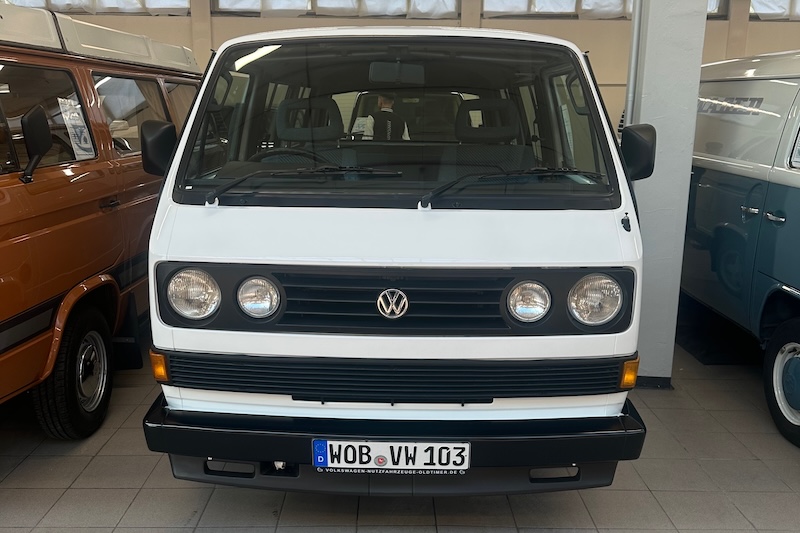
Devices have been around for a long time. The magical attraction of Volkswagen's air-cooled bus and van generations may not fit into any existing grid of classic automobiles. However, this does not detract from the prices. Basically, the prices are somehow always at the Porsche level of the same model year... And even the prices of the front-engine successors are on a handsome price hump for 20-year-old used cars in good condition. No matter which model variant you want to take.

A book about brochures, is that possible?
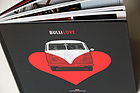
After all, the author duo Christian Schlüter and Christoph Boltze not only cover the 40 years of rear-engined models, but have also included the front-engined T4 and T5 models. And after the first review, you realize that it works. In fact, it works magnificently, because it opens up the gap between yesterday and today, from the first leaflet to the luxury folder from the Volkswagen Center.
Look, marvel, read
First and foremost, this is a picture book. Countless brochures are presented chronologically and provide wonderful insights into the demands on brochure design over more than 60 years. The focus on just one model is helpful. Cultural and historical changes become just as clear as social changes. From fashion and the lack of seat belts to the demands for special equipment, the book succeeds in holding up a mirror to everyday life in society. What there was for the Bulli, that's what you wanted. No more, but also no less. And so you are amazed at cab models, butchers' wagons and cattle trucks or Bentley-seated luxury buses with wooden inlays for two evenings by the fire. The accompanying texts, which follow exactly this line and always turn the history of the VW Bulli into a cultural history, are helpful.

The peoples of a Volkswagen
VW's success is global. Right from the start. The car for the Germans has become a car for the world. That was the Beetle's recipe for success, followed by the Bulli. And so, fortunately, the authors do not limit themselves to purely German brochures, but also provide an insight into the sales documents of other countries, preferably those in which the Bulli was also built: Brazil or South Africa. And, of course, in one of the main sales markets: the USA. It quickly becomes apparent what perhaps accounts for the success of this model as a classic to this day. Likeability. Without appearing staid, the catalogs in all countries radiate a great deal of sympathy, paired with a pinch of humor, in addition to the classic Volkswagen virtues.
Samba, Doka, Pritsche, Multivan and Carat
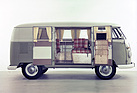
While the monoculture of the Beetle almost meant the end for VW for decades, there was a wide range of derivatives in VW's Transporter program from the very beginning. The bus was followed by the luxury bus (Samba), and the Transporter was followed by the open flatbed. A model was developed for every requirement, which later developed cult status, such as the Multivan or the Carat. These derivatives are not neglected. Thanks to a clever selection of the illustrated brochure pages, one quickly gains an overview of the fact that, in addition to the classic buses and vans, 18 special versions for the fire department, police with lift or refrigeration unit and many more could be ordered. And what was expensive on the European market was not cheap on foreign markets either. Vanagon for the USA. Six-door models for Brazil's cab industry, luxury T3s in South Africa. It's wonderful to see how they were presented by the respective marketing departments and who they were aimed at. The fact that models such as the Syncro Tri Star are not forgotten is testament to the authors' masterful selection.

Speaking of selection
It goes without saying that not every type 2 brochure has found its way into this book. On the contrary: a selection of brochure pages is illustrated here chronologically and in line with the narrated history of the type, making it possible to trace the vehicle at the time. It is both valuable and exciting that the overseas markets are also given enough space for comparative amazement. Incidentally, the illustrations are of a particularly good quality and the catalog texts can generally be read (and understood if you speak the language).
What is missing?
It is not so easy to determine what the book could do with. In itself, it appears cohesive and well-rounded, although the art here was probably in the reduction. So there is nothing to add. Spontaneously, the comparative presentation of brochures of a selected model in the various markets comes to mind. But can this broaden the horizons of all readers and do justice to the book's claim, or is the idea only of interest to specialists? Probably the latter. Nevertheless, the book claims to present the sales literature of the VW Bulli. And in addition to the brochures in the stand, this also includes the internal sales literature. In other words, the brochures and catalogs for service, sales and the workshop. And these can certainly be missed here as an enlightening addition. It would also have been helpful to indicate the printing dates next to the illustrations.
An infinite number of Bullis in one book
On over 160 pages, the authors succeed in presenting the first 65 years of the VW Transporter in an exemplary and entertaining way using selected illustrated brochure pages from various countries. It is foreseeable that this will take us on a journey through time into the history of the model, and it is a positive surprise that it also succeeds in tracing the spirit of the times in art and society. The short but concise accompanying texts help to link precisely this zeitgeist with the history of the Bulli and sometimes even make you smile as you ponder over a double-page spread. Clean and sharply scanned brochure pages round off the book's good impression and also clearly distinguish it from similarly ambitious book projects. The fact that experts and brochure collectors would have liked at least 160 more pages is certainly clear to the creators. But for € 29.90 you get a ticket for a little journey through time. And for some, it may even be the start of a tangible love affair with the VW Bus. A love that you now have to be able to afford. And which nobody can really explain.
Bibliographical details
- Title: VW Bulli
- Author: Christian Schlüter, Christoph Boltze
- Language: German
- Publisher: Delius-Klasing, 1st edition 2015
- Format: 240 x 275 mm, hardcover, 160 pages, 2 color and 30 b/w pictures and 185 color illustrations
- Price: € 29.00, € 30.80 (A); CHF 40.90 (CH)
- ISBN: 978-3-667-101204-4
- Buy/Order: Online at amazon.de
, at the Delius-Klasing publishing house or in well-stocked bookshops