


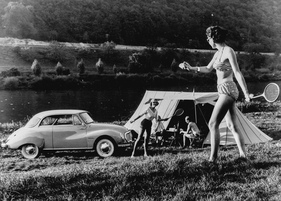


When Adolf Hitler decided to make the KdF-Wagen project a state task for the good of the people in 1934, it was only the Auto Union that was committed to opposing Prof. Porsche's concept. Not only did it lobby the RdA against the "Volkswagen", it also saw the KdF-Wagen as a direct attack on its best-selling and most profitable product: the DKW front-wheel drive cars. DKW board member Dr. Carl Hahn reacted immediately. "We will have to create fundamentally new models which, from the outset, can be expected to have a low cost price due to their design," with which he already had the Beetle's greatest advantage firmly in his sights. Its price. Hahn wanted to create a better product than the later Beetle and thus not only defend Auto Union's market position but also significantly expand it. The book "F9 - Der sächsische Konkurrent des "Volkswagens"" is dedicated to the development history of the DKW F9 at Auto Union and the post-war developments in East and West.

A book that you have to discover
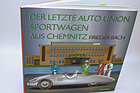
They still exist, the car books that you wish had been published because you are interested in exactly what they contain. I stumbled across this one when I was researching the board members of Auto Union AG in Saxony. It was a side note that brought me to this little booklet. Fortunately, for me it closes another gap in my knowledge of Auto Union. And that's why I don't want to withhold it from other readers. It's not a magnificent volume, but just a booklet that contains some interesting information for those interested. It's the content that counts and that's why the book by authors Frieder Bach and Dirk Schmerschneider is being reviewed.
The F9 anniversary
Bach and Schmerschneider are experts in the history of motor vehicles in Saxony and are committed to preserving history and vehicles. The book was created on the occasion of the special exhibition at the "Museum für Sächsische Fahrzeuge", which offered the F9 its own platform to mark the 75th anniversary of its launch. The book should be seen as a supplement to the exhibition, but without the museum tour it does not always have enough substance to stand on its own.
F9 - The great promise of the Auto Union
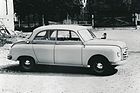
The Second World War had already overrun Poland and occupied France when Auto Union AG presented the DKW F9 in a specially produced brochure. The pictures showed some of the ten prototypes that had been produced in Saxony in anticipation of the expected peacetime production.

Basically, the car was to go into series production from 1940 with the Horch 930S, which was also designed as a streamlined car and had already been presented in Berlin in 1939. At the same time, the W6 with streamlined bodywork for the Auto Union brand "Wanderer" was well advanced in Saxony. Eight years after its foundation, Auto Union was preparing to become the German avant-garde. It can be assumed that the luxury Horch and the mid-range Wanderer would have found a following. But the F9 was to contribute to Auto Union's expansion. Not only had the car been given an extravagant dress in Chemnitz, but the technology with the longitudinally installed 3-cylinder two-stroke engine also traditionally drove the front axle of the DKW.

Naturally, the engine was liquid-cooled. The thermosyphon cooling system did without a pump. What is not installed cannot break. In terms of design, however, it was an outright counter-design to the KdF car with rear-wheel drive and air-cooled boxer engine. With reservations, Auto Union was able to continue developing the F9 during the war until it was ready for series production. The plan was to replace the entire F-series with the F9 and production was to level out at 200,000 vehicles per year in order to reduce the cost price through the production volume. In view of the number of vehicles produced annually by DKW to date, this figure is quite an announcement and was probably measured against the KdF-Wagen. Ultimately, however, the start of series production could not be maintained even during the planning phase. The machines for the production of the F9 already had delivery deadlines at the end of the 1930s, which made a timely start a long way off. However, Auto Union did not allow this to divert it from its course and continued with production preparations. Indeed, a plastic body had even been developed ready for series production in order to achieve savings in the manufacture of the body. In 1944, the Auto Union trial declared the F9 ready for series production. But in the last full year of the war, the start of production was as much a utopia as the final victory. Nevertheless, Auto Union was satisfied, as it was hoped that the F9 would be able to enter so-called peacetime production after the end of the war. And with a promising product. Things turned out differently.
The F9: hope in East and West
Auto Union AG, liquidated in Saxony in 1948, no longer had anything to do with the F9. However, IFA, as its successor, relied on pre-war developments and began production of the IFA F9 in 1950. Technically and constructively closely based on the original, like the DKW F89, which the newly founded Auto Union GmbH in West Germany brought onto the market in 1950, but which did not receive the three-cylinder engine until 1953 as the F91.

Despite the outward resemblance and the many design parallels, both models had developed away from the F9 in many details. This was partly due to the shortage situation after the lost war, but also simply because many parts had to be redesigned and redrawn due to the lack of character sets. Nevertheless, the DKW F 89 and the IFA F9 were automobile hopes and dreams in East and West. But neither of them could compete with the Beetle.
What do the authors make of this story
As already mentioned, not a book, just a booklet. A booklet about the rather unknown development history of a special vehicle for historical reasons. The DKW F9 was developed in the mid-1930s under the aegis of the Saxon Auto Union as a direct competitor to the Volkswagen. That's what makes it so worth reading. The authors briefly and concisely outline the development history of the DKW F9. It is regrettable that there is not a single picture from the development of the F9. Soon after the end of the war, the successor companies in both German states took up the idea again and developed it further. It is precisely this aspect - certainly an exciting part of industrial history - namely how this happened under market and planned economy conditions, that the authors devote the much larger part of their explanations to. The fact that motorsport on an F9 basis in particular is widely acknowledged has little to do with the promise in the title.

On the other hand, the special bodies that were based on the three-cylinder chassis in the FRG and GDR are comprehensively represented in the illustrated section. With one exception: estate and platform bodies are completely missing.
F as in conclusion
The F9 could have been - and Auto Union was already convinced of this in 1939 - a superior competitor to the KdF-Wagen. Unfortunately, the authors only manage to draw this comparison in the title. In its basic design features, the Auto Union design was ahead of the Beetle. The fact that it was not quite able to prove this was due to a caesura that brought much deeper cuts into everyday German life than the competition between the Beetle and the F9 could ever have achieved. As far as the F9 is concerned, this can be read in a booklet that is well worth reading at an affordable price of €12.50. In the end, it can only be seen as a very focused supplement to the relevant DKW and Auto Union literature. Apart from the title, the booklet was probably not launched with any other ambitions. Competition with the Volkswagen is and was never an issue.

Bibliographical information
- Title: F9 The Saxon competitor to the "Volkswagen"
- Authors and editors: Friedet Bach and Dirk Schmerschneider
- Publisher: Mironde Verlag, 1st edition 2014
- Format: 230 x 230 mm, paperback, 84 pages, numerous, mostly b/w images
- Price: € 12,50
- ISBN-10: 3937654887
- ISBN-13: 978-3-937654-88-1
- Order at Amazon ( free shipping and duty free) or at buchversand.mironde.com




_Daimler_AG.jpg)