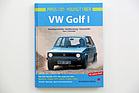
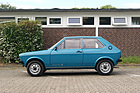
If you ask someone about their car, you often hear: "I have a Golf", or "It's a Golf". That's all that's usually necessary. We know the score. After the Beetle, the Golf became the same eternal constant in the company's history that it had to replace: the Beetle. In his book "VW Golf Story", Russel Hayes traces the arc from the first preliminary considerations: the burden was great, the Beetle monoculture was pronounced. Right up to the current electric developments.

Reason 1: Everything inside
This book manages to cover seven generations of Golf and thus four decades since the VW Golf was launched. This ranges from the basic Golf to the GTIs, not forgetting the Cabriolets, the Jetta or Bora and later the Variant version. Things get even more exciting with the US Golfs. In this book, you will find pretty much every model that has been on the market since 1974 within the wide range of Golf models. Including the Scirocco, which was presented back in 1973.

Reason 2: From the very beginning
Before a Golf is launched on the market, it is developed. And this development history is not neglected, especially in the first three generations. For example, the entire state of the VW Group is laid out in the Golf 1 in order to illustrate the urgency and importance of the first Golf. VW was on a drip. Technically, it was dependent on its subsidiary Audi NSU, and it was beginning to distance itself from Porsche. Visually, it was dependent on Giorgetto Giugario, who had been given responsibility for design because Wolfsburg simply lacked the skills and self-confidence. This changed rapidly with the success of the Golf 1. Golf 2 and 3 were then self-confident statements from Wolfsburg.

Reason 3: The side notes
The author doesn't make it too easy for himself. The reader benefits from this. Whether Audi 50 or VW Scirocco. Whether it's the ESVW 1 research car or Oettiger's 16 V development for the French market. The author presents them in the right place and thus reorganizes the history of the Golf and its significance for the company. An exciting side effect. The reader is presented with many interesting facts from VW's history that have not yet been published.

4. reason: the design
The Golf is not just any car. It was already on sale all over the world when others only had to invent such terms 20 years later as a brand-strategic safeguard for their wishy-washy design. The Golf is different. Distinctive C-pillar, pronounced Toronado line and no experiments. A design philosophy like that celebrated by Porsche in the 911 also surrounds the viciousness of the Golf design. It's nice to be able to follow the evolution of the Golf alongside sketches, clay models and prototypes in this book.
Reason 5: The technology
Whether GTI, TDI, 16V, Synchro, VR6, plastic tank, Golf Country or Cabriolet development. Again and again, passages on the side paths and developments are pointed out and presented in detail. In this way, the book succeeds in taking entire technological movements within the VW Group out of the abstract and placing them in historical context. The fact that the author also goes into the background and people involved gives the book a touch of personality.

6. reason: the research
The author has conducted countless interviews with former VW Head of Development Ernst Fiala, Head of Design Walter de Silva and ex-VW Board Member Carl Hahn. He contacted the former VW Motorsport racing managers and obtained information from the most important importers in Italy, the USA, South Africa, France and Great Britain. The extensive list of sources is proof of the extensive research that is evident in this book and, with its countless details, is a major attraction of the book.
7th reason: The Golf
To this day, the Golf is the only vehicle that has given its name to an entire vehicle class. This means that the Golf has always been the target of countless hunters for the Golf throne. Reason enough to get to the bottom of the history of the Golf. The fact that a British author, Russel Hayes, is pursuing this does not make it any easier at first glance, if only because of the language barrier. But the author seems to have managed this balancing act well in the German translation.

The book does not simply run through the Golf models chronologically, but knows how to go into the company's history or developments in the right places. That's how you come across the Audi 50 or the Skoda Favorit. And not even surprisingly, but comprehensible after reading. The history of the Golf comes to life.

Conclusion
In this 300-page golf monograph, British author Russel Hayes succeeds in presenting the history of golf in an exciting and comprehensive way. He does not leave out any exciting technical developments or side issues. Motorsport, tuners and special models are covered as well as the technical evolution of the Golf. The author organizes the inserts and marginal narratives largely chronologically, but also deviates in order to emphasize the developments that are significant for VW. Here and there, one discovers the occasional error that creeps in from secondary sources and that only absolutely profound experts in the company's history can identify as such at first hand. Otherwise, a book worth reading about the Golf and the technical history of the Volkswagen Group when they turned their backs on air cooling.
Bibliographical information:
- Title: VW Golf Story
- Author: Russel Hayes
- Publisher: Motorbuch, 1st edition 2015 from English
- Format: 230 x 265 mm, hardcover, 320 pages, 362 color and 70 b/w images
- ISBN: 978-3-613-03792-2
- Price: Euro 39,90,
- Buy/order: Online at amazon.de, at Verlag Motorbuch, or in well-assorted specialist shops