


25 years ago, Mercedes-Benz surprised more than just roadster fans with a revolutionary concept: thanks to its vario-roof, the new SLK (R 170 model series) transformed from an open-top vehicle into a coupé with a fixed and noise-insulating steel roof in less than half a minute. It scores with further innovations, for example in terms of safety. The SLK impresses in all relevant crash tests, including rollover. A lightweight construction concept, including magnesium, reduces the weight of the basic version of the SLK 200 to just 1,270 kilograms. By 2004, 311,222 vehicles of the SLK of the R 170 series had been built at the Bremen plant. In a total of three generations with the R 170, R 171 and R 172 model series, the compact open-top Mercedes-Benz roadster is sold more than 710,000 times - from 2016 as the SLC. The first generation is already a popular youngtimer and is thus completing its second career. As the specialist magazine "Motor Klassik" wrote in April 2019: "The first SLK series (R 170) was a bestseller and has what it takes to become a classic."

The roadster was given its name during the design phase, when engineers referred to it as the "SL short" in reference to the Mercedes-Benz SL. In fact, with a body length of 3995 millimetres, the R 170 model series was around 500 millimetres shorter than the SL roadsters of the then current R 129 model series.
World premiere in Turin
The production version of the SLK is unveiled at the Turin Motor Show on April 22, 1996. This sports car fits perfectly into its time: open-top two-seaters were experiencing a strong renaissance at the time. In Western Europe, annual registration figures in this market segment rose from 11,300 in 1992 to 98,500 vehicles in 1995. The SLK contributed to the boom in open-top vehicles in the 1990s and 2000s. At times, this Mercedes-Benz is the best-selling vehicle with a folding top in Germany. The SLK is of great importance to the brand, as it appeals to a younger and lifestyle-oriented group of buyers. Looking back, former Mercedes-Benz board member Jürgen Hubbert says: "The SLK, CLK and M-Class models have contributed a great deal to the new image of Mercedes-Benz."

Appetite for the Roadster was whetted by a study that was also presented in Turin in April 1994. It was based on a draft by designer Michael Mauer and already came very close to the production model. Mauer's model with short overhangs at the front and rear in conjunction with a comparatively long wheelbase impresses with many details, from the hood with "powerdomes" to a striking spoiler lip at the rear. A second study was presented in Paris in the fall of 1994, showing not only the vario-roof, but also a varied interior design. From 1996 onwards, the SLK series-production sports car attracted attention with a surprisingly colorful and varied interior including refreshing exterior colors.
"Trick with the kink": the vario-roof
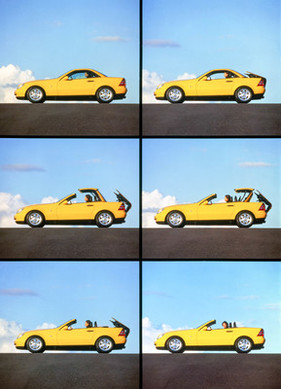
The folding steel roof of the SLK as an alternative to the classic fabric soft top is an outstanding and much-noticed technical feature of the roadster. The idea is not new in the automotive industry, but in the few previous designs, the entire roof sinks into the trunk, taking up a lot of space. The Mercedes-Benz engineers revolutionized the concept with a process known internally as the "trick with the kink": The roof made of steel and glass elements folds backwards under the trunk lid, which is open in the direction of travel. This allows for a short rear body, and even when open, there is still room for luggage in the trunk.
An electro-hydraulic system choreographs the opening and closing process with the help of five hydraulic cylinders. Before the start of series production, 30 prototypes have to undergo the opening and closing process 20,000 times each. Extrapolated over ten years, this corresponds to opening and closing the roof six times a day. The operation is simple: a switch on the center console transforms the SLK from a coupé into a roadster in 25 seconds - or vice versa.
The SLK also impresses with a safety concept that sets standards in its class at the time. Two sturdy rollover bars provide striking protection for occupants in the event of a rollover. Tube-reinforced A-pillars add to the protective effect. The SLK is also equipped with airbags, belt tensioners and belt force limiters as standard. The newly developed ellipsoid bulkhead as part of the front structure increases the front deformation area in the event of a frontal impact. This reduces the risk of the footwell being restricted. In crash tests, the SLK meets Mercedes-Benz's own specifications and thus exceeds the legally prescribed values.
Four- and six-cylinder engines in the R 170 model series
The Roadster was initially offered as the SLK 200 (100 kW/136 hp) and the SLK 230 Kompressor (142 kW/193 hp). Following a facelift in 2000, the six-cylinder models SLK 320 (160 kW/218 hp) and SLK 32 AMG (260 kW/354 hp) were added to the portfolio. The first SLK gave rise to a small and fine traditional line: in January 2004, Mercedes-Benz presented the subsequent SLK of the R 171 model series. One highlight is the optionally available AIRSCARF.

This world first conveys warm air between the seat backrest and headrest into the neck area of the occupants and, in conjunction with the standard wind deflector, enables open driving even at low outside temperatures. The third SLK generation (R 172) comes onto the market in 2010. It is renamed the SLC in 2016 and produced until 2020.
