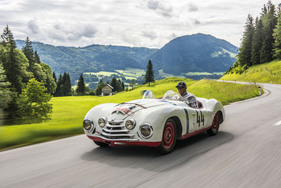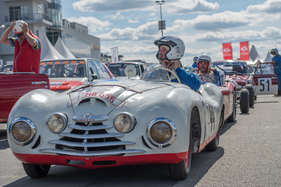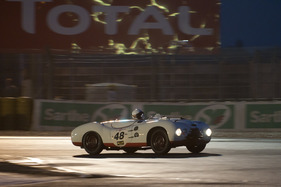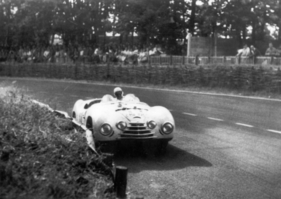
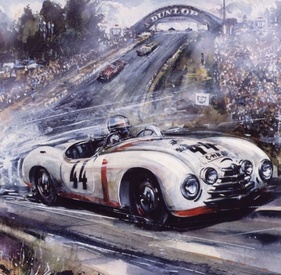
The manufacturer from Mladá Boleslav has been active in motorsport for 121 years with numerous special racing and rally vehicles. In 1946, Škoda impressed with the attractively designed model 1101, which was named 'Tudor' due to its two-door body, in reference to the English 'two door'. The new model was also quickly in demand due to its many successes in motorsport. The vehicle took part in the 2,649-kilometre Rajd Polski Rally (1948) as well as the South American Montevideo-Melo-Montevideo Rally and the circuit race in Spa, Belgium. Here, three 'Tudor' four-seaters covered 1,972 kilometers in 24 hours and crossed the finish line together.
At the Czechoslovak Grand Prix in Brno (1949), the Tudor-derived Škoda Sport with numerous parts from the production car and a hand-built aluminum pontoon body successfully held its own against the competition. The vehicle was then adapted to the regulations of the 24 Hours of Le Mans. The works team of Václav Bobek and Janoslav Netušil took to the track at the Sarthe in the 18th edition of the race on June 24, 1950.

The Škoda Sport was prepared for the night hours of the race with two additional headlights, special openings in the radiator grille improved the cooling of the drum brakes on the front wheels and the wheelbase, which was extended to 2,150 millimetres, ensured greater driving stability. Including tools and spare parts, the weight was a low 700 kilograms. The vehicle had a water-cooled four-cylinder engine with a displacement of 1,089 cc; the electrical system was supplied by the Czech manufacturer PAL 12 V.
The Škoda Sport delivered an output of 50 hp (37 kW) at 5,200 rpm. It ran on a special fuel mixture of petrol, ethanol and acetone and was fitted with cross-ply tires from Barum. The top speed was 140 km/h and fuel consumption at the time was a low twelve liters per 100 kilometers. The Škodians therefore refueled less frequently than many of their competitors.
During the first 13 hours of the race, the driver team Bobek/Netušil in the Škoda Sport fought their way to second place in the category up to 1100 cc and a sensational fifth place in the overall standings according to power coefficient. The sensation was prevented by a minor technical defect that could not be rectified on site for regulatory reasons.

On the 121st lap of the race, the piston pin fuse broke. In accordance with the regulations, the crew was only allowed to use the spare parts and tools on board, but the required fuse was not among them. In the following year, the use of two revised Škoda Sport vehicles was planned. Due to the political situation, however, this never happened. As a result, the participation in June 1950 is still the last start of a Czech vehicle with a Czech crew in the 24-hour race at Le Mans.
Return after 72 years: Le Mans Classic 2022
The 24-hour race in Le Mans was held for the first time in May 1923, and historic vehicles now also race on the 13.626-kilometer track every two years as part of the Le Mans Classic. Due to the coronavirus pandemic, the participation of the Škoda Sport had to be postponed from June 2020 to 2022 to mark the 70th anniversary of its Le Mans start.
This year's edition was the first time that the car that had already competed in the 24 Hours of Le Mans in 1950 started. The extensively restored Škoda Sport was driven by Stanislav Kafka and Michal Velebný, the restoration workshop coordinator at Škoda Auto. His grandfather Josef Velebný designed the body of the Škoda Sport at the time. As at its first start in 1950, the car took to the track again this year with the starting number 44. The second Škoda Sport ever built took part in the classic race at Le Mans in 2006.
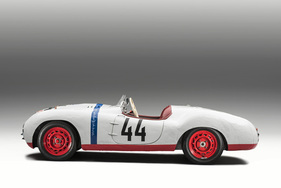
Michal Velebný emphasizes: "We have been working on restoring the car for six years. With the return of the Škoda Sport to Le Mans this year, we have achieved our goal. Thanks to constant, careful maintenance, the car survived the demanding weekend without any major technical problems. A fantastic achievement for a 73-year-old vehicle."
Numerous races are held as part of the Le Mans Classic, and registered vehicles of all model years from 1923 to 1981 are eligible to compete. The organizers divide them into six basic categories and various special categories. The Škoda Sport started in 2022 in the second group with vehicles from 1949 to 1956.
Each vehicle category competes in three 43-minute heats at the Le Mans Classic. After half of each race, the cars come into the pits, where a driver change takes place. The last race begins with a classic Le Mans start: after the starting signal, the drivers sprint to their vehicles, jump behind the wheel, start the engines and take to the track.

The chequered flag is waved from the 43rd minute of the race as soon as the fastest car crosses the finish line. The final result is determined by the number of laps completed and the time gap to the winner. The different technical requirements of the participating vehicles in the respective categories are also taken into account in a further classification, where a special coefficient is decisive. In a further classification, vehicles that started with the same starting numbers in the different groups were grouped together in teams.
Numerous vehicles started in Class 2 for cars from 1949 to 1956. Stanislav Kafka and Michal Velebný showed strong performances both in qualifying and in the competition and were able to compensate for the Škoda Sport's lack of performance compared to more powerful or newer vehicles. They finished 47th overall in their category out of 74 crews. In the overall ranking by power coefficient, they even managed 43rd place. Victory was secured by a Jaguar D-Type from 1954.