


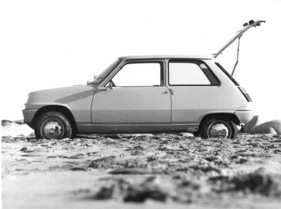
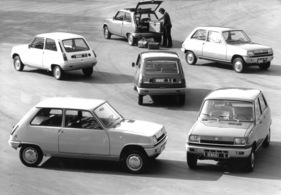
Alongside red wine, haute couture and haute cuisine, France brought revolution to the world. The Renault 5 started just such a revolution when it appeared in the small car class in 1972, making the competition look ancient in one fell swoop. The fact that the revolutionary car spiced up its revolutionary character with typical Gallic ingredients such as charm and chic lent it additional appeal and brought it a large fan base practically from day one. No wonder, because the R5 concept is based for the first time on consumer surveys, the results of which were incorporated into the project specifications.
Brevity with spice
The 3.51 meter shortness of the Renault 5 does indeed have a lot of spice: The little Gaul takes up very little traffic space, is handy in the city with a turning circle of just 9.8 meters and is easy to park, but still offers enough space for four adults and their luggage.
And then there's the design: with large headlamp eyes, an interpretation of the "childlike scheme" that immediately arouses sympathy, surfaces smoothed in the wind tunnel without frills and a tidy interior, the Renault 5 combines functionality and form in a unique way.
Practical world first: plastic bumpers
More than just a design gimmick are the large plastic bumpers used for the first time on a series-production vehicle instead of the completely impractical bumpers that were previously used. The advantage of the protective surfaces: they are insensitive and can be replaced much more cost-effectively after an accident. Renault thus created a new industry standard that was later adopted by the entire sector.

No less futuristic are the Renault 5's upright rear lights, which also serve a practical purpose: they allow the wide, low-slung tailgate to be installed, making it easy to load and unload the trunk. Despite its undisputed advantages, the large tailgate itself was still an exception in the world of conventional notchback saloons in 1972, the year of its premiere. Not so at Renault, as the French car manufacturer had already been celebrating great success with this concept for years with the Renault 4 and 16.
The color scheme of the avant-garde body is completely in keeping with the spirit of the times: Renault sends the newcomer onto the road in bright poison green and bright orange. The trendy outfit signals modernity and is very well received by the flared trouser-wearing post-68 crowd. Correspondingly, the interior can also be ordered in shock colors.
Compact on the outside, big on the inside
Inside, the small Renault 5 impresses with its superior space. The rear seat can be folded down, thus increasing the luggage compartment volume to 900 liters. Indispensable for a car from the land of "Amour" and "Gauloises", the cheeky Frenchman also has reclining seats and three (!) ashtrays. To make getting into the car as comfortable as possible even for backseat passengers without yoga skills, its creators have also given the small car a pair of extra-long doors.
Proven components lower the price
The technology base is also right. The five shares a large number of components with the Renault 4 and 6, ensuring high reliability, safe handling and exemplary driving comfort. For example, all Renault 5 models have independent suspension with torsion bars all round. The legendary revolver gearbox also originates from the sister models. The common parts strategy under the body reduces production costs. Renault passes the price advantage on to the customer.

The proximity to its established relatives can also be seen in the engines. The compact Renault makes its debut as the "5 L" with a four-cylinder engine familiar from the Renault 4, producing 25 kW/34 hp from a displacement of 782 cm3. However, the tried-and-tested engine is only used in France, while Switzerland immediately receives the more modern unit with a displacement of 845 cm3 and 26 kW/36 hp. The somewhat more powerful "TL" variant is a delight to drive thanks to its almost one liter engine with 32 kW/44 hp. This enables the 775 kilogram compact car, which is already equipped with front disc brakes as standard, to reach a top speed of 137 km/h. As in the Renault 4 and 6, the four-cylinder engines are located longitudinally behind the gearbox.
Vehicle concept based on customer surveys
Bernard Hanon is regarded as the spiritual father of the Renault 5. Under his direction, the compact car began its career in 1967 as "Project 122". Hanon had just arrived from the United States, where he was a professor of management at New York University alongside his work for Renault. He brings two insights from there: That the younger generation has a penchant for the unconventional, and that society is facing deep upheaval. The student revolt that began shortly afterwards proved him right.

But what does the contemporary vehicle look like for society in transition? To find out, Hanon, who has just been promoted to Director of Planning and Product, and Renault Head of Development Yves Georges are taking a completely new approach: they are analyzing customer surveys. Until then, it was common practice to listen only to the engineers when designing new car models. Now, for the first time, potential owners also have a voice.
Wanted: a car for broad target groups
The survey results feed directly into the project specifications. In it, Pierre Dreyfus, Chairman of the Board of Renault S.A., asks his developers for a car that appeals to young people, small families, second car owners and, above all, women. The new car is to have a large tailgate like the Renault 4, but with a more modern and youthful look. In addition, it should be small enough to whizz through city traffic and have a variable interior space to cope with large purchases, vacation trips and long weekends for two. In order to save costs and make the car attractive for new drivers, the relationship to the Renault 4 is expressly desired.
Michel Boué's big hit
Renault head of design Gaston Juchet commissioned Michel Boué, his youngest employee, to design the newcomer. The talented young designer's second design was so convincing that it became the basis for the Type 122 with just a few retouching. Boué conceived the little Renault as "a car that is capable of crossing social boundaries - because the woman of the world, the doctor and the worker can meet with it at a red light and feel equally comfortable," says the designer.

In doing so, he has really struck a chord with customers, who are so enthusiastic about Boué's creation that Renault is struggling to cope with the flood of orders. The German press, traditionally reserved in its assessment of foreign vehicles, celebrates the Renault 5 as a "space miracle" ("Deutsche Automobilrevue") and "car of the future" ("Frankfurter Rundschau"). And "auto motor und sport" writes: "In terms of space utilization, transport capacity and its suitability as a city and shopping car, the little Renault is undoubtedly the greatest of Europe's small cars."
In the spirit of its fathers, women in particular love the chic French car (share of more than 50 percent). But even men can no longer resist its charms, at the latest when they have found a parking space in the city or are looking at the fuel bill. No doubt about it: the Renault 5 is the right car at the right time.
Engines for all requirements
It is above all its versatility that makes this little friend so popular: Renault has an engine solution for every requirement. From as early as 1975, the sportier "Alpine" version with its 68 kW/93 hp was already setting ambitious drivers' hearts racing. With a top speed of 173 km/h and ten seconds for the sprint from 0 to 100 km/h, the vehicle, which weighed just 840 kilograms, rivaled even lavishly powered saloons.
As a turbo pioneer in Formula 1, Renault gave the sporty five a performance injection in 1981 and equipped it with a turbocharger. This increased the power output of the Renault 5 Alpine Turbo to 79 kW/108 hp and the top speed to 191 km/h.
Renault 5 Turbo: extreme sports car with mid-engine
The increase in performance culminated in the radically designed Renault 5 Turbo, which rolled into dealers' showrooms in 1980 and no longer had much in common with the successful model series. The 118 kW/160 hp 1.4-liter turbo engine with intercooler was not mounted under the front hood, but longitudinally behind the front seats, and transferred the power to extremely wide rear wheels with 220/55 VR 365 tyres. Its impressive performance - such as its ability to accelerate from 0 to 100 km/h in just 6.9 seconds - secured it a place among the super sports cars of the time.

The interior of the car, which was manufactured by Alpine in Dieppe, amazed with its futuristic design: two unusual sports seats caused a stir, as did the colorful carpets, door panels and instrument panel. The asymmetrical two-spoke steering wheel provides a clear view of the impressive collection of clocks with a total of ten round instruments.

The real terrain of the Renault 5 Turbo is the world's rally tracks. Here, the car shines with victories at the Monte Carlo Rally and the Tour de Corse, among others. The power output of the competition versions increased from 184 kW/250 hp at the beginning to 300 kW/408 hp in 1985.
Also with four doors from 1980
Almost at the same time as the debut of the brute model, Renault launched the four-door Renault 5 with a six centimeter longer wheelbase in 1980. The entire model series was given some bodywork cosmetics on this occasion. In addition, a more pleasing dashboard and a re-foamed steering wheel delighted buyers. The result of the careful model update: in 1980, over 660,000 Renault 5s rolled off the assembly line. This corresponds to 44.6 percent of the manufacturer's total production.
Debut of the second generation after 5.5 million units
The 1984 model year marked the end of the first-generation Renault 5's career. After 5,544,695 vehicles had been produced in 13 years, the "Supercinq" ("Super 5"), a completely redesigned successor, made its debut at the Paris Motor Show. In Switzerland, the car is simply called "the new Renault 5". There is also continuity in the design, which is strongly based on its predecessor, but appears smoother and more mature overall. The length of the five-cylinder has increased by 8.5 centimeters to 3.59 meters and the width by 3.5 centimeters to 1.58 meters. Right from the start, Renault is also offering the "Supercinq" in a version with four doors, stretched by a further six centimeters to 3.65 meters.

Despite the outward family resemblance, a look under the bodywork designed by Italian design legend Marcello Gandini reveals that this is a completely newly developed vehicle. For example, the engines are now installed transversely in front of the front axle instead of longitudinally behind it to provide more space in the interior. The chassis has also been fundamentally redesigned and improved. McPherson struts are now used on the front axle, while trailing arms and torsion bars are used to guide the individually suspended rear wheels.
Wide range of engines for all requirements
The new Renault 5 starts its career with a significantly greater variety of engines than its predecessor. In addition to the 1.0-liter base engine with 30 kW/41 hp, a 1.1-liter engine with 33 kW/45 hp and a 1.4-liter engine with 43 kW/59 hp or 52 kW/71 hp are available for the chic French car. The top version is the GT Turbo. Its turbocharged 1.4-liter engine delivers 85 kW/115 hp, accelerates the compact dynamo from 0 to 100 km/h in just 8.0 seconds and enables a top speed of 200 km/h.
With regulated catalytic converter since 1986
The new Renault 5 also set an example in terms of environmental awareness: in 1986, the first variants with lambda-regulated three-way catalytic converters in accordance with US standards were launched, the ultimate in exhaust gas purification at the time. Renault thus took on a pioneering role in the entire market. Just three years later, all petrol engines for the Swiss market had the catalytic converter on board.
Also in 1986, the diesel found its way under the hood of the five-seater: the Renault 5 TD (three-door) and GTD (four-door) with a displacement of 1.6 liters produced 40 kW/55 hp and was one of the most economical models on the market at the time with a fuel consumption of 5.1 liters per 100 kilometers.
1994: End of production after over nine million vehicles
Thanks to its successful technical basis and careful model upgrades, the Renault 5 remained at the cutting edge until the end of its production run. In 1990, Renault launched its designated successor, the Clio, which also arrived in Switzerland a year later. However, this was by no means the end of the road for the much-loved five-seater. The two crowd favorites are built in parallel for four years. Then, after 22 years and a total of 9,008,912 units of both model series, it was "au revoir" for the long-runner.
Sports enthusiast: success on race and rally tracks
The Renault 5 is not only a successful sports car on the road, but also on race and rally tracks. Two years after its market launch, the small car also began a fabulous career on the racetrack, which continues to this day with the successor model Clio.
The story continues: Renault 5 Prototype combines history and future
With the recently unveiled Renault 5 Prototype, Renault has presented a sensational concept car that will make the hearts of many car fans beat faster. The new concept car is inspired by the past, but is firmly oriented towards the future and exemplifies the brand's new direction.

With the Renault 5 Prototype, the Renault developers have created a smart city car that combines the iconic R5 design with an all-electric drive. The icon drives emission-free into the future while retaining the fun factor and carefree character of its ancestors.

The new electric Renault 5 Prototype embodies the new Renault strategy. It is strongly linked to Renault's history, but at the same time represents the future of the brand. "On the one hand, the design of the Renault 5 Prototype is based on the iconic car from 1972. On the other hand, this study simply embodies modernity, a vehicle in keeping with its time: urban, electric, attractive," says Gilles Vidal, Renault Design Director. The original R5 will celebrate its 50th birthday in 2022.
