


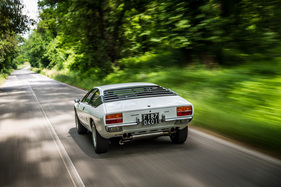

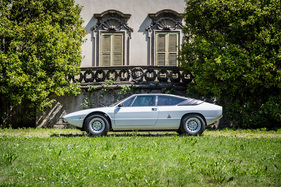

The Lamborghini Urraco made its debut at the Turin Motor Show at the end of October 1970 and is celebrating its 50th anniversary this year. The model impressed right from the start with the introduction of innovative technical solutions, for which Paolo Stanzani, then Technical Director at Lamborghini, was largely responsible. Marcello Gandini, then designer at Carrozzeria Bertone, was involved in the design of the project.

New ideas
The Urraco is a fast coupé with 2+2 seats, a V8 mid-engine and independent suspensions with MacPherson struts on all four wheels, a solution that was used for the first time in this form in the automotive sector.

The Urraco's V8 engine, equipped with a single camshaft per cylinder bank, was also completely new. With a displacement of 2.5 liters and an output of 220 hp at 7,800 rpm, it provided a top speed of 245 km/h. The use of a "Heron head", in which the combustion chamber is located entirely in the piston crown and the cylinder head is completely flat on the inside, was also decisive for its technical significance. This solution made it possible to achieve a higher compression ratio at no extra cost. Another innovation for Lamborghini were the four Weber twin carburetors of type 40 IDF1.

Another innovative aspect was that, from the very first stages of the project, far fewer manual steps were planned for production than was the case with other Lamborghini models. The birth of the Urraco can be traced back to Ferruccio Lamborghini's desire to expand vehicle production and make Lamborghini accessible to a wider public, even if only small numbers were planned.
Origin of many other Lamborghinis
With a length of just 4.25 meters, the Urraco impresses with the innovative design of the interior, the shape of the dashboard, the position of the instruments and the bowl-shaped steering wheel.

The coupé presented as the Urraco P250 was produced from 1970 to 1976. The "P" stands for "posteriore", i.e. the rear position of the engine, and 250 for the displacement (2.5 liters). At the 1974 Turin Motor Show, the P200 version of the Urraco with a smaller displacement (1994 cm3, 182 hp) was presented especially for the Italian market and was produced from 1975 to 1977. The P300 version (2996 cm3, 265 hp) was presented in 1974 and produced from 1975 to 1979. The concept, which was tested and successfully launched on the market with the Urraco, later gave rise to the eight-cylinder models and the newer ten-cylinder models such as the Gallardo and the current Huracán.
Number of units produced
- P250 Urraco, 1970-1976: 520
- P200 Urraco, 1974-1977: 66
- P300 Urraco, 1975-1979: 190

