Lamborghini founded his company in 1963 with the aim of creating the perfect sports car. He was certain that he needed a V12 to achieve this: although a naturally aspirated V12 engine is challenging in terms of technology and its dimensions, Lamborghini was firmly convinced of its importance for the positioning of its top models. The result was Lamborghini's first V12, with its inimitable and emotional twelve-cylinder sound, as well as acceleration and performance that have been a true Lamborghini hallmark and identifying feature ever since.
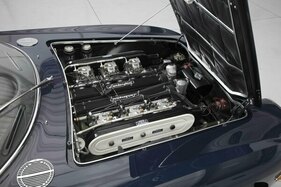
The Lamborghini 350 GT presented in the same year was equipped with a 3.5 L V12 engine developed in-house under the direction of Giotto Bizzarrini with a 60° bank angle, two overhead camshafts and an output of 320 hp. Legend has it that Lamborghini offered Bizzarrini a supplement for each additional horsepower he was able to tease out of the engine. The wide front of the vehicle housed the drive unit with the mechanical structure typical of the time and according to the principle that "the oxen pull the car".
350 GT
Then as now, acceleration and the feeling of being pressed into the seat were among the most exhilarating sensations in a super sports car. The naturally aspirated V12 engine was and is the epitome of linear power and speed, which stands for sportiness, direct response and a vibration-free drive.
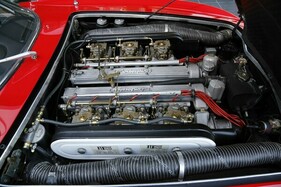
The first Lamborghini V12 created the basis for future developments and improvements to the V12 engine in subsequent models. In the 400 GT (1966), the displacement of the V12 engine was increased to 4.0 liters with an enlarged bore and stroke, which resulted in an output of 320 hp at 6500 rpm and an increase in top speed from 250 to 270 km/h (155 mph). This new 4.0 L engine served as the basis for a number of important successor models, including the Espada 2+2 (1968) with 350 hp and a top speed of 260 km/h. The Islero (1968) with 330 hp evolved into the Jarama (1970), initially with 350 hp and later with 15 hp more in the Jarama S - perhaps the favorite car of Ferruccio Lamborghini, who, like the changing world around him, wanted a two-plus-two-seater sports car.
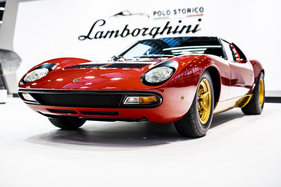
Yet performance is based on science, not courage alone. Lamborghini recognized that weight distribution improved as the engine moved to the center of the car. The Miura (1966) broke all the rules: The engine and transmission were molded in a single casting until the last editions of the Miura SV, and the 4.0-L V12 power unit in the so-called P400 was mounted more centrally in the rear of the vehicle. The design of the vehicle took this brand new layout into account and a legend was born. The fastest production vehicle at the time with 370 hp, acceleration from 0 to 100 km/h in 6.7 s and a top speed of 285 km/h. The mid-engine layout of the Miura also set new standards for Lamborghini and other brands in the high-performance sector.
Miura & Countach
From this point on, 370 Lamborghini bulls began to push the car instead of pulling it. This reinforced the brand's innovative approach to the design of its naturally aspirated supercars.
From the very first prototype, the sound of the V12 was like a symphony, with the driver sitting very close to the orchestra in the Miura. The 12 cylinders must be perfectly in tune with each other: 12 outstanding violins under the direction of the most capable conductor and the result of masterful research and development as well as technical brilliance. The crescendo - the frequency that swells with every upshift - increases the sensual and physical appeal of the V12 immeasurably.
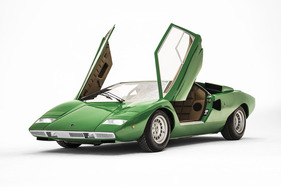
Following the success of the V12 models of the sixties and early seventies, the engine in the Countach (1974) was again relocated: again to the rear, but this time longitudinally - hence its nickname LP 400 ("Longitudinale Posteriore" with 4.0 L displacement). With its daring design with scissor doors and its pronounced attention to detail, the Countach wrote a new chapter in the design history of Lamborghini super sports cars and was even closer to the driver with its soundscape at a top speed of 300 km/h.
The LM002 (1986) had the honor of housing the Countach engine, this time with a displacement of 5.2 liters and 444 hp, as the heart of the first SUV. The vehicle, which was in the top league in terms of power and torque, had the sound of the V12 orchestra in its luggage both on and off the road.
Diablo & Murcièlago
Although all the possibilities in terms of engine layout had already been exhausted and the best solutions were in use, the research team worked tirelessly to continuously increase performance. The Diablo (1990) with its 5.7 L V12 unit with 485 hp confirmed the LP engine position, but was equipped with all-wheel drive for the first time and delivered acceleration from 0 to 100 km/h in 4.5 seconds and a top speed of 320 km/h.
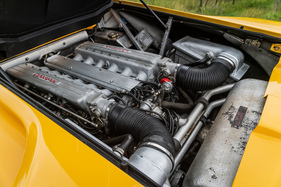
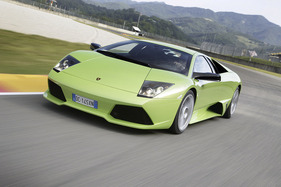
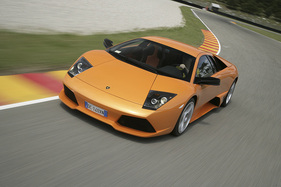
As the new century dawned with the introduction of a new flagship model in 2001 and the Diablo gave way to the Murciélago, the infamous Lamborghini V12 was still the engine of choice: initially with 580 hp at 6.2 L displacement and finally in the Super Veloce version, increased to 6.5 L, with 330 km/h and 670 hp, as recognizable by the name suffix LP 670-4.
Lamborghini Aventador
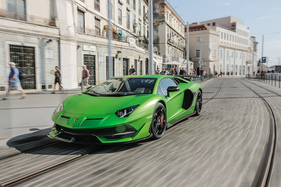
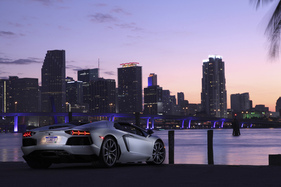
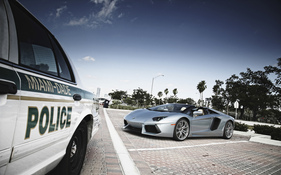
The final V12 chapter began in 2011 with the introduction of the Aventador and its remarkable, brand-new 6.5 L V12 engine. With 700 hp, acceleration from 0 to 100 km/h in just 2.9 seconds and a top speed of 350 km/h, the model was presented in no less than 4 engine variants to date, including the SVJ unit with 770 hp of power and 720 Nm of torque at 8500 rpm.
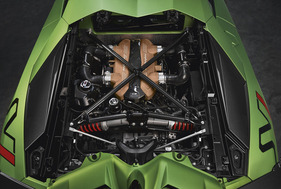
The Lamborghini V12 is a piece of engineering art that only those drivers who appreciate its unique performance and unmistakable sound will tolerate behind the wheel. You can listen to its music during the anticipation of meeting one.