


1st Marzal: The car with the largest glazed surface area: 4.5 square meters
The Marzal was designed as a four-seater GT by Marcello Gandini for coachbuilder Bertone. The Marzal immediately became an icon of style and design. The special design features of the Marzal are its interior, which is completely upholstered in silver-colored leather, the hexagon as the central theme of the overall design, which is repeated in many details as well as in the shape of the dashboard. It can also be seen in the rear window and in the cross-section of the dashboard. The most striking feature, however, is the 4.5 square meter glass surface of the gullwing doors, which extend to the middle of the roof. For this last special feature, the Marzal bears the title of the functional exhibition vehicle with the largest glass surface in history.

2. Miura: The car created by the youngest team in Lamborghini history
From the very beginning, Ferruccio Lamborghini as an entrepreneur offered many opportunities to brilliant young people - the Miura project is a prime example of this decision. Ferruccio, in an effort to challenge his competition, employed talented people selected from universities and from among the youngest in the automotive world. In 1966, Marcello Gandini as designer and Bob Wallace as test driver, both only 28 years old, as well as Gian Paolo Dallara as chief engineer and Paolo Stanzani as assistant engineer, both 30 years old, designed the now legendary Miura. The group had an average age of just under 29 and is still the youngest development team in the history of the car manufacturer from Sant'Agata. Each of them became a great in their respective fields, which is testament to Lamborghini's foresight and belief in their abilities.

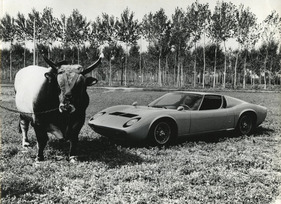
3rd Miura: The lowest production road car: 105.5 centimetres high
In the 1960s, the vehicle height and the curved and aerodynamic shapes were the most important aspect in the common imagination of the designers when developing a sports car. At 105.5 centimeters high, the Lamborghini Miura is the lowest series-produced road car of all time. It is also a styling feature that is still an integral part of all Lamborghini vehicle shapes today.

4th Lamborghini LM002: The first super sports SUV in history
Started as a project to develop a high-performance off-road vehicle for military use, the production model was first presented at the Brussels Motor Show in 1986 under the name LM002.
When it was launched, the LM002 was a completely different vehicle compared to the rest of the market, absolutely avant-garde in terms of shape and performance, on a par with Lamborghini's super sports cars. The LM002 had an engine with a displacement of 5,167 cubic centimeters and 450 hp at 6,800 rpm. The SUV proved its worth off-road and featured a design with powerful lines. A total of 300 units were built between 1986 and 1992.

With its aluminum and GRP body, all-wheel drive, two-speed transfer case with self-locking center differential and a climbing ability of up to 120 percent, the LM002 was the first supersport SUV in history, a solitaire. This distinction was confirmed by the current Lamborghini Urus, which is the direct successor to the LM002 and the first super SUV to be built in series.
5th Countach: The first car with scissor doors
The vertically opening Lamborghini doors, also known as "scissor doors", are the trademark of the most iconic V12 super sports car ever built by Automobili Lamborghini.
The revolutionary Countach, designed by Marcello Gandini in 1971, was the first production car with vertically opening doors, which are still the hallmark of the Sant'Agata Bolognese manufacturer's most powerful cars today. The decision to use this technology was not only an aesthetic one, but the upward opening also brought an advantage: it allowed the driver to lean out to have a better view of the area behind the car when reversing. It was also more practical when parking in tight spaces, as the long doors would otherwise not open sufficiently.
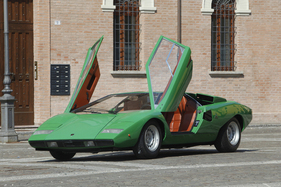
From the Diablo, the successor to the Countach, to the Murciélago, the Reventón, the Veneno, the Centenario and, last but not least, the Aventador series, the vertically opening doors have become a fundamental feature of Lamborghini's 12-cylinder DNA.
