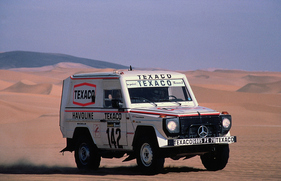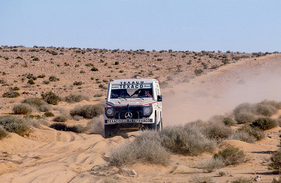
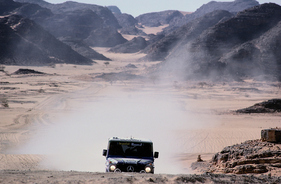
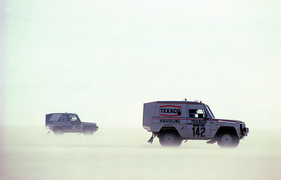
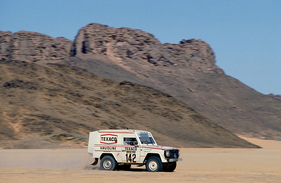
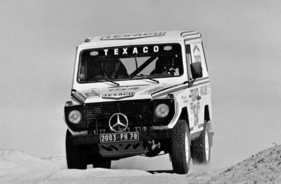
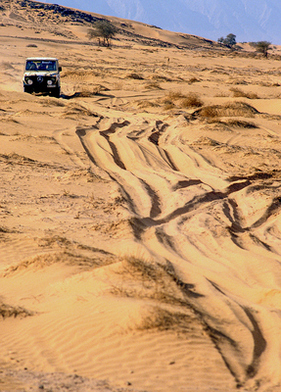
40 years ago, Mercedes-Benz triumphed in the world's toughest rally: racing driver Jacky Ickx and his co-driver, actor Claude Brasseur, won the 1983 Paris-Dakar Rally in the Mercedes-Benz 280 GE. The project was supervised by Mercedes-Benz France. Engineers from Germany support the company with the engine and aerodynamics of the off-road vehicle.
At the time, the Paris-Dakar Rally had great worldwide appeal. It is the fifth edition. For the first time in 1978, several hundred adventurers set off from the French metropolis to the capital of Senegal. They set off from Place de la Concorde in Paris in the early morning of January 1, 1983. After around 20 extremely challenging daily stages through deserts such as the Ténéré in the southern Sahara and northern Niger, the heavily thinned-out field of participants reached the city of Dakar on the Atlantic coast. The participants in the car, truck and motorcycle competitions cover between 10,000 and 12,000 kilometers to the finish.
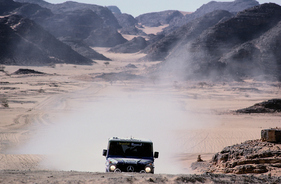
The "Paris-Dakar" has been attracting well-known car manufacturers to the competition in the African desert since its early years. Former car and motorcycle racer Thierry Sabine founded and organized the spectacular adventure. He died in a helicopter crash in January 1986. The event continues to this day, it is now called the "Dakar Rally" and currently takes place in the desert regions of Saudi Arabia. Before that, it was held in South America from 2009 to 2019.
The engine of the Mercedes-Benz 280 GE "Paris-Dakar"
Mercedes-Benz France is in charge of preparing the victorious Mercedes-Benz 280 GE of the 460 model series, and customer service manager Gunter Latour maintains good contacts with Mercedes-Benz in Untertürkheim. Georg Berkmann is put in charge of the project there. In his main job, the graduate engineer is responsible for the combustion processes of passenger car engines in commercial vehicles. He reworks the M 110 twin-camshaft six-cylinder engine for the tough rally use of the 280 GE. With this sporty engine, a Mercedes-Benz 280 E of the 123 model series wins what is probably the longest rally in motorsport history as early as 1977: Andrew Cowan, Colin Malkin and Mike Broad take first place in the London-Sydney rally marathon after more than six weeks and around 30,000 kilometers.
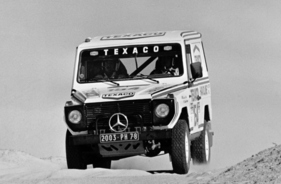
Georg Berkmann chooses the standard version of the M 110 with 136 kW (185 hp) as the basis. For the Paris-Dakar Rally in 1982 and 1983, he wanted to tease out even more power. For comparison: the M 110 in the Mercedes-Benz 280 GE presented in 1979 produced 115 kW (156 hp). The engineer used camshafts that were originally intended to increase the performance of the 280 SL (R 107). As a result, the "Paris-Dakar" engine achieved around 145 kW (197 hp). One of the unusual solutions is the hydraulic pump from the T-model of the 123 series for level control: in the motorsport G-model, it is used to cool the manual gearbox.
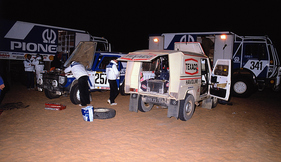
Extreme temperatures, dust and poor fuel quality are the main problems when operating in the deserts of the African continent. First of all, Berkmann relocates the engine's air intake to the interior. Temperatures are usually lower there and the amount of dust in the air is lower. He chooses a simple but effective remedy for the poor fuel quality. Four decades later, he explains: "I put yellow and red markings on the ignition distributor. This allowed the drivers to quickly adjust the ignition timing if the engine rang due to poor fuel quality." To make this quick and avoid having to search for the right tool, the resourceful engineer attached a four-millimetre Allen key to a chain near the ignition distributor. Jacky Ickx is also thorough. During his preparations, he labels every relay so that he can quickly track down any defects.
Optimized aerodynamics
With the more powerful engine, the 280 GE achieves a top speed of 175 km/h. This is 25 km/h faster than the standard model. That is 25 km/h faster than the standard version. However, after the previous year's experience, Berkmann was certain that this speed would not be enough to achieve the desired victory in 1983: in 1982, the Mercedes-Benz 280 GE finished third (Jean-Pierre Jaussaud/Michel Brière) and fifth (Jacky Ickx/Claude Brasseur) in the Paris-Dakar Rally. A radically increased engine output is out of the question for reasons of reliability. Berkmann turns to fellow engineer Rüdiger Faul, who has developed the aerodynamics of various racing cars and the C 111-IV. This record-breaking car reached more than 400 km/h during world record runs in Nardò in 1979.
Faul took a pragmatic approach to optimizing the aerodynamics of the 280 GE. "I went to the construction department at the Sindelfingen plant and got hold of plastic waste water pipes with a diameter of 70 millimetres," he says, looking back. He attaches pipe segments around the windscreen and in this way significantly optimizes the flow in this area. At the rear, Faul opted for striking extensions to the roof and the rear side walls.
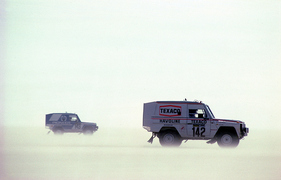
Within the company, this significant change to the body line is known as the "bus shelter". The measures drastically optimize air resistance. Measurements in the Untertürkheim wind tunnel show that the drag coefficient drops from the original 0.52 to 0.41 - that is a reduction of 20.5 percent. Georg Berkmann sums up: "Due to the aerodynamic changes, the top speed increased by a good 20 km/h to almost 200 km/h, while fuel consumption was reduced by five liters per 100 kilometers."
Jacky Ickx and Claude Brasseur
Born in Brussels on January 1, 1945, Jacky Ickx was one of the best racing drivers from the late 1960s to the end of the 1980s. Between 1966 and 1979, he won eight Formula 1 Grands Prix and was runner-up in the 1970 World Championship. He won the 24 Hours of Le Mans six times between 1969 and 1982. At the Paris-Dakar Rally, in addition to his victory in 1983, the Belgian took fifth place in the Mercedes-Benz 280 GE the previous year and second place in 1986.
"We discovered the 280 GE in 1982. You can push it to the limit and have complete confidence in its technology - that's an asset for the Paris-Dakar Rally," explained Ickx in an interview shortly after his victory in 1983. He added that he got on very well with his co-driver Claude Brasseur. "We didn't just start as colleagues, but as accomplices. That was certainly essential." Brasseur, who died in 2020, was one of the best-known French cinema and TV actors at the time.
The 1983 Paris-Dakar Rally
As early as 1982, Mercedes-Benz France's involvement in the Paris-Dakar Rally bore fruit with third and fifth places. Two more 280 GEs and a Mercedes-Benz prototype were among the first ten vehicles to cross the finish line. In 1983, 193 cars, buggies and trucks as well as 111 motorcycles drive the 12,000 kilometers from France via Algeria, Niger, Burkina Faso, Ivory Coast, Mali and Mauritania to Senegal. The most important navigation aid is the compass.
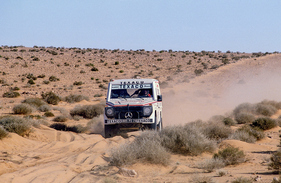
The most prominent starters in the field, Jacky Ickx and Claude Brasseur, take an early lead with the 280 GE. Before the stage finish in Agadez (Niger), Ickx notices a severe loss of power in his engine. He is given the engine of a team colleague. Changing complete power units with another vehicle in competition is permitted. Ickx then resumes his usual high pace.
Many participants drop out due to the exertions of this rally with 20 daily stages of 300 to 1,000 kilometers in length: Technical problems, accidents and crashes decimate the field. Some give up out of sheer exhaustion - or because they can no longer reach the stage finish in time after many hours of wandering through the desert. Only 61 cars and trucks and 28 motorcycles reach the finish. Ickx and Brasseur are the exhausted but celebrated winners on the beach in Dakar. Other Mercedes-Benz G models reach the finish line in fifth, sixth and eighth place.
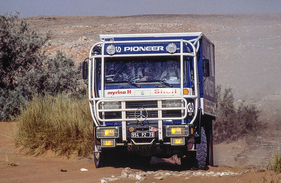
The brand even celebrates a double victory: Georges Groine, Thierry de Saulieu and Bernard Malfériol reach Dakar with a Mercedes-Benz 1936 AK all-wheel drive truck (261 kW/355 hp) as the best truck.