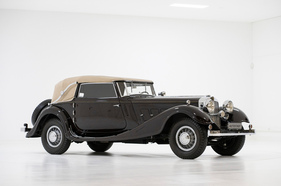
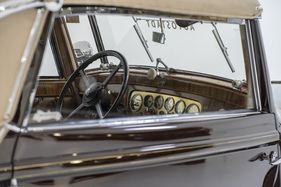
When the Horch 670 V came onto the market in 1931, it was considered the most revolutionary vehicle of its time and the ultimate in contemporary automotive engineering. The vehicle celebrates its 90th anniversary in 2021 - only four of a total of 80 vehicles produced have survived to this day. One of them is part of the ZeitHaus collection at the Autostadt in Wolfsburg.
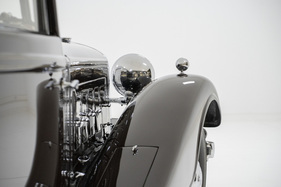
With this vehicle, its owners acquired a piece of technical innovation that was previously unknown in European automotive engineering in the 1930s: The Horch's V12 engine, designed by Fritz Fiedler, had a displacement of 5,990 cc and a hydraulic valve lash adjustment system - this ensured extremely smooth running in addition to a high degree of ease of maintenance. A fully synchronized gearbox was also installed in the 670.
The top speed was 145 km/h and the brakes were fitted via a four-wheel servo brake system from Bosch.
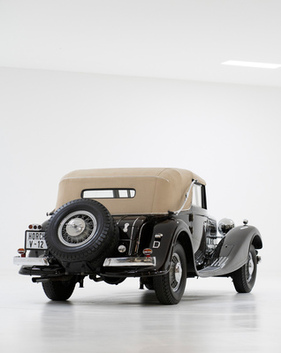
The rear of the vehicle was adorned with two spare wheels, both of which could be folded down to load the trunk. In the event of a breakdown, it was possible to lift the vehicle, which weighed almost 2.5 tons, using a permanently installed hydraulic jack and change the wheels. Due to the high price of 23,500 RM, only a few people could afford this vehicle, so its production was discontinued in 1934 after just three years.
The first owner of the Autostadt's Horch 670 was a Swiss national. After the end of the war, the vehicle found its way to the USA via Austria and France - in the 1980s it was re-imported to Germany and completely restored on behalf of a Munich doctor.
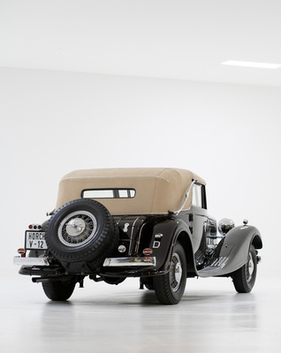
Technical data Horch 670 V
V-twelve-cylinder, bore x stroke 80 x 100 mm, displacement 6,021 ccm (according to the tax formula of the time 5,990 ccm), output 88 kW/120 hp at 3,000 rpm; kerb weight approx. 2,500 kg, wheelbase 3,450 mm, top speed 145 km/h; new price at the time: from RM 23,500. Production period: 1931 to 1934; number of units: 80 (600/670; 670: 53).
Horch company history
The history of the legendary Horch 670 V began with August Horch, one of the pioneering engineers of German automobile construction. Born on October 12, 1868, Horch founded August Horch & Cie. Motorwagenwerke AG in Zwickau in 1904. After leaving his company, the company was renamed Horchwerke AG Zwickau in 1918, and Paul Daimler became its chief designer in 1922 - Gottlieb Daimler's son paved the way for the Horch brand to become the leading German luxury car manufacturer - a path that Fritz Fiedler continued from 1930.
In 1932, Horchwerke merged with Audi, DKW and Wanderer to form the Auto-Union. Each of the four brands was assigned its own market segment: DKW - motorcycles and small cars; Wanderer - mid-range automobiles; Audi - automobiles in the upper mid-range segment; Horch - luxury top-of-the-range automobiles.
About the Autostadt in Wolfsburg - the world's leading automotive destination
As a communication platform for the Volkswagen Group and its brands, the Autostadt in Wolfsburg brings the values of the Group and the topic of mobility to life in all its facets. Over 42 million guests have visited the theme park and extracurricular learning venue since it opened in 2000, making it one of the most popular tourist destinations in Germany. The Autostadt is also the world's largest automobile delivery center and is home to the cross-brand automobile museum ZeitHaus. With a variety of cultural events, the Autostadt is also an international meeting place for those interested in culture.