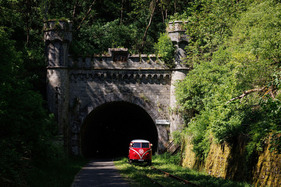
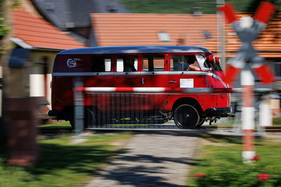
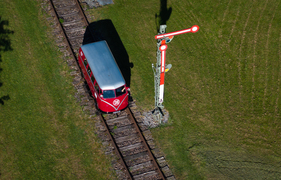
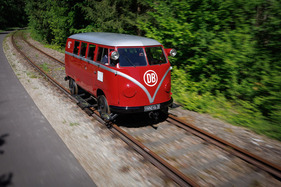
The specialists at Volkswagen Commercial Vehicles Oldtimer (VWNO) have once again recovered a Bulli treasure. After the spectacular Raupenfuchs, the all-terrain Bulli with four axles and half-track drive, they are now showing their latest automotive unicorn: the 1955 Draisine Bulli - also known as the Klv-20 in the trade.
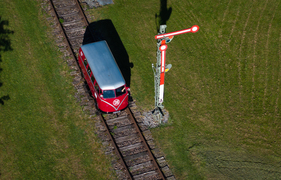
When you think of a bus and train combination, you usually think of a bus being used as a rail replacement service. But this VW Bus runs on the rails - an incredible mix of rail and VW Bus.
From road to rail
The year is 1954 and the German Federal Railways (DB) are faced with the challenge of procuring new compact service vehicles for the tracks. Instead of developing such a vehicle from scratch, they combined the versatile Volkswagen Transporter with a railroad chassis.
To this end, two companies were commissioned to build the "small car with combustion engine", or Klv-20 for short. The companies Martin Beilhack (Rosenheim) and Waggon- und Maschinenbau GmbH Donauwörth each converted 15 units for rail transport within a year.
The vehicle in VWNO's collection was manufactured by the conversion company Beilhack. The main purpose of these "Schienen-Bullis" was to carry out inspection and repair work at railroad and signal maintenance depots. It was not until the 1970s that these Klv-20s were largely taken out of service. Today, only a few vehicles remain that are actually roadworthy and in such good condition as the Klv-20 with vehicle number 20-5011 from VWNO.
A different kind of hybrid
A Klv-20 essentially consists of three components: the body of a T1 station wagon, a Volkswagen industrial engine with 21 kW/28 hp and a chassis with a hydraulic lifting and turning device. This meant that the Klv-20 could be lifted, turned and retracted on the spot by one person instead of having to reverse to the starting point. This meant that this compact rail vehicle could be used very flexibly.
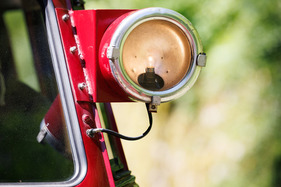
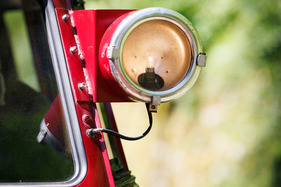
To ensure that the "Schienen-Bulli" complied with the regulations for railroad auxiliary vehicles, the lights at the front and rear were removed and replaced with the standard lamps prescribed for rail traffic at the front (2 x white) and rear (1 x red) in new positions.
History with detours
The journey of the Klv-20 from VWNO took it to its first place of use in Plattling/Bavaria in the railroad depot (Bw); later in the Plattling signal maintenance depot (Sm). After being taken out of service in the 1970s, the trolley found a new home in the Palatinate. In 1988, it was acquired by a railroad collector in Hesse.
The "Bulli on rails" is now part of the collection of Volkswagen Commercial Vehicles Oldtimers in Hanover. Interestingly, there was actually a sales brochure for this unusual Bulli. In this brochure, the vehicle is described as follows (text excerpt from the original brochure):
"Track vehicle for universal use
As a small rail omnibus or small transporter with the pleasing-looking, streamlined and purpose-built VW station wagon body.These vehicles, built by us as type GBA 1, are fitted with the tried and tested VW engine, a four-cylinder, four-stroke petrol engine. The directly flange-mounted manual gearbox has four gears and a reverse gear. Power is transmitted from the gearbox to the drive wheels via 2 lateral swing axles with articulated joints.
The drive unit is mounted in a chassis frame welded together from strong sectional steel, which also carries the wheelsets - well sprung and guided. The wheels are made of steel and have a running circle diameter of 550 mm. Rubber blocks are pressed in between the wheel rim and the wheel body according to the Bochumer Verein system, which result in very good damping of the driving noise. However, the vehicles can also be fitted with simple wheels. The axles run in roller bearings. All 4 wheels have internal shoe brakes which are actuated hydraulically by the brake foot pedal. One pair of wheels can also be braked mechanically using the lockable handbrake lever. The body is connected to the frame by rubber elements. It has three well-padded benches, which are designed for two seats in the driver's compartment and two times three seats in the passenger compartment. The two benches in the passenger compartment can be easily removed, making this space available as a load compartment. The driver's compartment has 2 doors, the passenger or load compartment has a wide hinged door. Headlights, tail lights and interior lights are harmoniously integrated into the bodywork. The drive unit is housed in the rear of the vehicle and is easily accessible from the outside through a special door.An oil-hydraulic lifting and turning device, operated by a hand pump, whose swivel bridge rests securely on the rail heads, enables the vehicle to be turned effortlessly in the desired direction of travel."
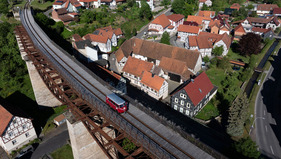
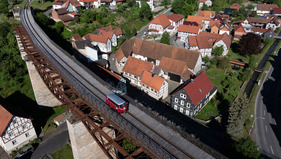
This is how the Beilhack company succinctly described this unusual Bulli. A matter of course for railwaymen - a completely unfamiliar feeling for Bulli fans - the vehicle has neither rear-view mirrors nor a steering wheel. A truly surreal feeling when driving for the first few meters. But you soon get used to the steady rumble on the tracks and start to enjoy the scenery. The first ride of this automotive unicorn took place on the picturesque trolley line in Lengenfeld unterm Stein.
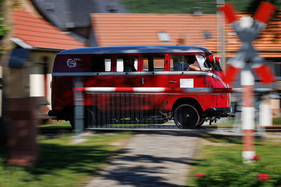
Tobias Twele, Volkswagen Commercial Vehicles Oldtimer, describes this trip as follows:
"It was a moving experience for our team to put the Klv-20 back into operation. There aren't many variants of the Bulli that we haven't seen or driven before - this trolley is definitely one of them. That's why it was a very emotional moment for us when we drove over the 24-metre-high viaduct with the team for the first time. In total, we covered over 32 kilometers on the tracks on our first trip, five kilometers of which were through tunnels, and we climbed 154 meters in altitude. We crossed the impressive 244-metre Lengenfeld viaduct countless times."
Anyone who would like to see this "rail bus" and a few other highlights from the VWN Oldtimer collection live will have the chance to do so on June 2, 2024 in Hanover. On the occasion of the 2nd International VW Bus Day, a Bulli & Coffee meeting for Bulli fans will take place in the parking lot at the customer center of the VWN plant in the Stöcken district. Following the American model, the meeting will begin at 09:00 in the morning and end at 12:00 noon, as is usual for such an event format.
The purpose of a "Cars&Coffee" meeting is to meet like-minded people in a parking lot and talk about the vehicles. There is no program or even entertainment - the cars and their stories are the focus. And it's all over by lunchtime so that the participants still have time for other activities with family or friends that day.