


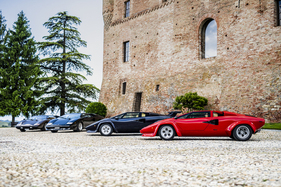

Lamborghini is celebrating 50 years of the Countach in a special way: Starting this Monday, an inspiring personality will talk about the legacy of the icon in several episodes on social media. Designer Marcello Gandini, who created the futuristic lines of the super sports car at a time when developers enjoyed great stylistic and technical freedom and only had to adhere to a few legal and regulatory requirements, will kick things off.
The 1970s were a time of creativity and one of the most important decades for design. They were years of important achievements such as space travel, the advent of high technology with the construction of modern computers and jets, and fashion trends with geometric patterns and vibrant colors. The Countach looked out from the teenage bedroom walls of an entire generation and was much more than an exuberant commercial success. As soon as it was produced, it took on the role of a style and performance icon, and conquered its place in the world history of the automotive sector.

1971: the debut with the "Idea Car", the Countach LP 500
In the summer of 1970, Ferruccio Lamborghini put the pressure on to create a revolutionary vehicle to replace the Miura. The new super sports car was to be technically more advanced and faster and at the same time become a symbol of the 1970s. The twelve-cylinder engine with a displacement increased from four to five liters was installed longitudinally at the rear instead of transversely. The technical manager, engineer Paolo Stanzani, found a solution for this with the gearbox in front of the engine, almost directly behind the seats, and a drive shaft through the monobloc.

For stylistic reasons, Marcello Gandini, style director at Carrozzeria Bertone, decided to leave the rounded shapes of the 1960s behind and designed a very low-slung, long and angular vehicle with an absolutely extraordinary shape.
Gandini opted for the scissor doors not only for technical reasons relating to the height of the sides of the frame. He secured Ferruccio's approval for another innovation and created something that was to become a characteristic feature of all twelve-cylinder cars from Sant'Agata Bolognese. The uniqueness of the LP 500 is reflected in its angular shapes, which became the stylistic symbol of the automotive sector in the years that followed. They breathed life into a model that was produced for a good 17 years with very few changes.
The word "Countach" appeared for the first time during work on the first prototype with the name LP 500, which had to be completed for the Geneva Motor Show in March 1971. The expression from the Piedmontese dialect means astonishment and admiration for something.

1973: Birth of the first generation, the Countach LP 400
The Countach LP 500 was an immediate success. However, it was not fully developed, it was merely an "idea car" to test the reactions of potential customers. But they were consistently positive. So Lamborghini decided to start development and bring the sports car onto the market as quickly as possible. Two years of intensive work were necessary, often together with the New Zealand test driver Bob Wallace, before the Countach LP 500 could go into series production. Numerous changes were required, particularly to the engine cooling system and the air intake to the interior, for which two NACA side air flaps and two air ducts above the radiator air intakes were added. The front end changed slightly and was raised by a few centimeters.
After the first tests on the road, the five-liter engine proved to be immature and too sensitive and was replaced by a four-liter engine. The Countach LP 400 made its official debut at the Geneva Motor Show in March 1973 with a prototype with chassis number #1120001, which was very similar to the later production car in every respect. Compared with the Countach LP500, the LP400 differed primarily in the use of a tubular frame instead of a self-supporting structure. The body was made of aluminum parts; it incorporated all the visual and technical changes that had become necessary during development. The car, which was presented in red in Geneva, was later exhibited in medium green at the 1973 IAA motor shows in Frankfurt, Paris and Earls Court in London. It was then sold to Switzerland, located in the early 2000s and is now owned by Automobili Lamborghini, exhibited in its own museum, the MUDETEC.
The standard Countach had a frame made of steel tubes with differentiated diameters, a fiberglass floor and sheet metal panels to "close" the engine compartment and trunk. The car also offered numerous advantages in terms of weight and remained practically unchanged throughout the years of production.
The 4.0-liter engine fed by six Weber twin carburetors (type 45 DCOE) produced 375 hp at 8000 rpm for a top speed of almost 300 km/h. The suspension had its origins in racing with wishbones of different lengths, coil springs, hydraulic shock absorbers and a coupling rod to the front and rear axles, trapezoidal springs at the top and triangular springs at the bottom, adjustable shock absorbers for each wheel and cross struts. The brakes were self-venting disc brakes with brake callipers for racing applications. Considered by many fans to be the purest version of Marcello Gandini's design, the LP 400 is the most sought-after version among collectors today, with only 152 examples sold by 1977.

1978: the Countach LP 400 S
From 1978, the LP 400 was replaced by the Countach LP 400 S, with the newly designed, heavily lowered Pirelli P7 wheels with magnesium rims and 205/50 VR15 tires at the front and 345/35
VR15 tires at the rear, the wheel arch trims required for larger tires, a very low front spoiler and a rear spoiler, which also became a distinguishing feature of the Countach in subsequent years. Today, the LP 400 S is considered the perfect example of the Countach's and Lamborghini's DNA, combining sportiness, beauty of form and futuristic technology. Never before had a "normal" car with such a track-ready look been seen on the road, and the LP 400 S served as inspiration for all subsequent Countach series. 235 units were built until 1982.

1982: the Countach LP 5000 S
The successor LP 5000 S made its first appearance at the Geneva Motor Show in March 1982. Giulio Alfieri, who had joined the company in 1979 as Technical and Production Manager and later became General Manager, developed the engine with (almost) five liters.
The model, which was visually indistinguishable from the LP 400 S, had a slightly different interior. The new engine produced 375 hp at 7000 rpm. The horizontal Weber twin carburetors (Type 45 DCOE) remained unchanged (only some vehicles were fitted with Bosch K-Jetronic electronic fuel injection after being imported into the USA). Production totaled 323 units until it was replaced by the LP 5000 Quattrovalvole in 1985. In March 1985, its first version was presented at the Geneva Motor Show, which was officially imported and also registered in the USA.

1985: the Countach LP 5000 Quattrovalvole
In the Quattrovalvole or QV, the twelve-cylinder engine with a displacement increased to 5.2 liters and a four-valve cylinder head underwent further development. The new technical solution required the use of new carburetors, six Weber DCNF, no longer in a horizontal position but mounted vertically. In contrast, the version for the US market was equipped with Bosch KE-Jetronic electronic injection in a unit with catalytic converter and fuel vapor recirculation. The increase in power is astounding: 455 hp at 7000 rpm. The front track width increased by 44 millimeters, the aesthetic changes were minimal: only a new hood with a large hump necessary to make room for the new vertical carburetors.
From 1988, the QV received side skirts that made its appearance even more modern. In addition to the side amplifiers, the US version can be recognized by the bumper contour on the rear wall and the extended front bumper. The QV is the first series-produced Lamborghini with a composite hood. A total of only 631 Quattrovalvole were produced up to 1988.
Although a number of vehicles had been launched on the US market since the Countach was first built, the Countach was not officially registered for the US market until the 1986 model year with the LP 5000 Quattrovalvole.
Every Countach for the USA underwent a series of necessary modifications to adapt it to the strict regulations in the USA with regard to environmental and impact protection. However, these were improvised solutions that severely limited the Countach's sales opportunities in one of the world's most important markets. It is no coincidence that the Countach accounted for almost 50 percent of Lamborghini's total production towards the end - in the last four years from 1987 to 1990 alone, when the model was already more than 15 years old.

1988: the Countach 25° Anniversario
The Countach 25° Anniversario, the latest evolution of the Countach, made its debut at the 1988 Paris Motor Show. Since 1985, when engineer Luigi Marmiroli took over from Giulio Alfieri at the head of Automobili Lamborghini's technical department, the need to replace the Countach, which had now been in production for 14 years, had been felt. In the meantime, it was renewed with a special version that was given the name 25° Anniversario to celebrate the company's 25th anniversary.
There were major visual changes, but only a few technical ones. The engine was given an improved cooling system and the frame was realigned to fit the new Pirelli P Zero tires. The developers renewed the passenger compartment and made it more comfortable with less shaped, electrically adjustable seats and electric windows. The still young Horacio Pagani, who was at Lamborghini at the time, redesigned the style of the bodywork, making the shapes rounder and integrating the exterior appendages such as wheel arch trims and lower pillars better into the whole. A visible feature of the 25° Anniversario, in addition to the new composite aluminum wheels, are the rounded and elongated rear air intakes. These changes, some of which were borrowed directly from the prototype Countach Evoluzione, made the 25° Anniversario the Countach with the best results in terms of dynamic lift and aerodynamic drag.
The 25° Anniversario is the most produced type in the history of the Countach, raising the total production of the Countach model to 1999 cars (not counting the very first LP 400 #1120001). On July 4, 1990, the last Countach rolled off the production line, a 25° Anniversario in the version for Europe in metallic silver and with gray leather interior. This Countach with car no. 658 was not sold, but remained in the Mudetec showroom.


