

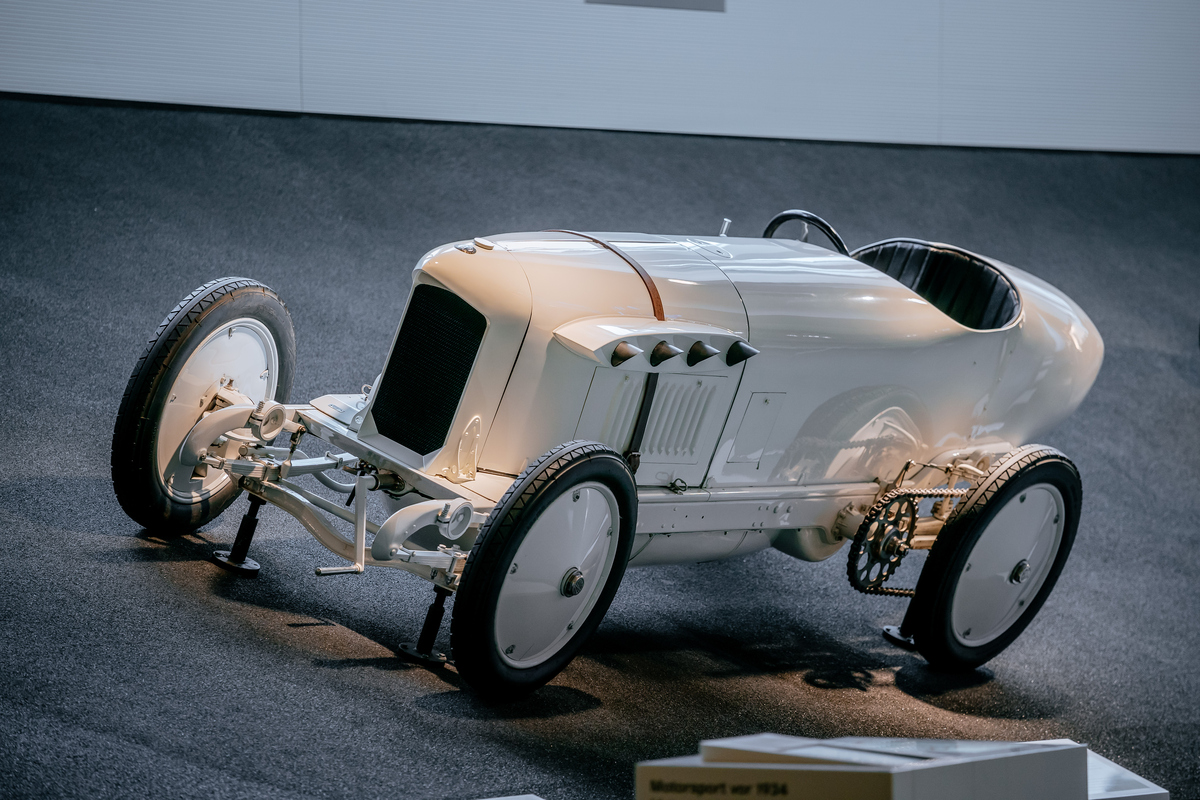


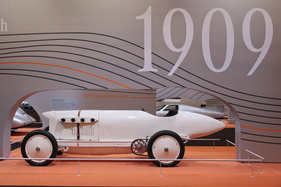
Powerful and fast - that's how the Benz 200 hp "Blitzen-Benz" with its "arrow shape" looks in the racing curve of the Mercedes-Benz Museum in the Myth 7: Silver Arrows - Races and Records room. Almost 115 years ago, the designers designed the body to be as aerodynamic as possible without any help from the wind tunnel. The basic shape resembles a cigar. The rounded radiator grille splits the airstream at the front, which flows out over the longer rear end. The driver crouches low in the cockpit. The seat for the accompanying mechanic is narrow, as are the tires on the clad wooden-spoke wheels. Other details are also designed to be streamlined.
Powerhouse
Four large-diameter exhaust pipes protrude from the hood. They suggest plenty of engine power. Silencer? Not a thing! The appearance of the fast "Blitzen-Benz" is extremely loud.

Large gear wheels and strong chains transmit the power to the rear wheels. The engine is started using a crank at the front of the vehicle.
To the front
Pushing boundaries - that was the task of the Benz 200 hp "Blitzen-Benz" in 1909. It was the first car in the world with an internal combustion engine to break the magic 200 km/h barrier and set the world speed record for road vehicles.

These and other successes make it world-famous. Only six "Blitzen-Benz" were built, four still exist.
Success factor
At the turn of the 19th and 20th centuries, Benz & Cie. was the largest car manufacturer in the world. The vehicles from Mannheim enjoy an excellent reputation. They are considered suitable for everyday use, reliable and affordable - these are the requirements of Carl Benz himself. They did not have to be the fastest and most powerful cars, he said. But the competition - and not least Daimler-Motoren-Gesellschaft - saw things differently. DMG cleverly used the sporting success of its vehicles for advertising purposes. Benz is in danger of losing market share.
Exclamation mark
The company decides to make a U-turn. Clear target: the fastest car in the world should come from Mannheim. Faster than all other means of transportation at the time - including the railroad and the airplane. In figures, this means that the vehicle should easily break through the 200 km/h barrier - after all, record-breaking trains were already traveling at 210 km/h in 1903. A steam car reached 205.44 km/h in 1906. The Blitzen-Benz would first surpass these figures and then completely eclipse them.
Power station
Work starts at the beginning of 1909. The basis is the engine of the Benz 150 hp Grand Prix racing car, but this power is not sufficient for the ambitious project. The displacement of the four-cylinder engine is increased to 21.5 liters.

It finally delivers 147 kW (200 hp) at 1,600 rpm. The gigantic power unit weighs 407 kilograms. Following the usual naming logic with a power rating in horsepower, the racing car is called Benz 200 PS.
Record mark
The feverish work is rewarded. 205.666 km/h over half a mile and 202.648 km/h over one kilometer, both with a flying start - these average speeds were achieved by works driver Victor Hémery on November 8, 1909 on the race track in Brooklands. The magic mark of 200 km/h is broken for the first time in Europe, and at the same time for the first time ever with an internal combustion engine.
Brooklands is opened in 1907 as the world's first circuit built specifically for motor racing; the race track is already characterized by banked curves.
Departure
At Brooklands, the Benz 200 PS still competed with the bodywork of the 1908 Grand Prix car. But the car was already pushing the known boundaries. It became clear that all European racetracks were unsuitable for the speeds that the super-powerful car with its new streamlined body was aiming for. The "Blitzen-Benz" needed very long straights to show its potential. Benz & Cie. goes to the USA.
Attraction
In 1910, the record-breaking car is shipped to America. Its owner Ernest "Ernie" Moross calls it "Lightning-Benz". Translated into German, the name "Blitzen-Benz" was created shortly afterwards. On March 16, 1910, Barney Oldfield reaches 211.97 km/h over the mile with a flying start on the dead-straight Daytona beach runway.

After that, Oldfield used the Blitzen-Benz at show events and demonstrated it to thousands of curious people in America.
Increase
The Benz 200 hp can do even more. On April 23, 1911, Robert R. "Bob" Burman also drove the further improved racing car over the flying mile at Daytona Beach at 228.1 km/h. Another world record. It was twice as fast as an airplane at the time and faster than any car or rail vehicle of the day. The "Blitzen-Benz" remains the fastest car in the world - for another eight years. The record for the famous vehicle from Mannheim was not broken until 1919.
