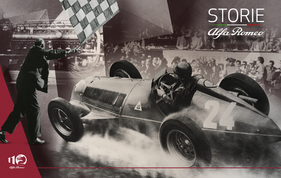
Alfa Romeo is indelibly rooted in the history of Grand Prix racing. When the Formula 1 World Championship was launched in 1950, Alfa Romeo works driver Nino Farina won the title in the Grand Prix Tipo 158 "Alfetta". The following year, teammate Juan Manual Fangio became world champion in the Alfa Romeo Grand Prix Tipo 159.
70 years of Formula 1
The very first Formula 1 race took place on May 13, 1950. The foundation stone for one of the great sporting myths of our time was laid on the race track at Silverstone in the UK. On July 14, 2019, the 1000th race in the premier class of motorsport was celebrated as part of the Chinese Grand Prix in Shanghai. On May 13, 2020, Formula 1 will be exactly 70 years old.

1950 and 2020 - two eras in motorsport could hardly be more different. Seventy years ago, helmets were not yet mandatory, there was no television coverage and spectators stood fairly close to the race track. Today, Formula 1 is a high-tech global corporation that reaches 400 million fans in front of the TV and on the internet every season.
However, both eras have two things in common: the passion of the fans and Alfa Romeo. The brand, which won the first Formula 1 race in history in May 1950, returned to Formula 1 in 2018 together with Team Sauber and will compete in 2020 under the name Alfa Romeo Racing Orlen. Alfa Romeo would not be the same without Formula 1. And who knows, maybe Formula 1 wouldn't be the same without Alfa Romeo either.
A Grand Prix racing car called "Alfetta"
The origins of the Alfa Romeo racing car with the model designation Tipo 158 date back to 1938. With a displacement of 1.5 liters, the eight-cylinder in-line engine complied with the current Grand Prix regulations at the time, the forerunner of Formula 1. However, the engine and the vehicle itself were significantly smaller than its famous predecessors, the P2 and P3. The Tipo 158 was therefore nicknamed the "Alfetta", little Alfa Romeo.

The Tipo 158 was a technological jewel, the work of Gioacchino Colombo, head of the design department at Alfa Romeo. Colombo opted for an overhead camshaft, triple carburetors and supercharging with the aid of a compressor. By using light metals - the magnesium-aluminum alloy Elektron for the block, nickel-chromium steel for the crankshaft - the engineer reduced the engine weight to just 165 kilograms. Another special feature was the so-called transaxle layout. The gearbox did not form a single unit with the engine as usual, but was combined with the rear axle differential to form a single unit. This design took up less space and ensured optimum weight distribution between the two axles.

The Second World War halted the development of the Tipo 158, but the technical solutions of the Grand Prix racing car were so sophisticated that they were still successful in the post-war period. In some respects, even to this day. For example, Alfa Romeo also used the transaxle design in production vehicles from 1972, the first being the Alfetta model named after the Formula 1 racer.
Escape to Abbiategrasso
The Alfa Romeo racing cars from the years immediately before and immediately after the Second World War were not just similar - they were actually identical. The story behind this could hardly have been more exciting for a book author.

Jumping back to 1943, the northern Italian industrial city of Milan is occupied by German troops and arrests are increasing by the day. There are a small number of Tipo 158s at the Alfa Romeo Portello plant just outside Milan; they could end up as spoils of war at any time. Engineers and employees in the racing department devise a plan to prevent this. They load the Grand Prix racing cars onto trucks to transport them to various hiding places near Abbiategrasso, around 20 kilometers west of Milan. A handful of passionate Alfa Romeo admirers volunteer to take on this task. Among them is racing boat champion Achille Castoldi, who set a world speed record in 1940 with a Tipo 158 engine in his boat.
But just as the convoy is about to leave, a Wehrmacht patrol appears in Portello. Alfa Romeo test driver Pietro Bonini, of Swiss nationality and speaking perfect German after several years in Berlin, stands in the soldiers' way. He confidently presents the commander with a transport permit. In fact, the Germans let the convoy pass unmolested. The Tipo 158s are taken to various garages and sheds, where they are hidden behind false walls or piles of tree trunks, waiting for better times.
The birth of Formula 1
Not long after the end of the war, the Tipo 158s were brought back to the Alfa Romeo Portello plant, carefully overhauled and prepared for their return to racing. And racing often meant victory for Alfa Romeo, even though few circuits were in operation at first and many championships were in a provisional state. In 1947 and 1948, Alfa Romeo driver Nino Farina won the Grand Prix of Nations in Geneva/Switzerland, team colleague Achille Varzi the Grand Prix of Turin/Italy and Carlo Felice Tossi the Grand Prix of Milan/Italy. The message was clear: the Alfa Romeo Tipo 158 was still the car to beat.

The British Grand Prix at Silverstone was the first of eight races in the newly founded Formula 1 World Championship in 1950. Nations that had been at war with each other just a few years earlier were now united in sport. It was a historic moment. For Alfa Romeo, it was a historic victory.
The Tipo 158 took the first four places on the starting grid. Giuseppe "Nino" Farina took pole position, the fastest lap and victory. Luigi Fagioli came second and Reg Parnell third. The first Formula 1 podium in history was firmly in the hands of Alfa Romeo.
The "team of the big three Fs"
The combination of superior speed, outstanding handling and high reliability made the Tipo 158 the crown jewel of automotive technology of its time. At its racing premiere in 1938, the 1.5-liter supercharged engine produced 136 kW (185 hp). With a two-stage supercharger, the Alfetta already achieved 202 kW (275 hp) after the break due to the war. By 1950, the power output had risen to 257 kW (350 hp) at 8,600 rpm. The Tipo 158's power-to-weight ratio in this year was just two kilograms per hp - a value that would be equivalent to a super sports car today.
The Alfa Romeo works drivers turned this technical superiority into victories. The trio of Farina, Fangio and Fagioli became famous as the "team of the big three Fs". The three aces won all the Grand Prix races in which they took part in the 1950 season. They stood on the podium twelve times and set the fastest race lap five times. Giuseppe Busso, designer at Alfa Romeo and colleague of chief designer Gioacchino Colombo, later said: "Our biggest problem was deciding which of the three drivers should win a particular race."

On September 3, 1950, Alfa Romeo entered the Tipo 159 for the first time at the Monza Grand Prix in Italy. Originally developed for the following year's World Championship, the next generation of the Alfetta celebrated its debut with a victory. With this success, Nino Farina was finally crowned the first Formula 1 world champion in history.

The Tipo 159 Alfetta
In 1951, the duel for the Formula 1 World Championship between Alfa Romeo and Ferrari was only decided in the final race. After 17 years, the Alfetta's phenomenal engine was slowly reaching the end of its development potential. But over the course of the year, the technicians once again succeeded in generating additional power and breaking the barrier of 331 kW (450 hp). Thanks to this further increase and the outstanding Alfa Romeo works drivers, the Tipo 159 crossed the finish line as the winner in four out of eight Grand Prix, scoring eleven podium finishes and the fastest lap in all seven races in which Alfa Romeo took part. Defending champion Farina won in Belgium. But with victories in Switzerland, France - where he shared the car with Luigi Fagioli - and Spain, his team-mate Juan Manuel Fangio now secured the world championship title.

The "Three Big Fs" and their victories became legendary and made Alfa Romeo a movie star. The two most important Italian producers of the time, Dino De Laurentis and Carlo Ponti, made a film (original title "L'Ultimo Incontro") that was set on the Formula 1 racetracks and in the offices of the Alfa Romeo racing department. The writer Alberto Moravia collaborated on the screenplay. The leading roles were played by Amedeo Nazzari and Alida Valli, also two superstars of the era.
The film premiered on October 24, 1951. Four days later, Juan Manuel Fangio drove the Tipo 159 to victory in the Spanish Grand Prix. Alfa Romeo had thus won the first two Formula 1 world championships in the history of motorsport. Unbeaten, the brand withdrew from Formula 1 and instead concentrated fully on producing unbeatably beautiful sports cars.