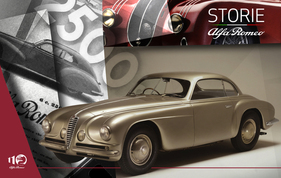
The next chapter in the online film series sheds light on the era immediately before and after the Second World War, in which Alfa Romeo mastered the transition from manufacturing to series production. At the 1949 Concorso d'Eleganza in Villa d'Este on Lake Como, a variant of the Alfa Romeo 6C 2500 designed by Carrozzeria Touring caused a sensation. The model went on to impress numerous celebrities, including Prince Rainier III of Monaco, actors Rita Hayworth and Tyrone Power, presidential wife Evita Peron and Italian football star Valentino Mazzola, who worked at the Alfa Romeo plant in Portello before his career as a professional sportsman.
The Concorso d'Eleganza in Villa d'Este on Lake Como has been one of the world's most important beauty contests for automobiles since the 1930s. In 1949, the renowned Carrozzeria Touring designed a particularly elegant version of the Alfa Romeo 6C 2500 especially for this event, whose originality and unique lines won over the jury, who awarded the vehicle the most important prize, the "Coppa d'Oro" (Gold Cup). This success inspired Alfa Romeo and Carrozzeria Touring to offer the model regularly from then on under the name 6C 2500 Villa d'Este. The third episode of the documentary "Storie Alfa Romeo" is dedicated to this model.
An international engineer from Treviso
But the Alfa Romeo 6C 2500 Villa d'Este was not only one of the most beautiful cars of its era. It was also a link between the hitherto customary production of handmade, one-off vehicles tailored to the customer's wishes and a modern production organization. The person responsible for this change at Alfa Romeo was an engineer with an international career - Ugo Gobbato.

When Alfa Romeo presented the 6C 2500 model in 1939, Gobbato had already been head of the Portello plant on the outskirts of Milan for six years. The manager, who came from the province of Treviso, had studied mechanical engineering at the Technical University in Zwickau, Germany, became the first director of the revolutionary Fiat plant in Lingotto after his military service and subsequently managed the construction of factories for Fiat in Germany and Moscow, among other places. Gobbato was also project developer for the first large ball bearing factory in the Soviet Union.

Gobbato was known as a down-to-earth man who spent a lot of time in the production facilities, often talking to the workers and always persistently trying to improve efficiency. In 1933, Gobbato was appointed director of Alfa Romeo. Right from the start, he focused on efficiency. He phased out obsolete machines and streamlined work processes. In his analytical diagnosis, Gobbato adhered to the strategy he had already published in 1932 in two manuals entitled "The Organization of Production Factors". He devoted himself to the theorization and implementation of a well-planned combination of modern production methods and the artisan tradition that had characterized Alfa Romeo up to that point.

"Rational production, but not mass production" was Gobbato's goal, which he achieved primarily by hiring a generation of young engineers. With them, Alfa Romeo implemented a variety of new processes and modern methods. These included a clearer hierarchy, precisely defined responsibilities and performance-related salaries.
A promising football talent
The far-reaching reorganization of the Alfa Romeo Portello plant also included the construction of a football pitch and a running track, including a small stand, on a neighbouring site. In 1938, the factory football team - Gruppo Calcio Alfa Romeo - won the regional championship and was promoted to Division C. With this success behind them, the team hired a promising young player who was also convinced by the prospect of a permanent job as a mechanic in Portello. His name was Valentino Mazzola.
Mazzola later became one of the country's most famous footballers, joining AC Torino via Venice, becoming captain of the legendary "Grande Torino" team, which won the league title five times, and also played for the national team. In 1949, Mazzola and almost the entire AC Torino team died in a plane crash.
It is not known whether Mazzola ever worked as a mechanic on the Alfa Romeo 6C 2500. The fact is that he worked at the Portello plant in 1939, when the first models of this series were produced.
The beginnings of the Alfa Romeo 6C 2500
The Alfa Romeo 6C 2500 presented in 1939, powered by an in-line six-cylinder engine with a displacement of 2.5 liters, was the further development of the 6C 2300 and 6C 2300B models. Important technical innovations were adopted for the 6C 2500, including the rear suspension with torsion bar suspension, telescopic shock absorbers and hydraulically actuated brakes instead of the mechanical brakes previously used. The increase in displacement by 200 cubic centimetres also increased performance.

In the Supersport model version, up to 81 kW (110 hp) was available, which enabled a top speed of 170 km/h. The Alfa Romeo 6C 2500 made its motorsport debut in 1939 at the 1,500-kilometer race from Tobruk to Tripoli in present-day Libya. A variant of the Alfa Romeo 6C 2500 Supersport with fenders integrated into the bodywork was used.
The technical innovations of the Alfa Romeo 6C 2500 and its sporting successes attracted an elite clientele. Production began with the five- or seven-seater Turismo chassis versions as well as the Sport and Supersport variants with a short wheelbase. Customers turned to external coachbuilders for the bodywork.

Despite the high price - between 62,000 and 96,000 lire - the response from customers was very positive. With the 159 Tipo 6C 2500s sold, Alfa Romeo earned about as much as Fiat with the sale of 1,200 vehicles from the 508 Balilla series.
The comeback of the Alfa Romeo 6C 2500
After the Second World War, many factories in Italy switched their production back from military equipment to civilian goods. The Alfa Romeo plant in Portello had been severely damaged by air raids in 1943 and 1944. The resumption of automobile production was therefore a complex challenge. A pragmatic start was made with the last model of the pre-war era, especially as many components of the Tipo 6C 2500 were still available.
Milan, like many other Italian cities, was in ruins. The same applied to the country's economy. Companies often had to buy the necessary materials and fuel for their factories on the black market. As a result, only a few examples of the Alfa Romeo 6C 2500 Sport could be completed in Portello in 1945. But for the engineers and workers, it was a dream come true.

The Alfa Romeo 6C 2500 Pinin Farina Speciale Cabriolet
In 1946, production in Portello rose to 146 units, divided between complete cars and chassis, which were completed by external coachbuilders. One of the best known was Battista "Pinin" Farina.
Farina provided an Alfa Romeo 6C 2500 chassis with an elegant cabriolet body, which was to be exhibited at the 1946 Paris Motor Show. But as one of the so-called "defeated countries", Italy was excluded from the event. Without further ado, Farina parked his convertible in front of the entrance to the exhibition grounds in the Grand Palais and also took it to the Place de L'Opéra every evening to present it to Parisian high society. The plan worked, and the success of the Cabriolet and its creator Battista "Pinin" Farina was unstoppable.
Also in 1946, another body variant was created on the shortened chassis of the Alfa Romeo 6C 2500 Sport - the Freccia d'Oro (Golden Arrow). The short and rounded rear corresponded to the latest findings in aerodynamics. The Freccia d'Oro inspired numerous ambitious versions. Pinin Farina, among others, designed an elegant coupé with revolutionary lines and a later award-winning Berlinetta for the Concorso d'Eleganza at the Villa d'Este. Achille Castoldi, engineer and successful motorboat racer, bought a coupé with bodywork from Touring and used the same tactics at the Geneva Motor Show as Farina had previously used in Paris.

A car for celebrities
The American actor Tyrone Power drove through Rome in an Alfa Romeo 6C 2500, the Argentinian President Juan Peron and his wife Evita through Milan. King Farouk of Egypt and Prince Rainier III of Monaco also bought the Alfa Romeo 6C 2500. On May 27, 1949, when Rita Hayworth married Prince Ali Khan in the town hall of Cannes, she drove up in the 6C 2500 that she had just received as a wedding present. The convertible had an elegant gray body with a dark blue soft top and upholstery that perfectly matched the bride's wardrobe.
The wedding was originally planned for the beginning of May. However, football fan Ali Khan had it postponed due to the so-called "Superga tragedy", in which a plane with the AC Turin team on board crashed on its approach to Turin's local mountain, Superga, on May 4, 1949. Valentino Mazzola was among the fatalities. In a way, this brings us full circle to 1939, when the still unknown Mazzola was working at the Alfa Romeo Portello plant, where the first Tipo 6C 2500s were built.
The Alfa Romeo 6C 2500 Villa d'Este
The Tipo 6C 2500 Villa d'Este was one of the last Alfa Romeo models to be built with a chassis separate from the body. Only 36 examples were built in total, all of them unique creations, designed according to the owners' wishes and inspired by the coachbuilders.

Based on the 6C 2500 Supersport coupé, which had already been built by his coachbuilder Touring, designer Carlo Felice Bianchi Anderloni made fundamental changes. He redesigned the front of the vehicle by integrating the four headlights and the cooling air intakes more harmoniously into the bodywork. Anderloni integrated the front fenders into the bodywork. The windshield is split in two and more inclined. The rear of the vehicle is flat and has two small, elegant round tail lights. In short: a masterpiece of 20th century automotive art was born.

At the 1949 Concorso d'Eleganza in Villa d'Este, the Alfa Romeo 6C 2500 designed by Carlo Felice Bianchi Anderloni won the "Grand Prix Referendum", the audience award. Since then, the model name has been inextricably linked with the legendary beauty contest on Lake Como.