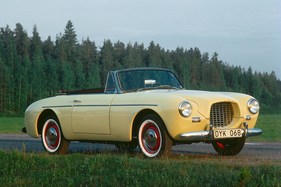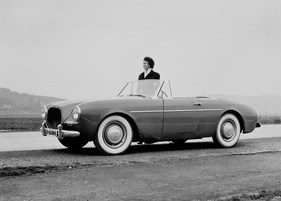

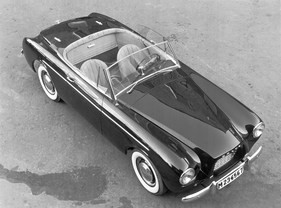

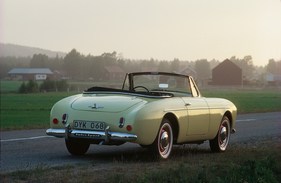
The farewell could not have been more stylish for a Volvo, for which two summers and just 67 or 68 units had to suffice to establish the Swedish premium brand in the sports car world.

The last Volvo Sport P1900 rolled out of the production halls in Gothenburg on May 21, 1957 and was shipped directly to a sports car enthusiast in California. It was from there that Volvo CEO and company founder Assar Gabrielson had brought the concept for the first European production roadster with a plastic body in 1953, and it was in America that the Volvo Sport P1900 celebrated its greatest success: Together with its technical gene donor Volvo PV 444 "Humpback Volvo", the fiberglass sports car made the Swedish brand famous there under the slogan "Volvo is the sports car, a product of superb Swedish engineering". However, the futuristic fiberglass body prevented the Volvo Sport P1900 from achieving the high Volvo quality standards. Despite its premature discontinuation, the roadster initiated the development of the legendary Volvo P1800 sports coupé.

Short career
Its career was short, but its historical significance should not be underestimated: The Volvo Sport P1900 made history as the first Swedish sports car and the first European production car with a body made of fiberglass-reinforced plastic. Above all, however, the agile and lightweight two-seater - the type designation referred to the original target kerb weight of just 1,900 pounds (lb) or the equivalent of 862 kilograms - acted as the perfect image carrier for Volvo's entry into the glamorous sports car market and the leap into North America.

In the world's largest market for premium brands at the time, the rare but racy roadster accelerated the sales success of the high-volume Volvo PV 444. A justified image transfer, as the Volvo PV 444, celebrated as the "Family Sports Car", supplied the mechanics and the reliable B14A four-cylinder engine for the Volvo Sport P1900 in a twin-carburetor version with an increased output of 51 kW (70 hp).

Nevertheless, the Roadster lacked the robustness typical of the Volvo brand, which is why production was discontinued so soon.
Visionary sports car that was too far ahead of its time
Its pioneering plastic body became its fate. The Volvo Sport P1900 initially owed its conception to it, then its meteoric rise into the spheres of the most exciting sports cars of the 1950s and finally the fiberglass production problems and the high costs led to the premature end of the career of Sweden's first sporty spearhead after only 67 or 68 units - chassis number 20 was accidentally assigned twice. However, this only became apparent when the production statistics were later compared with the delivery lists. But that's not all of the curiosities: The two chassis with the number 20 were not exported as originally intended, but were both registered on the Swedish domestic market.
Sporty image for Volvo
Nevertheless, the Volvo Sport P1900 made a big impact, as it was present at every product presentation of the Swedish premium brand, giving it a sporty image worldwide and making it even more desirable. In the USA, the roadster made its debut in 1956 under the name Volvo Sport in the glamorous Coliseum at the New York Auto Show. It was a glamorous premiere, which was followed by an even more glamorous promotional tour from the East Coast to the West Coast. In contrast to many other European sports car show stars, the new Volvo Sport P1900 immediately showed itself to its public on the road. After all, it was based on the shortened chassis of the solid Volvo PV 444 and also used its drive technology.

Pioneer of modern lightweight construction technologies
The supplier of the lightweight fiberglass body was the Californian boatbuilding specialist Glasspar. Its innovative fiberglass production techniques had convinced Volvo CEO and company founder Assar Gabrielsson when he was preparing Volvo's launch on the US market in 1953 and planning an extravagant roadster as a flagship project
In the same year, Glasspar developed the first body designs for the Volvo Sport P1900 and in the spring of 1954, the Americans sent three prototypes across the Atlantic for a press and public presentation at Torslanda Airport in Gothenburg. The runway provided the perfect launch pad for the two-seater roadster with its spectacular radiator grille design in the style of a jet turbine. The 1.4-liter four-cylinder engine did not unleash that much temperament, but it was still enough for a top speed of up to 170 km/h, which was extremely sporty at the time. For the experts, this fiberglass racer was a sensation that no one had expected, especially as not even the European sports car specialists had dared to mass-produce plastic bodies before then.
A roadster as Volvo's first global brand ambassador
Volvo had big plans for its avant-garde roadster, which was intended exclusively for export and was to open up new markets in North America, South America and even Africa. To achieve this, Volvo announced an initial series of no less than 300 vehicles, and the contract between Volvo and Glasspar included training Volvo employees in the production of the fiberglass bodies, which were delivered in three exclusive paint finishes: light yellow, light grey and light blue. In the end, however, the numbers of the Volvo Sport P1900 remained so modest that the open two-seater was also offered on the domestic market.

With this first series-produced car made of glass fiber-reinforced plastic, Volvo was actually breaking new ground in terms of production technology, as the factory long-distance tests throughout Europe and North Africa showed. The body could never fully meet the quality requirements, and delivery of the first customer vehicles had already been postponed until January 1956. This problem was also recognized by the newly appointed Volvo CEO Gunnar Engellau in 1957, who therefore decided to end production of the Volvo Sport P1900 immediately in the spring of 60 years ago.
From fiberglass pioneer to collector's car
If the Volvo Sport P1900 is one of the most sought-after Swedish classics today, this is not only due to its small production run, but also to its status as the first true sports car from Scandinavia, which found a spectacularly successful successor in the Volvo P1800. Moreover, the powerful and reliable twin-carburetor engine of the fiberglass roadster was also available for the Volvo PV 444 from 1957, which finally established Volvo as a "sensational family sports car" in the USA. A nimbus that was confirmed by countless motorsport successes.