


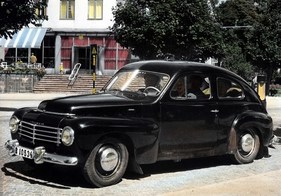


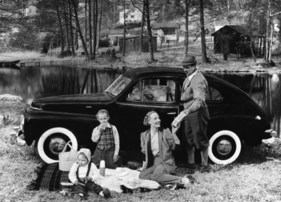

Volvo is celebrating a milestone anniversary: 70 years ago, the era of mass production began at the Swedish premium brand. In September 1950, the Volvo PV444 rolled off the production line in the further developed B-series, and the streamlined fastback saloon achieved its first sales figures, which put Volvo permanently in first place in the Swedish new car registration statistics. Above all, however, the Volvo PV444, affectionately known by German fans as the "humpback Volvo", laid the foundations for the global export success of the model series, which was praised for its safety innovations and durability. The related Volvo PV445 Duett, which is regarded as the pioneer of all variable estate cars with passenger car characteristics, contributed to this.

The Volvo PV444 A with its avant-garde aero design celebrated its world premiere back in 1944 as the first Swedish volume model with pioneering safety technology for the period of economic recovery after the Second World War. Due to a shortage of materials, however, series production did not get underway until 1947 and only around 12,500 vehicles were delivered by September 1950. Series A was therefore followed by B and in this and subsequent evolutionary stages, the Volvo PV444 was able to break all existing Scandinavian passenger car production records. It took just five years for the 100,000th Volvo PV444 to be delivered, and by the time the only moderately modernized Volvo PV544 succeeded it in 1958, a total of almost 200,000 units of the Volvo PV444 sedans, renowned for their safety innovations and durability, had been sold worldwide. To put these sensational figures into context: Until the market launch of the "humpback Volvo", a maximum of 2,000 units of a Volvo model were built.
Revolutionary safe, sporty and durable family cars
However, the two Volvo founding fathers Assar Gabrielsson and Gustaf Larson were also able to present a new family car with the Volvo PV444 - the type code stood for Personvagn (PV), 4 cylinders, 40 hp and 4 seats (444). The self-supporting body with innovative independent front suspension, the generous wheelbase of 2.60 meters and the solid construction with exemplary passive safety for all passengers at the time stood for this. This was also the case with the first Swedish cult estate car for family, leisure and business, the Volvo PV445 Duett, introduced in 1953, which scored points as an estate saloon with up to two folding rear seat rows and a huge, variable load compartment.

Like the Volvo PV444 B, it was also powered by the efficient, legendarily robust B4B four-cylinder engine, which now produced 32 kW (44 hp). An engine that made the Volvo PV444 fit for a favorite role in rallying. There, the dynamic and reliable two-door car showed its assertiveness both at the Monte Carlo Rally and at the notorious Tour de Belgique in 1951, where Volvo PV444 Bs won all three podium places.
Pioneer for exemplary vehicle safety
Further motorsport successes cemented the reputation of the iconic fastback saloon as a dynamic and safe "family sports car", which took North America by storm as an important export market for Volvo from 1955. By 1956, Volvo was already the second largest import brand in California. In Germany, too, it was the Volvo PV444, with its striking "humpback" shape and completely new safety features, that made the Swedish brand popular. Innovative two-point seat belts were first offered in the Volvo PV444 and then the pioneering first three-point seat belt was introduced in the further developed Volvo PV544 model. A patented lifesaver for more than a million people, the effect of which Volvo demonstrated dramatically at a safety conference in Germany in 1961: the "humpback Volvo" overturned and its driver got out unharmed. The development of rear-facing child seats to protect young children also began in the Volvo PV544 "Humpback".

Other visual safety features such as the original fixed light on the roof of the Volvo PV444 B, known as the "cuckoo", were short-lived but inspired lasting solutions. This "cuckoo" fixed light served as a highly visible direction indicator with a blue lamp in the middle and orange indicators to show the direction when turning. However, the unconventional "cuckoo" interfered with the installation of roof racks, which is why it was soon replaced by clearly recognizable side indicators.
Particularly durable and reliable
The safety program for the Volvo PV444 also included a new, effective rust prevention system, as this was the only way to ensure that the body and passenger cell remained stable over the long term and offered effective protection in the event of an accident. For this reason, all Volvo PV444 B bodies went through a rotational dip bath, which provided a long-term protective phosphate layer - and incidentally laid the foundation for the Volvo PV444's later career as a classic car. The reliable Volvo B4B engine also contributed to this, a 1.4-liter four-cylinder that achieved record-breaking mileage and, with an oil filter, new crankshaft and new cylinder head, provided the basis for sports versions with up to 38 kW (51 hp). It is therefore no surprise that the solid and reliable Volvo PV444 is still one of the most popular cult classics today. Wherever the "hunchbacked" Swede appears, it is sure to be applauded.
