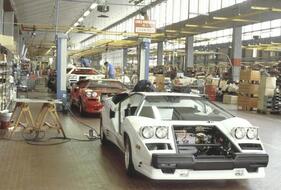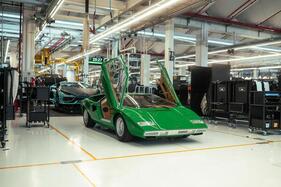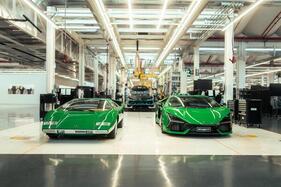

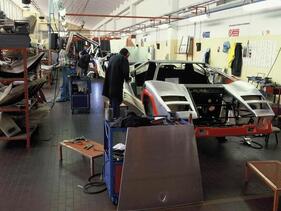
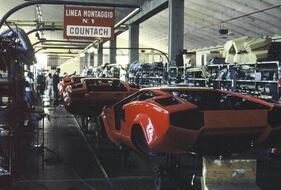
Series production of the Countach began at the Lamborghini plant in Sant'Agata Bolognese in March 1974. This model became a legend and remained on the market for 16 years. The Countach was the first model whose bodywork was manufactured by Lamborghini, the sheet metal parts were formed by hand and the interior fittings were also made in the factory's own saddlery. What was a real revolution back then has long since become a tradition 50 years later. To celebrate this anniversary in style, Lamborghini has brought the very first Countach LP 400 back to the assembly line where the Lamborghini Revuelto is produced today.
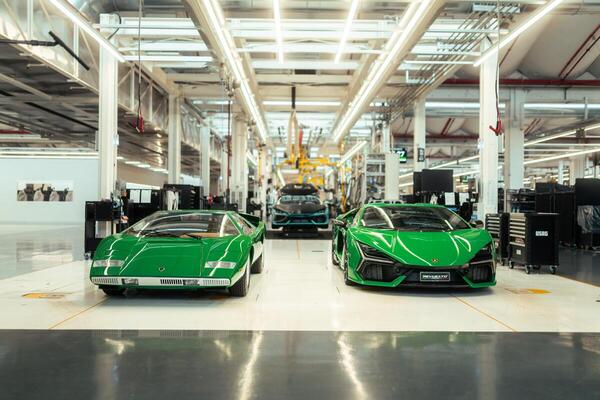
"We are proud to still produce our super sports cars where the first Countach rolled off the production line," explains Ranieri Niccoli, Chief Manufacturing Officer at Lamborghini. "Production has changed radically from the production of the first Countach to our current models, with significant changes in many areas. Today's production processes are very different from those in 1974, but the best has been retained. Today, in the 'Manifattura Lamborghini Next Level', we rely not only on the craftsmanship of our employees, but also on the best available technologies. But attention to detail is the common denominator in the production of all our vehicles."
The birth of the Countach
On March 11, 1971, the Lamborghini Countach LP 500 concept car was presented at the Geneva Motor Show. Its resounding success made the decision to go into series production an easy one. Several prototypes, three years of technical development and numerous intensive test drives later, the new production model, the Countach LP 400, was ready. While the vehicle was being developed, the production facilities for the Countach were also being set up. The Countach was also revolutionary in this respect: for the first time in the brand's history, its body was to be produced in its own factory. Until then, Lamborghini vehicles had been built at two different locations: the technical underpinnings were produced at Lamborghini, while external coachbuilders produced the bodies. These were then brought to Sant'Agata Bolognese, where they were combined with the frame and technology. The decision to bring the body shop in-house from then on had a significant impact on the company's growth right from the start.
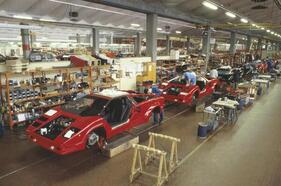
The Linea Montaggio N.1 Countach
The original Lamborghini plant comprised 12,000 square meters of built-up area, construction of which began in 1963 and was completed in 1966. From this time onwards, gearboxes and differentials were also manufactured in the company's own factory. At that time, the factory included production, offices, test areas and a workshop. Production comprised two assembly lines: one for engines and mechanical components, the other for the final assembly of the vehicles. On October 18, 1968, Lamborghini announced the imminent completion of three new factory halls, which entailed an expansion of the built-up area by 3500 square meters. Today, the factory is almost unrecognizable with an area of 346,000 square metres, but the production line of the Countach, the so-called LineaMontaggioN.1Countach, is still the same. Today, the new twelve-cylinder plug-in hybrid Revuelto is assembled there.
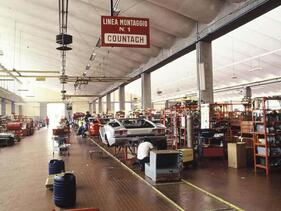
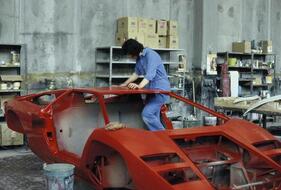
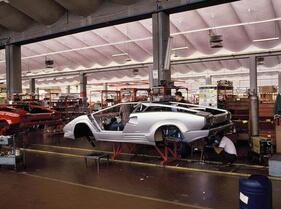
At the time of the Countach, the assembly line was still in its infancy and almost all the work was carried out by hand. After machining, the body panels were checked on a wooden model and then welded together and aligned. This final processing step was essential, as each part produced and assembled by hand differed slightly from the other parts, which only appeared to be identical. The complete body, then still made of raw aluminum, was then joined to the frame. A rail transfer car then took this assembly to the various assembly stations where the individual mechanical components were installed.
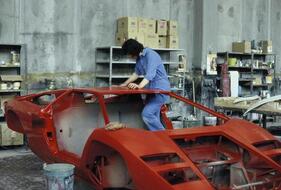
The Countach was also the first model for which the in-house upholstery shop produced interiors; before that, it was only responsible for customizing and assembling interiors from external suppliers. It eventually became an independent unit that also took over the production of leather upholstery and stitching and formed the basis for the essential personalization options that Lamborghini still offers its customers today as part of the Ad Personam program. In the meantime, the production lines have changed significantly as a result of different machines and materials being used, and the processes are much more organized, efficient and ergonomic. While aluminum was used in the seventies, carbon fiber is used today, which is also produced at the Sant'Agata Bolognese site. What has not changed is the passion and care with which the employees produce the new cars.
A common thread from the Countach to the Revuelto
Half a century lies between the Countach and the Revuelto, a period in which the volumes have also changed: In the 16 years of production of the Countach, 1999 examples as well as the LP 500 prototype rolled off the production line. In the eleven years of production of the Diablo, the number of vehicles produced amounted to 2903, while the Murciélago produced more than 4000 vehicles in nine years. Finally, the Aventador produced a staggering 11,000 units in eleven years. Despite these differences at one and the same production site, the Countach and the Revuelto have a lot in common. The overall technical concept with a twelve-cylinder longitudinal engine in the rear has remained the same. In the Revuelto, however, the battery pack has been added, which led to the gearbox being relocated behind the V12 engine. The driving settings are also unchanged, as are the scissor doors, which were born with the Countach and have become a typical distinguishing feature of Lamborghini's V12 models. In terms of design, there is also a remarkable continuity that extends from the Countach through the Diablo and Murciélago to the Aventador: the fine visual line that runs between the front fender, roof and rear is called the Countach line.
All Countach models from A to Z
The first Countach, with 152 examples produced, was the LP 400 (1974-1978), which was characterized by the fenders without wheel arch trims and the tunnel in the roof for the rear-view mirror, to which the vehicle owes its nickname Periscopio. The LP 400 S (1978-1982), with a production run of 235 vehicles, was directly influenced by the LP 400 special model, which was designed for the Canadian Lamborghini fan Walter Wolf. The LP 400 S was equipped with Pirelli low-profile tires, wheel arch trims, rims in the shape of a telephone dial and an aerodynamic attachment under the front end. This configuration, albeit in an optimized and better integrated form in the subsequent versions, shaped the appearance of the Countach in the following decade. The 5000 S (1982-1984), of which 323 units were produced, largely corresponded to its predecessor in terms of appearance, but boasted a larger displacement of 4.8 liters for the V12. The successor Quattrovalvole (1985-1988) with a production run of 631 vehicles was characterized by the hump on the hood, which was necessary to accommodate the 5.2-litre engine with four valves per cylinder. The 25° Anniversario (1988-1990) with 658 units was launched on the occasion of the company's 25th anniversary and featured completely revised aerodynamic add-on parts: Wheel arch trims, sill trims and front and rear end panels were given a completely new look. The shape of the air intakes on the rear fenders was also modified and some panels, such as those on the front and rear hatch, were made of carbon fiber for the first time. The Countach's increasing commercial success is remarkable, as is the fact that most of the last two model versions were produced - not least thanks to the Countach's approval for the US market.
The Countach not only adorned the walls of an entire generation and became the star of the silver screen in numerous films, but also enabled Lamborghini to remain competitive and achieve true legendary status during its marketing period from the mid-1970s to 1990.