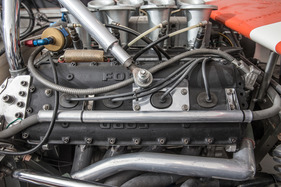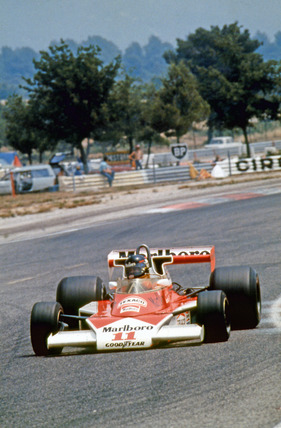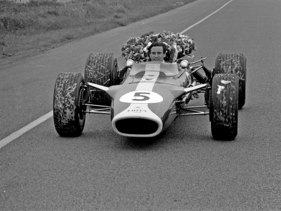
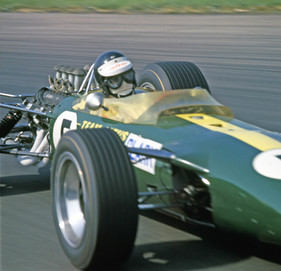
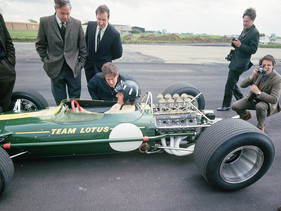
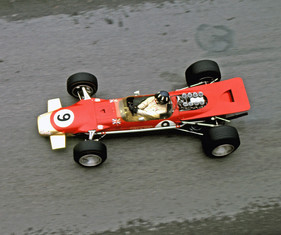
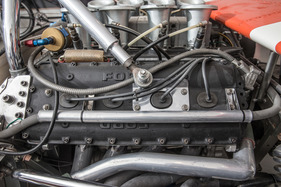
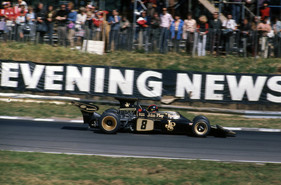
This year, one of the most successful racing engines in history is celebrating its golden anniversary - it is 50 years since the legendary Ford Cosworth DFV eight-cylinder engine made its Formula 1 debut. On June 4, 1967, Jim Jim Clark won the Dutch Grand Prix in Zandvoort in a Lotus 49-Ford. It was to be the start of an unprecedented success story. In the following 262 Grands Prix, the eight-cylinder won 155 times. Between 1968 and 1982, twelve drivers and ten racing teams won the world championship title with the Ford Cosworth V8. A full 16 years lie between the debut victory and the final Grand Prix success.
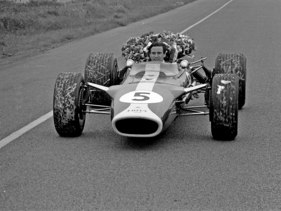
The path to this success story is closely linked to four names: the designer and Lotus founder Colin Chapman, the engine engineers Mike Costin and Keith Duckworth and Walter Hayes, who was Ford's PR director in Great Britain at the time.
For the 1966 Formula 1 season, the FIA had phased out the 1.5-liter formula and instead allowed naturally aspirated engines with a displacement of up to 3.0 liters. This meant that Lotus needed new, competitive engines. Chapman therefore turned to Duckworth, who came up with the idea of deriving a four-cylinder engine for Formula 2 from the "Kent" engine block of the Ford Cortina. This then formed the basis for the Cosworth DFV, which dominated Formula 1 in 1967.
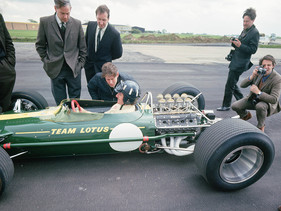
Graham Hill was brought into the Lotus team for the 1967 season and was the first to test the Lotus 49 with the brand new V8 in the rear. After the drive in Snetterton in the UK, the Brit commented: "It's got some poke, not a bad old tool".
When the Ford Cosworth DFV was finally ready for the third race of the 1967 season, Hill immediately set the first exclamation mark: In Zandvoort, he took pole position with a lead of more than half a second. Although Hill had to retire his Lotus early, team-mate Jim Clark drove from eighth on the grid to the front and gave Ford its maiden DFV victory.
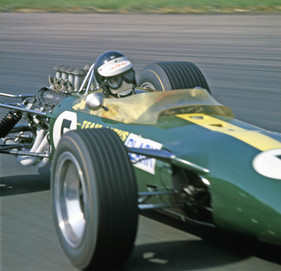
The brilliant Scot won three more Grands Prix that year, but still missed out on the World Championship title. 1968 would probably have been his year. Clark won the Formula 1 season opener in Kyalami, but then had a fatal accident at the Formula 2 guest start in Hockenheim. His Lotus teammate Graham Hill thus had the honor of going down in racing history as the first Formula 1 world champion with a Ford V8.
Other independent Formula 1 teams had long since become aware of the successful engine. Although the Ford Cosworth DFV initially produced 410 hp, less power than the twelve-cylinder engines of the competition, it had advantages in terms of vehicle balance and power-to-weight ratio. Ford did not actually want to supply the DFV to other racing teams, but in view of the outstanding performance and the outdated competition engines, Walter Hayes feared that Ford could become a victim of its own success. Victories without real opponents were of no interest to the PR strategist.
Consequently, he persuaded Colin Chapman to relinquish his exclusive rights for the 1968 season. The teams promptly queued up at Ford. The DFV became the most sought-after engine in Formula 1 history and was regarded as the backbone and icon of Grand Prix racing for decades. In addition to Lotus, McLaren, Matra, Brabham, March, Tyrrell, Hesketh, Williams, Penske, Wolf and Ligier also won over the years with the indestructible V8. Dozens of other racing teams such as Surtees, Shadow, Ensign, Kojima, Lola, Fittipaldi, ATS, Arrows, Osella and many more benefited from the technically relatively easy-to-handle modular principle with the DFV engine and the classic Hewland gearbox when building their racing cars.
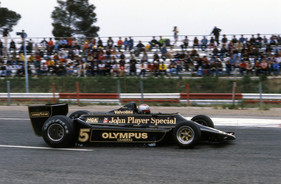
After a full decade of racing, the Ford Cosworth DFV experienced its next spring: in 1977, it was Colin Chapman again who used the special advantages of the 90-degree V8 for a revolutionary concept. The ingenious Brit invented the "wing car". The slender V-construction of the engine left enough space for the inverted wing profiles, which swept under the sidepods to just in front of the rear axle. The wide 180-degree twelve-cylinder engines of the competition did not allow for this design in its entirety.
At the beginning of the 1980s, the dominance of the epochal power unit was slowly coming to an end. Several car manufacturers entered Formula 1 with turbo engines and only the less well-heeled racing teams remained loyal to the Ford Cosworth DFV. On pure power tracks, the turbocharged 1.5-liter engines usually had the edge. On angular handling circuits such as Monaco, Long Beach, Zolder, Montreal, Brands Hatch or Detroit, the naturally aspirated V8 engine made full use of its superior response and excellent drivability. Even on tracks with fast corners such as Zeltweg, Silverstone and Hockenheim, the DFV remained capable of winning because, as described, its design enabled an optimum ground effect. In 1982, Finland's Keke Rosberg achieved the feat of winning the world championship title in a Williams-Ford against the supposedly overpowering turbo competition.
But at some point, even the best story comes to an end. In 1983, Michele Alboreto in the Tyrrell 011B showed his opponents the beautifully shaped four exhaust pipes of the DFV once again at the seventh round of the season in Detroit - it was the 155th and last Grand Prix victory for this engine. Williams-Ford (Keke Rosberg) and McLaren-Ford (John Watson) were the most loyal and successful partners of the Ford Cosworth DFV era alongside Lotus.
The V8 saw its last Grand Prix in 1985 - but instead of being consigned to the museum, it was used as a reliable and cost-effective power unit in Formula 3000. And it even contributed to overall victories at the 24 Hours of Le Mans. In 1975, a Mirage GR8 crossed the finish line at the Sarthe in first place, while the Rondeau-Ford DFV won in 1980.
Facts and figures about the Ford Cosworth DFV
V8 cylinder, 90° bank angle, crankcase and cylinder block cast in one piece from aluminum, oversquare design, double overhead camshafts (DOHC), 4 valves per cylinder, forged aluminum pistons (328 g each), valves each inclined outwards by 16° to the cylinder axis, Lucas Mk1 mechanical fuel injection with one injector per cylinder.