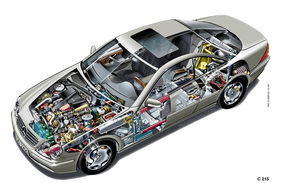
The new large Mercedes-Benz CL coupé from the C 215 model series effortlessly took the stars from the sky 25 years ago. Even at its premiere at the Geneva Motor Show in March 1999, the public was enthusiastic. The press drive presentation in the south of France in the fall reinforced this impression. As a world first, the Coupé features the Active Body Control (ABC) active suspension system, a Mercedes-Benz development for maximum dynamics and comfort. Mercedes-Benz Head of Design Bruno Sacco and his team are responsible for the design. The C 215 model series is one of the brand's last cars to bear the signature of this influential stylist.
Pioneering chassis with Active Body Control
"Active Body Control is perhaps the vehicle's greatest innovation," says Frank Knothe, looking back. The engineer and model series manager for the Mercedes-Benz S-Class, SL and SLK carried out the overall tuning with his team. "With ABC, the CL is not just a luxurious coupé, but also displays sporting genes and comes very close to exclusive Gran Turismo vehicles in terms of its overall characteristics."
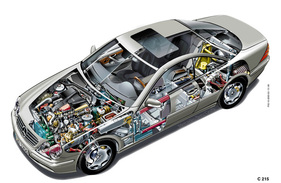
With a 200-bar high-pressure hydraulic system and powerful sensors and controls, ABC minimizes rolling, pitching and lifting movements of the bodywork, thus increasing the driver's safety in terms of physical condition. The company's research department developed the system in the 1990s. Due to its high level of effectiveness, it is transferred directly to the C 215 series vehicle. "With Active Body Control, we have opened a new chapter in comfort combined with active handling when driving. Due to the short time available, series development was a major challenge. But the result was worth it," says Knothe.
Exquisite design meets lightweight construction
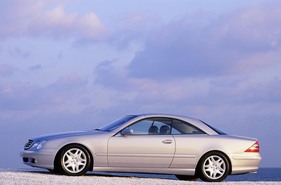
The design of the CL is also impressive. It looks out into the world with four headlights, its elongated silhouette and curved roofline emphasize the dynamism of the coupé. The designers have achieved a feat: the body of the C 215 is 72 millimetres shorter, 55 millimetres narrower and 54 millimetres lower than its predecessor, the C 140, and the wheelbase is 60 millimetres shorter. However, with interior dimensions at S-Class level, the CL meets the highest demands in terms of spacious comfort. The lightweight construction concept with high-strength steel, aluminum, magnesium and plastic reduces the vehicle weight by 340 kilograms compared to the C 140.
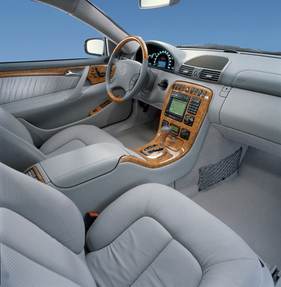
Its position at the top of the Mercedes-Benz model range is reflected in the equipment of the CL, which is built on a separate line at the Sindelfingen plant. The instrument panel, seats, door and side panels as well as the armrest of the center console are upholstered in leather as standard. The interior is further accentuated by an abundance of wood. From spring 2001, designo stone trim parts will be available for the interior of the CL.
Top-of-the-range AMG model with V12 biturbo engine
The CL 500 with a V8 engine and an output of 225 kW (306 hp) goes on sale in October 1999. The 270 kW (367 hp) CL 600 with a newly developed V12 engine with automatic cylinder deactivation follows in 2000. Fuel consumption is reduced by around 20 percent compared to the predecessor model in the C 140 series. Cylinder deactivation is also available as an option for the CL 500.
In addition to the CL 500 and CL 600, there are two AMG high-performance versions in the C 215 model series: The V8 model CL 55 AMG (265 kW/360 hp) is presented in late fall 1999, the twelve-cylinder version CL 63 AMG (324 kW/444 hp) follows in 2001. In 2003, the CL 65 AMG with V12 biturbo engine, 450 kW (612 hp) and 1000 Newton meters of torque became the top-of-the-range model. The high-performance coupé is one of the two most powerful cars in the history of AMG and Mercedes-AMG to date - alongside the S 65 AMG saloon, which is presented at the same time.
Innovations in the sporty and luxurious model series
Active Body Control is not the vehicle's only technological innovation. The luxury-class coupé also has the ESP® Electronic Stability Program, ASR traction control, the ABS anti-lock braking system and BAS Brake Assist as standard. In addition, there are innovative bi-xenon headlights with cleaning system for high and low beam and the PARKTRONIC system. Numerous airbags protect the passengers, while integral seats for the driver and front passenger with easy-entry function contribute to comfort.
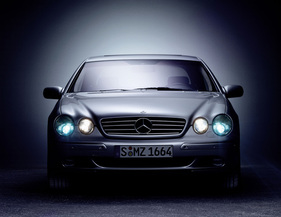
A new four-joint door hinge ensures easy entry and exit. "It looks inconspicuous, but the hinge is the result of considerable engineering effort. It's a challenging solution if the aim is to keep the door opening gap as small as possible," recalls Frank Knothe. An electronic tire pressure monitoring system, DISTRONIC adaptive cruise control and other solutions such as the Keyless Go driving authorization system based on a chip card are available on request.
By February 2006, 47,984 CL models of the C 215 series had been built - a successful chapter in the history of luxurious sportiness at Mercedes-Benz. The best-selling model is the CL 500 with 32,224 vehicles, accounting for more than two thirds of total production.
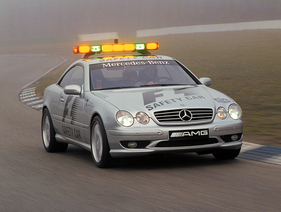
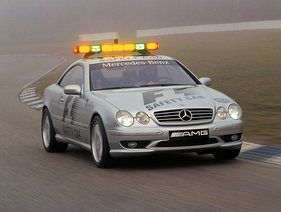
The C 215 also makes a career for itself on international racetracks. In the 2000 Formula 1 season, a modified Mercedes-Benz CL 55 AMG is used as the Official F1™ Safety Car. From fall 2000, Mercedes-Benz offers the CL 55 AMG "F1 Limited Edition" based on this safety car to customers with sporting ambitions. The coupé is limited to 55 units and has highly exclusive equipment. It is the world's first road-legal vehicle with a braking system featuring internally ventilated brake discs made of fiber-reinforced ceramic.