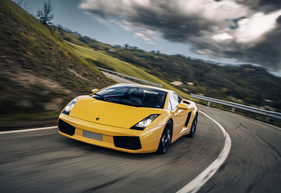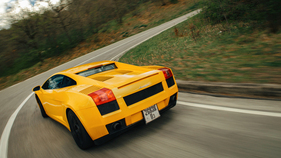
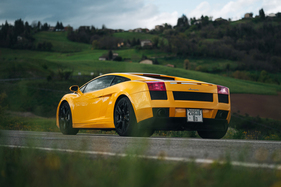
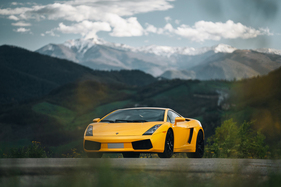
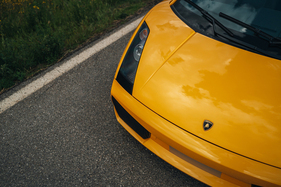
Unveiled at the Geneva Motor Show in 2003, the Gallardo was the first Lamborghini production car with a V10 engine. It became an incredible commercial success right from the start, setting sales record after sales record for Lamborghini. On the occasion of its 20th anniversary, Automobili Lamborghini looks back on its history to celebrate the iconic "baby Lambo".

Ferruccio Lamborghini had already recognized that there was a market for a "smaller" Lamborghini with lower purchase and maintenance costs in particular. In the early 1970s, he initiated the development of the later Urraco, which evolved into the Jalpa in the 1980s.
The history of the "small" Lamborghini with a big impact
In 1987, Lamborghini initiated the development of the L140 project, which was specifically aimed at creating a more compact Lamborghini. Over the years, several prototypes were developed and various technical solutions were tested, including first a V8 and later a V10.
In 1998, after careful consideration, it was decided to start from scratch. Only the concept, the general dimensions and the idea of the ten-cylinder engine, which had never before been installed in a Lamborghini road car, were retained as the basis.
The brand new engine was the result of the work of engineer Massimo Ceccarani, who became Technical Director after more than ten years with the company. Meanwhile, Maurizio Reggiani was responsible for engine development and design in the technical department at the time.

"The L140 had a V10 engine developed by Lamborghini with a 72-degree bank angle and a gearbox integrated into the oil sump area," recalls Maurizio Reggiani, Technical Director of Lamborghini from 2006 to 2022. "It was not practical to produce for the type of vehicle for which it was intended. It also had a high center of gravity due to the position of the gearbox under the engine, which would not have led to the driving characteristics that a Lamborghini super sports car should have. That's why we opted for a V8 engine when we launched the project with the code name Baby Diablo. We decided to look for a possible engine among those already available on the market, including the eight-cylinder from Audi. In the course of the subsequent takeover by Audi, it was decided to develop a completely new vehicle. It was to have an aluminum tubular frame, a ten-cylinder engine developed by Lamborghini and a brand new transmission in manual and automatic versions."

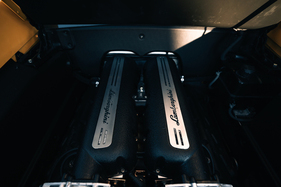
The power unit installed in the first Gallardo was a ten-cylinder DOHC engine with four valves per cylinder, a 90-degree bank angle and five liters of displacement, which produced 500 hp. Instead of the classic 72-degree V, a 90-degree bank angle was chosen to reduce the overall height of the engine. This in turn had positive effects on the vehicle layout, namely a flatter hood and better visibility to the rear, and lowered the center of gravity in the name of improved dynamics. Crankpins with an offset of 18 degrees ensured regular ignition intervals and thus the smooth running of the engine. A dry sump lubrication system not only ensured perfect oil supply even under extreme dynamic conditions, but also enabled a further reduction in the center of gravity.
"In order to be able to produce the planned number of units, the V10 had to have a bank angle of 90 degrees," explains Maurizio Reggiani. "That's why we opted for a so-called split-pin crankshaft, which ensures even ignition even with a cylinder bank angle of 90 degrees. The crankcase, which up to this point had been planned with retracted liners with Nikasil coating, was completely revised and redesigned by the Lamborghini engineers. It was made from a hypereutectic cast aluminum alloy, which allowed the liners to be incorporated directly into the aluminum block. This made it possible to reduce the distance between the cylinders and thus also the length, weight and cost of the engine. The result was the V10 engine with a 90-degree bank angle, multi-point injection and a displacement of five liters, which was installed in the first Gallardo series."
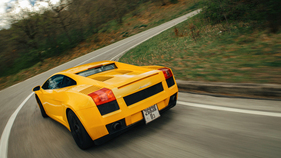
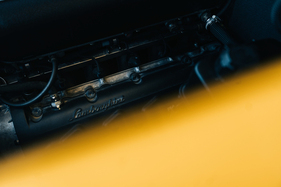
The first V10 was therefore a state-of-the-art engine: five liters of displacement with dry sump lubrication, double overhead camshafts for each cylinder bank with variable timing of the four valves per cylinder and chain drive.
The six-speed gearbox located behind the engine was equipped with the latest generation of double and triple-cone synchronizers with optimized control and engagement systems. The all-wheel drive was based on the tried-and-tested VT system. In addition, the Lamborghini E-Gear sequential gearbox was developed as an optional equipment element, although the basic transmission mechanics remained unchanged.
The all-aluminum frame is based on extruded parts that are welded together with cast connecting elements. The outer body parts were mounted on this frame using various methods - riveting, bolting or welding. Other add-on parts, such as the bumpers, were made of thermoplastic and attached using bolts.

The design project began in 2000 and was based on an initial proposal by Italdesign-Giugiaro. It was then optimized and completed by the newly founded Centro Stile Lamborghini under the direction of Luc Donckerwolke. The designers had the challenging but fascinating task of identifying Lamborghini's design features and combining them into a completely individual whole. The dimensions of the Gallardo and its performance goals gave it an athletic, compact look. The vehicle's wheelbase and shortened overhangs made for a more dynamic appearance. A key aspect of the Gallardo's iconic design, which can also be found in the Murciélago introduced in 2001, is the strong influence of aviation: it can be seen in the cockpit, which is moved forward and integrated into the body, the flat sloping windscreen with tensioned pillars, the complex flat surfaces with clear markings and the orientation of the cooling system elements in the direction of the airflow.
But what really set the Gallardo apart when it was launched was its performance combined with driveability and reliability. It was also so suitable for everyday use that it could be comfortably used as a daily driver.
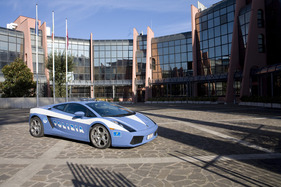
In May 2004, the Gallardo started the Lamborghini tradition of "donating" vehicles to the Italian police. The cars were mainly used for special purposes such as the transportation of organs or life-saving medicines.
In 2005, two years after the market launch of the coupé version, Automobili Lamborghini presented the Gallardo Spyder at the IAA in Frankfurt. It was not simply the "open" version of the Coupé, but a completely new model with a brand new opening and closing mechanism for the soft top, which also incorporated the hood of the vehicle. The Lamborghini Gallardo Spyder also brought important innovations in terms of engine, transmission and performance. Its ten-cylinder engine with a displacement of 4961 cubic centimeters now produced an output of 520 hp (382 kW) at 8000 rpm. The six-speed manual gearbox, which was also optionally available as an automated E-Gear, now had a shorter gear ratio, which resulted in more dynamic handling. From the 2006 model year, the new engine characteristics were also available in the coupé version.

The Gallardo Superleggera was presented in Geneva in 2007, when the "Baby Lambo" broke the 5000 units produced mark. The new model was even more dynamic thanks to an increase in power of ten hp and a weight reduction of 100 kilograms, achieving a power-to-weight ratio of just 2.5 kilograms per hp. The Superleggera was equipped with the automated manual gearbox as standard, which became an integral part of all subsequent models. It was available in four colors at no extra charge: Giallo Midas (yellow), Arancio Borealis (orange), Grigio Telesto (grey) and Nero Noctis (black). In addition, the Superleggera featured a host of carbon fiber parts to ensure significant weight savings. In addition to the fixed rear wing as an iconic equipment option for this model version, this also included carbon-ceramic brakes.
The LP 560-4 was presented at the Geneva Motor Show in March 2008. The revised version of the Gallardo was 20 kilograms lighter and equipped with a 5.2-liter V10 engine with a maximum output of 560 hp and direct injection. Also in 2008, production figures for the Gallardo reached the 7100 mark. At the Los Angeles Motor Show in November of the same year, the open-top LP 560-4 Spyder version followed with the same technical specifications. The new engine featured some important and unexpected technical changes, as Maurizio Reggiani explains: "For the successor version of the Gallardo with a 5.2-liter engine, it was decided to modify the geometry of the crankshaft by abandoning the split-pin design. As a result, we accepted an irregular firing order in favor of greater crankshaft rigidity. We also introduced gasoline direct injection technology, which increased efficiency in the combustion chamber and led to higher performance and lower emissions."

In 2009, after 9000 units had already been produced, Automobili Lamborghini presented the Gallardo LP 550-2 Valentino Balboni. Only 250 units were produced, characterized by a technical solution never before seen on this model: 550 hp and rear-wheel drive. Following numerous requests from customers, the Gallardo LP 550-2 was subsequently produced as a series model (2010) and in a Spyder version (2011). In order to emphasize its unique character, the engineers from Sant'Agata Bolognese reworked all driving dynamics components after installing the rear-wheel drive. These included springs, dampers, stabilizers and tires. Due to the changed power flow, the changes also affected the aerodynamics of the vehicle. The rear axle differential was brought up to date and significant changes were also made to the ESP dynamic stability control system.
In March 2010, the Gallardo LP 570-4 Superleggera was presented in Geneva, which was more dynamic, lighter, more powerful and more fascinating than ever before. The LP 570-4 was presented with the aim of building on the success of the 2007 version of the same name. It was 70 kilograms lighter than the previous Superleggera and equipped with a 570 hp (419 kW) engine, reducing the power-to-weight ratio to 2.35 kilograms per hp. The changes to the exterior were made solely to improve aerodynamics. The design increased the air flow through the radiators and enabled higher downforce on the front axle. Changes to the underbody, the use of side skirts and the new rear diffuser made of carbon fiber contributed to improved aerodynamics. In addition, the downforce on the rear axle was balanced out by the use of a fixed rear wing. In 2010, two more cars with the same engine were presented: the even lighter LP 570-4 Spyder Performante with a total weight reduced by 65 kilograms compared to the LP 560-4 Spyder and the Gallardo LP 570-4 Blancpain Edition. The latter combined the competitive spirit of the Lamborghini Blancpain Super Trofeo one-make championship initiated in 2009 with perfect handling on the road and an exclusive design inspired by the Super Trofeo.

In 2012, Automobili Lamborghini presented two variants of the updated model at the Paris Motor Show. These variants were even bolder and more extreme: the new Gallardo LP 560-4 and the Gallardo LP 570-4 Edizione Tecnica represented a further stylistic evolution of Lamborghini's first V10 model.
In January 2013, the development of a new GT3 program based on the Gallardo of the 2013 model year was announced. In the same year, the Gallardo LP 570-4 Squadra Corse was presented at the IAA in Frankfurt. This new, limited edition model was also the most extreme of the Gallardo series. It was inspired by the Gallardo Super Trofeo, which was entered in the Lamborghini Blancpain Super Trofeo one-make championship.
On November 25, 2013, the last Lamborghini Gallardo rolled off the production line at the historic site in Sant'Agata Bolognese. The last example built was a Gallardo LP 570-4 Spyder Performante in the color Rosso Mars (red).
Over the ten-year production period, the Gallardo was built in numerous special models, sold in 45 countries and, taking all 32 variants together, a total of 14,022 units were produced. These figures make the Gallardo one of the most highly regarded super sports cars of all time. It is guaranteed a place among the icons of Italian design and automotive engineering.