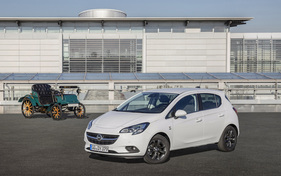
In 2019, Opel is celebrating 120 years of automotive engineering - and 120 years of innovations for everyone. The brand with the lightning bolt has a tradition of putting technical achievements on the right track and quickly into series production. This makes mobility affordable for the masses - and the product range safer, cleaner, more comfortable, more practical and even more far-sighted.

The 120th anniversary campaign "Opel. Born in Germany. Built for all of us." The first model, the Opel Patent Motor Car "System Lutzmann" from 1899, carried this basic idea, as did all Opel vehicles that followed over the decades, from the "Doktorwagen" to the "Laubfrosch" and P4 to the Kadett.
"Opel has been democratizing mobility for 120 years. We make pioneering technologies and comfort features in our cars affordable for all groups of buyers. This is what we stand for and the Corsa is the best example of this! Thanks to our anniversary model range, everyone can find their favorite - extensively equipped and at top conditions," adds Duchemin, Head of Sales and Marketing at Opel.

Since 1899: everyday practicality before technology as an end in itself

The Opel Corsa in general and the Corsa "120 Years" in particular show that it is part of the Opel brand essence to always offer customers more than they expect in the respective vehicle class. The foundation for this was laid at the end of the 19th century with the Opel Patent Motor Car "System Lutzmann". The short price list for this model already included two innovative extras: firstly, pneumatic tires, which had already been invented by Robert William Thomson in 1845, but had not yet been widely used in automobile construction. Secondly, a removable child seat was available on request. This example alone makes it clear what Opel was all about right from the start: unadorned suitability for everyday use instead of technology as an end in itself. Thanks to its 4 hp single-cylinder engine, the car was already capable of 30 km/h.
First "small car" in the history of the automobile

The Opel 4/8 PS sang the praises of affordable mobility in 1909. It was so modern and at the same time solid in terms of technology that ambitious car owners could drive it themselves and no longer needed a chauffeur - which made the overall maintenance of the car considerably cheaper. The quality of the materials and workmanship inspired confidence. The first officially designated "small car" in automotive history was considered fully suitable for everyday use. According to the advertising of the time, it was the ideal vehicle for "doctors, vets and lawyers" and was available at prices of between 4,000 and 5,000 marks, while other manufacturers' models cost around 20,000 marks. The means of transportation for the upper ten thousand thus became a vehicle for the middle classes - thanks to the "doctor's car".
In 1924, the Rüsselsheim-based company moved even closer to the "average Joe" - also thanks to an innovation. The 4/12 PS heralded the start of assembly line production in the German Reich. And because the 60 km/h car was only available "in a calm green that was pleasing to the eye" in order to consistently minimize costs, everyone called it the "Laubfrosch". Soon 25 two-seater "cars for everyone" were hopping off the production line every day. In the years that followed, an entire family of vehicles was built on the Laubfrosch technology. The smoother production ran, the greater the cost advantage that Opel passed on to customers. Unbelievable but true: the purchase price of the 4-PS series, of which a total of 119,484 were produced, was almost 40 percent lower in 1931 than at the Laubfrosch model launch.
Volkswagen with top drive technology at a low price

In 1935, the time was ripe for the Volkswagen - from Opel, mind you. The P4 presented in November rolled off the production line shortly afterwards. The four-seater with a four-cylinder, four-stroke engine cost just 1,450 marks in the standard version. "How was it possible to deliver such high value for so little money, a real fully-fledged car?" The answer to the riddle: state-of-the-art mass production. This was also applied to the Kadett 1 shortly afterwards.

This took over the design of the Opel Olympia and was one of the first German cars to have a self-supporting all-steel body. This was more comfortable, safer and more durable than the frame bodies that had been common until then.

The legitimate heir from 1962 was the Kadett A. The low maintenance costs were expressly part of the recipe for success of the two-door notchback model. The lines were modern and businesslike, right down to the practical "arrow corners" at the rear. At the same time, the interior space was anything but typical of a small car. The advertising promised "well-shaped seats and plenty of legroom. With its modern, water-cooled front engine, the Kadett offered a further design advantage over the Beetle. "Opel Kadett, in short: O.K." - Opel produced almost 650,000 units by 1965 alone.
Creating a lot of space in a small area

In 1982, Opel once again made a big hit with a small car: the Corsa A was added to the range below the Kadett, which had now outgrown the compact class. Just 3.62 meters long, a record-breaking drag coefficient of cw = 0.36 and wheel arches in the style of a rally car were the hallmarks of the new creation by chief designer Erhard Schnell
In fact, the Corsa demonstrated how virtuously the Rüsselsheim-based company could and still can create a lot of space in a small area and how pronounced economy and maximum driving pleasure could be combined. The highlight was the GSi with 100 hp. The Corsa A, originally designed for newcomers and sharp calculators, became a top seller, with a total of 3.1 million sold by 1993.
Corsa passes the 14 million mark on the road to electromobility

To this day, Opel stands firmly in the middle of society and offers components across all classes that are otherwise reserved for expensive premium vehicles. The Corsa, right up to the current fifth generation, is a prime example of this democratization of individual mobility. Thanks in part to the special "120 Years" model, which already comes with a host of state-of-the-art technologies as well as design and comfort features as standard, the Corsa is targeting 14 million registrations in Europe. In a few months, the next generation of the dynamic small car will be launched, including a purely electric version for the first time. The Corsa 2019 thus continues the Opel story of 120 years of automotive engineering and mobility for millions with a memorable and groundbreaking chapter.
Click here for the original press release