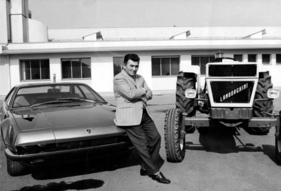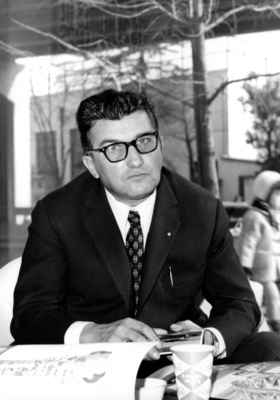
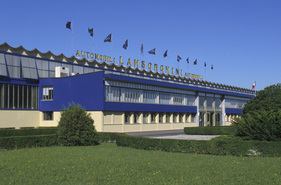
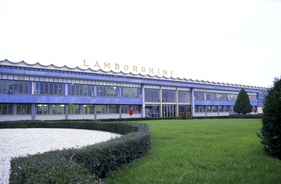
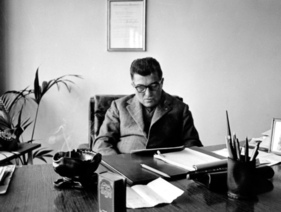
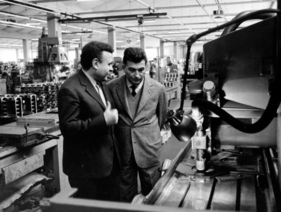
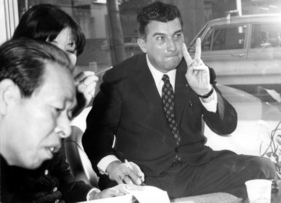
Automobili Lamborghini is celebrating the 105th birthday of its founder Ferruccio Lamborghini, a key figure in the history of the company, not only because of its foundation in 1963, but also because he was the source of ideas for iconic models such as the Miura and the Countach, driven by a relentless desire to improve and innovate. When Ferruccio Lamborghini sold the company in 1973-1974, which was already an established and highly esteemed car manufacturer, he left behind this same desire for constant innovation and an intolerance of entrenched habits that still characterizes the company today.
No desire to follow in the family's footsteps
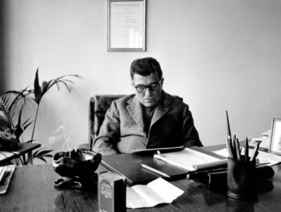
Ferruccio Lamborghini was born on April 28, 1916 in Renazzo, a district of the municipality of Cento (province of Ferrara). He was the first-born son of farmers Antonio and Evelina Lamborghini and his fate seemed predestined, as tradition dictates that the first-born inherits the family estate. However, the young Ferruccio felt more drawn to mechanics than to farm work and from an early age preferred to spend his afternoons in the farm workshop. As all those born under the sign of Taurus are said to be, Ferruccio was determined, persistent and convinced of his ideas, and as a young man managed to get a job in one of the best workshops in Bologna, where he was finally initiated into all the secrets of mechanics. After the outbreak of the Second World War, Ferruccio, already an experienced and valued mechanic, was called up and sent to the 50th motor pool stationed on Rhodes, where all the military vehicles on the island were serviced, including the trucks with diesel engines and the tractors used to tow the planes. Ferruccio successfully repaired Italian, German and British vehicles (and occasionally damaged them, as he would later recall) during the changing course of the war. After the end of the war, he opened his first business on Rhodes: a small mechanical repair workshop.
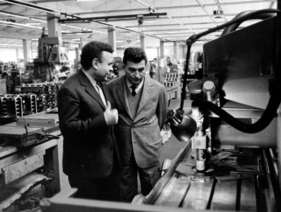
In 1946, he returned to Italy and, taking advantage of tax breaks to support the economic upturn, opened a mechanics workshop in Cento, where he repaired vehicles and refurbished small cars. While working in the workshop, he was able to observe the effects of the crisis facing local agriculture. Thinking about the tractors he had repaired on Rhodes, Ferruccio Lamborghini had an idea: to build inexpensive tractors for agriculture from parts of old military vehicles that would also be affordable for small landowners. His first converted vehicle was a Morris, in which Ferruccio installed a fuel evaporator of his own invention in addition to the main modifications. It was presented on February 3, 1948 during the patron saint's festival in Cento. He sold 11 of them. Thanks to this success, the entrepreneur Ferruccio Lamborghini, who borrowed from the bank to buy 1000 Morris engines and gave everything he owned as a guarantee, including the family estate with his father's blessing, established himself.
Stubborn and strong as a bull
When Ferruccio Lamborghini, already one of Italy's most important industrialists, decided in 1963 to produce the best Gran Turismo cars in the world, the need arose to find a suitable logo to identify them. Until then, the tractors had used a very simple trademark in silver under the Lamborghini lettering: a triangle with the letters FLC (Ferruccio Lamborghini Cento). Ferruccio turned to the renowned local graphic designer Paolo Rambaldi, who asked him about his personal characteristics. "I'm as stubborn as a bull" was Ferruccio's answer (the dialect word he used, "tamugno", means hard, strong, stubborn) and so the Automobili Lamborghini logo, now famous the world over, was created in reference to his star sign.
Inventiveness and technical curiosity (today we would say innovation) remained the distinguishing feature of Ferruccio Lamborghini and the people around him, often the best engineers in the world. The Miura rewrote the history of Gran Turismo cars in 1966, forcing journalists to invent a new word to describe it: thus the term supercar was born. Developed as a prototype in 1971, the Countach was so advanced that it was still modern in 1990 when, after 17 years and 1999 units produced, it was replaced by the Diablo, Lamborghini's first super sports car, which was also available in a four-wheel drive version.
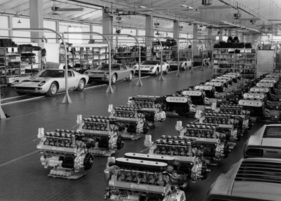
Ferruccio had not been with the company for years, but his spirit, in line with the conviction that even the best can be improved, and his absolute determination to break new ground, remained: 2018 saw the premiere of the Urus, the first super SUV to open up new markets, and finally in 2020 the Siän, the first Lamborghini with hybrid technology and 12 cylinders, in which supercapacitors store and deliver electrical power quickly and efficiently. Ferruccio, who passed away on February 20, 1993, would be proud.