

Anyone who initially puts the outwardly historically appealing but unspectacular building in the "look, another automobile museum" drawer is sure to be in for a surprise or two.
Nobody expects to be greeted with the words "Cars don't belong in a museum" at a place like this, especially as it comes from the mouth of the museum's founder. However, the second part of the sentence "They belong on the road!" shows the direction that is being taken here in Melle near Osnabrück.
As technical museums are generally not in a position to preserve the exhibits and the associated specialist knowledge for the future for financial and personnel reasons, a different approach is being taken in Melle.
Classic cars ready to drive at any time in constant rotation
The vehicles exhibited by friends and sponsors of the museum must be ready to drive and are exhibited for a maximum of 6 months, after which they must make way for other vehicles. The idea behind this is simple: regular and appropriate use of the cars not only preserves the cars themselves, but also the specialist knowledge associated with them. The fascination of historic technology can also be conveyed in a much more impressive and lasting way, and the ongoing use and care of the vehicles explains their good technical condition.

A nice side effect: the attraction of seeing other vehicles here again and again attracts numerous classic car enthusiasts from near and far. And not just once, but regularly. But if you come to Melle, one thing is already certain: you won't find most of the vehicles shown in this article. But almost more interesting than the collection itself are two world-famous regular events at the Automuseum, but let's take them in turn.

Let's start with the museum, which is now housed in the rooms of a listed industrial building of a former furniture factory. The building opposite not only houses the vehicle collection needed to fill the gaps created by the use of the museum vehicles, but is also home to two businesses that are independent of the museum and specialize in the restoration and fine-tuning of top-class automobiles such as Hispano Suizas, Bentleys from the 1920s, Bugattis and racing cars.

The museum's all-volunteer staff offer expert guided tours. The fascinating setting can be booked for events and, last but not least, the operation of the cafeteria also guarantees a cozy part for all visitors.
Incidentally, the history of the baby carriage began at almost the same time as that of the automobile. It was therefore a stroke of luck to be able to integrate a comprehensive collection of historical baby carriages.
A collection of model airplanes and countless model vehicles ensure that there is something for all members of the family - no one is left out. Let's take a look at some of the exhibits that simply catch the eye.

History on wheels
An entrepreneur from Osnabrück wanted to revive the Pierce-Arrow brand, which was famous in the early days of the automobile. Among other things, it had become famous for its cast aluminum bodies. He commissioned Lugi Colani with the task of designing a spectacular car body. This awaits visitors on the second floor. The design is based on the "ground effect", which is highly valued in racing car construction today and which sucks the floor of the car onto the road without having to pay for this with a significantly higher air resistance, as is the case when using a spoiler. However, the 2008 study on display never went into production.

The extensive collection of electric vehicles shows impressively that this drive concept has a long history. The so-called electric carts were once widely used in railroad stations and industrial plants. Among them is the "Eidechse" from the Leipzig-based company Bleichert, which is steered with the feet. Driving in a straight line is a demanding task, so the name "Eidechse" (lizard) fits quite well. Today, the TÜV and the employers' liability insurance association would surely suffer a nervous breakdown at the sight of these vehicles, let alone when they were inspected.
While it took Porsche until the end of the 1990s to offer water-cooled boxer engines, the Schatz, a typical high-wheeler, already had one 90 years earlier. The 22 hp two-cylinder engine has 6 oil pumps, a friction gearbox that allows the transmission ratio to be changed continuously, as well as genuine internal shoe brakes. It was therefore much more technically sophisticated than competing products at the time. However, the theoretical top speed of 60 km/h was not really to be exploited due to the limited lateral guidance forces of the narrow tires and the fact that the wheels and body were made entirely of wood.
In 1901, Henry Joy bought a Packard and was thrilled. He became friends with James Ward Packard, took a stake and soon owned the entire company. He also came up with the famous advertising slogan "ask the man who owns one". However, the team was only complete with Jesse Vincent, who created the famous Twin Six, the world's first twelve-cylinder engine. With the use of aluminum pistons for the first time at the time and a helical-toothed, quiet rear axle, the car made engineering history. The automatic ignition advance and electric starter made driving the car easier and it quickly became one of the most important luxury cars between the world wars.

The car on display in Melle is one of the few surviving examples from the first series. In the type designation "1-25", the 1 indicates the construction series, the 25 stands for the wheelbase (125 inches = 317.5 cm). One of the few permanent guests is a museum-owned vehicle with steam drive, which brings us to the next topic.
Steam in Melle - The Melle steam car meeting

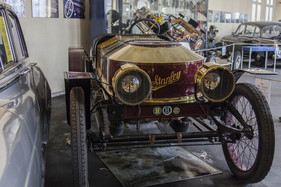
With this 1919 Stanley 735B, the enthusiasm for steam-powered vehicles in Germany was revived in Melle after many decades of abstinence. The idea of sharing this enthusiasm with other steam car owners led to the first big outing almost 20 years ago. There are now 15 of them, with enthusiastic participants from all over the world. Just watching the "steam cars" being unloaded from the trailer is fun and makes you want more. At the meetings themselves, there are significantly more steam-powered vehicles on display than in the building, which is in keeping with the museum's philosophy. However, Stanley's advertising at the time is probably no longer up to date today, as the car was advertised with the slogan: "Our cars are so easy to operate, you can even entrust them to your wife".
As the event lasts several days and takes place not only on immaculate asphalt roads but also on country lanes and mountain passages with considerable inclines, the historic vehicles and their crews have to put up with a lot. The one or other inevitable problem is immediately solved pragmatically. It seems strange at first, for example, when the driver of a car first buys an old copper can to replace a broken seal, but half an hour later a new seal has been made from the material and the journey can continue. There are no replacements here, repairs are still carried out in the old style, which is particularly interesting for younger visitors.
The tranquil pace of the carriage-like vehicles is met with spontaneous sympathy everywhere, even cyclists happily make way for the steam mobiles on the way out and wave behind them. Anyone who wants to indulge in the fascination of this technology is recommended to purchase the CD "Dampf in Melle", which lovingly captures the charm of the meetings. And that brings us to the third part of this article.
Schnauferl hike as another highlight
In addition to the excursion for steam-powered vehicles, owners of vehicles from the early days of the automobile's triumphant advance regularly meet here for a five-day Schnauferlausfahrt, which took place for the 23rd time in July 2014.

Three friends from Finland had the longest journey last year with a yellow Tin Lizzie and although there is no advertising in the local media, the crowds are overwhelming every time. It is impressive to see how the exchange of opinions and information about far more than just veteran vehicles is cultivated across all languages and age groups at the meetings - this is how friendships for life are formed.
Exotic vehicles such as the narrow 1914 Wanderer Püppchen, in which the passenger has to sit behind the driver, or the three-wheeled Leon Bollée from 1896 can be seen just as regularly as luxury vehicles of the Delaunay-Belleville type or a Stanley Mountain Wagon from 1913, which can seat twelve people. A Brennabor Type A, which my grandfather once raved about to me, was also there last year. These are all vehicles that really deserve their "H-Kennzechen". Seeing all of this together in one place explains the great attraction of this event. And there is much more to tell here too...
On a steep uphill section, for example, the driver of a Grégoire had to dig deep into his bag of tricks; his car initially stopped working because its rear fuel tank was lower than the carburetor on the hill ... and it's not just new vehicles that run out of fuel. Reverse gear was the solution to the problem and the journey continued.
Of course, the individual vehicles were presented to an inquisitive audience not only with their technical data but also with details of their varied history, for example the Sypiker of one participant who had already completed the entire route from Beijing to Paris twice.
Also worth mentioning is the 1921 Berliet VIL Sahara sandproof expedition vehicle, which features twin rear tires, sandproof brakes, a 3.3 l engine with 30 hp and a vacuum fuel pump, as well as a starter/alternator combination that differs from the series, to name just a few highlights.
A successful event for lovers of technical details, especially as the proud owners are happy to provide information about their treasures. In the evening, the "firefly ride" by the light of the carbide lamps leads back to the museum where an appropriate shelter awaits the veterans. The event is like a journey back in time and these impressions will never be forgotten by participants or spectators.

The concept of actively living the classic car passion and passing on the enthusiasm for it really works in Melle. Imitation is requested.
More information about the museum can be found on the website: www.automuseum-melle.de