The Tour Auto is one of the most prestigious classic car racing events, mentioned in the same breath as the Mille Miglia or the Monaco Grand Prix Historique.

No wonder, because when almost 300 top-class cars come together in a starting field to drive through half of France, it is certainly a special event, especially as half of the field is racing for the best times (on the special stages).
An event steeped in history
As early as 1956, one could read in the German magazine "Auto Motor und Sport":
"When one speaks of the Tour de France, one thinks first and foremost of the cycling competition that excites the minds of the French every year, right down to the last village. The Tour de France for cars, on the other hand, used to be regarded as a nice long-distance race without any particular international significance, albeit one with high cash prizes. Well, that all changed at this year's Tour de France for cars, which went far beyond the scope of an average long-distance stage and became an interesting competition in its own right. When drawing up the regulations, the French had their own idea of a modern motor sport stage. They combined a full-blown long-distance drive of 5383 km with numerous special stages, which were held in the form of pure races on the most famous French circuits and mountain roads."

Even with the reinterpretation by Patrick Peter (Peter Auto) from 1992, little changed in this characteristic; vehicles of the types that took part in the Tour between 1951 and 1973 are eligible to start. Incidentally, the Tour de France Auto was renamed the Tour Auto decades ago due to the risk of confusion with the cycle race. From 1975 to 1986, it was held as a typical rally and no longer as a road race.
Wide-ranging starting field
Several thousand cars took part in the Tour in the 1950s to 1970s, making it much easier to find a suitable participant vehicle than in other sporting events. Over the years, ordinary Renault or Peugeot models took part in France, as did the Deux-Chevaux from Citroën or famous sports cars from Ferrari, Porsche, Maserati, Alfa Romeo or Jaguar.

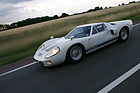
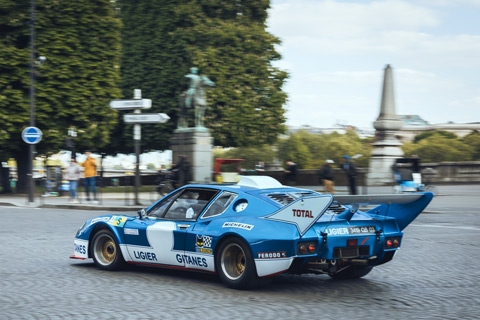
Almost thoroughbred racing cars were also at the start, such as the Matra 650, the Ligier JS2 or the Ford GT40.

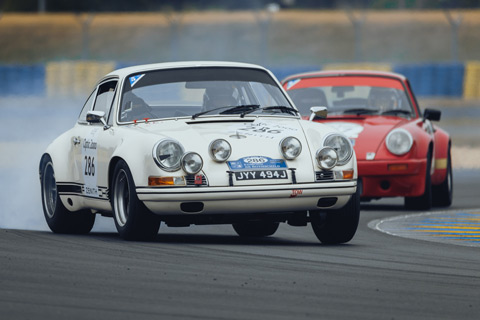
The starting field for this year's tour was just as broad, with "exotics" such as a 1953 Sunbeam Alpine, a 1952 Citroën 2 CV, a 1967 Fiat 600 D, a 1961 Panhard PL 17, a 1971 Honda N 600 and a 1953 Siata 208 S taking on the 2100 km route (not including special stages) alongside many Porsche 911s and Alpine-Renault A110s.

A stylish start
As always in recent years, the Tour Auto, which took place from April 23 to 28, 2018, began at the Grand Palais in Paris, where new products were once presented at the Salon de l'Auto. Some of today's participating vehicles must have felt right at home there, as the production version of the Ferrari 365 GTB/4 Daytona, for example, was also presented for the first time in Paris.

The Grand Palais was also a place to see and be seen, with Miss France and Miss Corsica attending the champagne reception. The latter, named Eva Colas, was supposed to drive the whole tour in a Fiat 600 D, but apparently that didn't suit her so well, so she passed on the passenger seat.

Margot Laffite, the daughter of GP winner Jacques Laffite, and Ari Vatanen, who was on site for BMW, were also seen.

However, too much champagne and celebrations were not recommended for the participants, as they had to get up early on Tuesday morning to drive from the Grand Palais to the actual start in the Château de Courances.
Attractive route
The long-distance ride was divided into five daily stages, which led from Paris to Besançon, then to Megève, finally to Avignon, Aix-en-Provence and finally to Nice.

So there was certainly a lot to see, especially as some of the most beautiful areas of France, e.g. Burgundy, Savoy, Provence and the south of France, were passed through.

And of course, Peter Auto's organization ensured that the accommodation and meals were of a high standard, as participation costs almost EUR 10,000.
Four circuits and 10 special stages
The Tour Auto can be contested in regular or competition mode.

Around half of the vehicles chose the second option in 2018, which meant that full throttle and late braking were the order of the day on the ten special stages (on public but closed roads) and on four circuit stages - Dijon-Prenois, Bresse, Ledenon and Paul Ricard.

Breakdowns and accidents
It is understandable that over a dozen high-speed tests and more than 2000 km on country roads do not leave an old car unscathed. So you could see hectic repair attempts at the side of the track time and again.

The Shelby Cobra Daytona team had to repair the rear axle, for example, while Jean-Pierre Nicolas, the well-known rally driver, had an accident on his Peugeot 504 Coupé near Megève, which he managed to repair within two hours.
Others were less fortunate, but it seems that the support vehicles are almost more at risk at such events than the actual participants. In any case, one of the special stages had to be neutralized after a modern BMW had a serious accident.
Beaming winners
While it had initially looked like a British victory, with the duo Andrew Smith/James Cottingham taking the lead in the Ford GT40 as expected, followed by Chris Ward/Andy Elcomb in the Jaguar E-Type, one of the favorites began to falter after the other as the week progressed.

Ward/Elcomb were caught out on the Paul Ricard circuit, while Smith/Cottingham had to contend with serious gearbox problems on the second-to-last special stage.

This benefited the Swiss team Raphael Favaor/Yves Badan, who ultimately provided the winning car with their Lotus Elan 26R, followed by the Frenchmen Frédéric Jousset/Paul Miliotis in a Shelby Cobra 2389 and Damien Kohler/Sylvie Laboisne in another Lotus Elan 26R. Colin Chapman's plastic dwarf once again gave the displacement giants a run for their money.

In the regularity classification, Jean Rigondet and Olivier Souillard in their CG 1200 S held on to the lead throughout the five days and won the stage ahead of Nicolas Pagano/Michel Périn in an Alfa Romeo 1750 GTV.
Great cinema
Tens of thousands of spectators lined the roads when the Tour Auto passed by. After all, it's not every day that you see some of the most beautiful Granturismo racing cars drive by, even if the heralded Matra 650 was just as absent in 2018 as the Ferrari 250 GTO or the Porsche Carrera 6 that could be observed in previous years.

This year, however, there were exotic cars such as a Group 5 Citroën SM or the flat Jidé to be seen, as well as a whole horde of Ferrari 308 GTBs in Group 4 trim, and all of this in the best weather conditions, apart from the stop at Paul Ricard.

Many of the participating competition cars are shown in the extensive picture gallery .