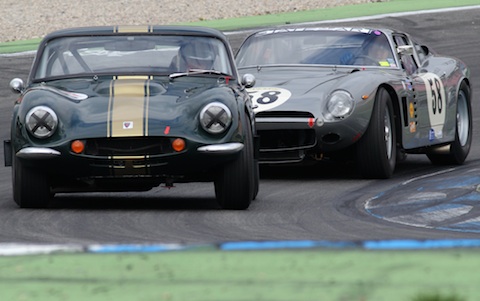
Just one weekend after the "Hockenheim Historic" event, the historic engines were already roaring again at the Motodrom in Hockenheim. It was all about the Prize of the City of Stuttgart and the racing program promised circuit races and regularity runs in a wide variety of categories, from formula cars to endurance racers, from touring cars to race karts. Even modern series were included in the program, so that spectators could certainly not complain about monotony.
While Friday, which was mainly dedicated to the training runs, was a bit of a washout with some torrential rain showers, Saturday and Sunday enjoyed perfect weather conditions.
The whole event was somewhat reminiscent of the English club races of yesteryear, the atmosphere was informal, the marshals showed their delight in the wide variety of racing cars and the participants helped each other wherever they could.
Dwarves with a grand entrance
The smallest participants of the race weekend, the dwarves, had a completely new line-up. While the races were still held according to the regularity regulations (GLP) last year, they will now be held in race mode in 2015. The organizers from Kampf der Zwerge e.V. are thus responding to the wishes of many drivers who want to compete in direct duels on the track. It also makes the competition easier for spectators. Because whoever crosses the finish line first is the winner.

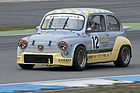
In any case, the change has not had a negative impact on the field of participants; 50 entries were registered for the season, with 37 vehicles starting in Hockenheim. In order to create fair conditions, the midgets will compete in four racing categories: the Abarth Coppa Mille, the British Car Trophy, the NSU TT Trophy and the 1300 Histo Cup.
Mini or NSU TT?
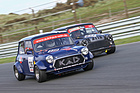
At the Hockenheimring, the 1300-series Minis, which are modeled on the British racing Minis, proved to be slightly faster than the NSU TT, which can only hold a candle to the British Mini in the right conditions.
Konrad Beckmann was one of the Mini drivers, he has been competing continuously since 2006 and even became champion in 2008, despite being the oldest driver in the field. He has been driving his 1969 Cooper S since 2007. Unfortunately, the drive shaft broke in practice, so Beckmann had to start from the back of the field. He then returned to the front of the field in the second race.

Roland Müller had more trouble with his NSU TT. The engine had already gone sour in practice, but it was fit again by the start of race 1. After a race to catch up from the back of the field to 7th place, however, the power unit in the rear caused trouble again - failure. Müller then had to enjoy the second race as a spectator from the Sachs-Tribune. He has exactly three weeks until the next race in Oschersleben to get the engine running again.
As expected, the British Mini Coopers came out on top, with James Lindridge finally coming out on top twice in exciting head-to-head battles against Damen Astin.

Exotics of the long distance
The driver of the conceptually fastest car also stood at the top of the podium at the end of the FHR endurance race. Felix Haas drove his 1970 Chevron B16 with care and got through the weekend without any major problems. With 640 kg and around 260 hp, no opponent was a match for him, even though he had dispensed with special set-up runs before the Stuttgart Prize. He could even afford to set the Chevron up a little softer than would have been sensible for optimum lap times. But Haas' goal was to arrive safely in the two races he contested - he won the HTGT race - and a softer setup protects the car and driver.

Also at the start of the FHR endurance race was Stefan Kremer in the only Lotus Europa. This was an S2 with a 1600cc Renault engine. The car was not without its problems, which is why the crew of mechanics was hard at work. "I don't like Hockenheim that much," said Kremer, "the track is too much of a drawing board for Formula 1, I prefer Spa with its hills." He could not be completely satisfied with his result, as he had probably hoped for more than 17th place.

Diversity among the "boys"
There was a reunion with many cars that are still familiar even to younger generations in the two races for the Youngtimer Trophy.

There were Ford Escort RS 2000, BMW 2002 Ti, Opel Ascona A, Peugeot 205 GTI, VW Scirocco, Suzuki Swift, Toyota Corolla, Porsche 924 and even a VW Derby in the "small division", while in the second race a Porsche 935 K1 competed against a horde of 911s, a BMS 635 CSI, half a field of BMW M3s and a few "exotics" such as a Mercedes-Benz 190E 2.3-16, Opel Kadett GT/E or Porsche 944 Turbo Cup.

As expected, the fast Daniel Schrey dominated Race 18 in a 935 K1, while last year's runner-up Fröhlingsdorf-Leiendecker in a Ford Escort RS 2000 finished Race 16 just ahead of Roland Portmann in a BMW 2002 TI.

Technology as a challenge
As is well known, the Hockenheimring presents manageable challenges in terms of driving, but it was the technology that posed more of a problem for some participants. Erich Stahler, for example, competed in the HTGT with his exotic Marcos 1800 GT from 1964. His car has a wooden chassis and a plastic body. He "lost" the gearbox during the test drives, something that should of course not happen again in Hockenheim.

"As a top speed circuit, the Hockenheimring is not ideal for the Marcos, especially the Parabolica is very difficult to drive, the hairpin bend demands the brakes to the utmost and at the same time you have to downshift using the tip-toe technique (while braking with the toes of the right foot, the heel is used to apply intermediate throttle). As the pedals on the Marcos are a thin aluminum construction, they warp when pressed hard," explained Stahler, referring to the beautiful English sports car. His aim was to get the car through, but after 13 laps his race was already over.
Wolfgang Sommer, who was competing in the long-distance race with a Ford Capri 2.6 RS, a favorite of the spectators, was also struggling with technical problems. The new wheel bearings weakened right from the start, which was probably due to a lack of material quality. The engine broke down during practice, but was repaired overnight. Sommer was also not a big fan of the Hockenheimring: "The brutal braking after the Parabolika is not good for our old cars".

Affordable historic motorsport
The Stuttgart City Prize showed that historic motorsport can also be run on a small budget and that the fun doesn't fall by the wayside if you don't want to invest millions in your racing car.
Particularly inexpensive motorsport is possible with a Mini SPI in the battle of the midgets. Minis built between 1992 and 1996 are available for between 3,000 and 5,000 euros, depending on their condition. Add to this the cost of the safety equipment, which consists of a roll cage, seat belts and fire extinguisher, and the racing car is finished. Tuning or special racing tires are not permitted in this vehicle class. The race set-up for these racing cars is reduced to adjusting the correct air pressure in order to find the last tenths of a second on the track. However, this is not a must, because in the battle of the dwarves, the focus is on camaraderie even under racing conditions. As Tom Schwede, the series' permanent track announcer, reports, there are some racing drivers in the Battle of the Dwarves who unload their vehicle on Friday and limit themselves to the right amount of fuel in the tank when setting up. Instead of doggedly striving for success, the focus on the race weekend is on meeting like-minded people.
For the few spectators, however, what counts most is the action on the circuit, and it's great fun when the Mini lifts the rear wheel in the bend and the BMW 2002 ti drifts around the bend with the front wheel," grins Schwede, who is delighted to see an international field of starters in the battle of the dwarves.
But where is the audience?
A successful event, this Prize of Stuttgart. The only question is where the visitors were. A few had gathered in the Sachs-Kurve, but the other grandstands were largely empty. It is unclear why the fans of historic motorsport did not find their way to Hockenheim. Perhaps the Techno Classica on the same weekend was more important for some classic car fans? But perhaps there was simply a lack of targeted promotion for this event ... It certainly deserves it.

All results of the individual races can be viewed here .