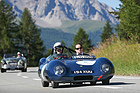
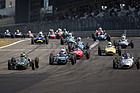
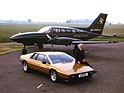
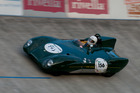
On the first weekend of September, it was that time again - and it was hard to imagine that this was only the first anniversary of the modern revival of a legendary acceleration race at the spectacularly situated Engadin Airport in Samaden (Graubünden, Switzerland). The entire staging seemed experienced and well-rehearsed and it was fitting that the perfect organization, which was still struggling with capricious weather on Saturday, did not want to give in to the participants' urge to go full throttle even on a rain-soaked track. Just as in aviation it is usually the captain alone who decides on the start, here it was deliberately left to the participants themselves to decide whether they wanted to start on the shorter 400-metre distance.
Brave before
The first brave ones did not take long to decide and stepped on the gas in a sporty manner. Vehicles without recognizable fenders, such as the 1924 Delahaye 107 Racer, driven in sandals by Swiss driver Riccardo Beccarelli, could be seen by the public even at a distance of 500 metres thanks to a 10-metre-high water fountain behind each wheel. It was just a shame that modern delivery vans were parked on the tarmac and in the field of vision of many interesting photo motifs - and thus unnecessarily disturbed the perfect illusion of time travel.

Back in the paddock, other drivers were quickly motivated to attempt the first run, including the very fast David Martin, who had traveled from L.A. in a Ford Model A Roadster Hotrod (base vehicle from 1931) and the Jaguar XK Jabbeke (1951). The latter later became the second winner of a design award presented for the first time, which primarily honors the aesthetics of the vehicle at full speed. Only the Streamliner C-16 from 1939, which arrived from Sweden, was ahead of it in first place, with the aforementioned Delahaye 107 Racer in third place.
Consistency is important
Of course, it was also about speed and victory required consistent performance: The Mercedes Simplex 60 hp (1903), for example, achieved the best result in the pre-war class with less than one second difference in two scoring runs in the morning and afternoon. A vehicle with the mysterious designation Project e01 1987 easily took victory in the Post War category, which is hardly surprising given that it is an electrified Porsche 911 G model. Certainly an impressive and very powerful technology carrier, but for many visitors somewhat irritating and always a matter of taste.

It's not just about historic test and record vehicles either, as the winner in the motorcycle category was a Ducati Monster 1200S from 2017, which is probably always fast to move. "It's about a mobility festival," says curator and organizer Tobias Aichele from Solitude, Stuttgart, explaining the concept of the event, which was held here in 1929 and 1930. "Just like back then, today there is a colorful field of participants with extraordinary vehicles and their passionate and authentic owners," he says, explaining the character and intention behind the selection of participants.
In the end, there was also a jump-off of the really fast vehicles and proof that power-to-weight ratio beats everything: a BMW S 1000 RR (2021) left a new Ferrari 296 GTB behind before the track became too short for these two modern technology carriers. Incidentally, the runway was always cleared, cleaned and opened for 90 minutes for individual private jets approaching the Engadin, which typically had to deliver guests of the St. Moritz Palace or the private chalets on time.
A long but almost forgotten tradition
The St. Moritz International Automobile Week was launched in 1929, not only to celebrate the fascination of the automobile and the mobility associated with it, but also to attract tourists. The up-and-coming St. Moritz Automobile Week consisted of several events such as the Kilomètre Lancé, a Concours d'Elegance in front of the Kurhaus, several driving tests and a rally. The crowning glory, however, was the Bernina Race.
The plan worked, more and more tourists sought relaxation in St. Moritz and the rest, as they say, is history. The town benefited from the 1928 Winter Olympics shortly beforehand, but it wasn't until 2015, when a small group of passionate enthusiasts led by collector, patron and motorsport enthusiast Kurt Alexander Engelhorn set about reviving the Bernina Race, that a second automotive era began for St. Moritz.
2021 was the year of the rebirth of the historic Kilomètre Lancé - Alpine 1000 kilometer race, which immediately established itself as a cult event. The great success was due to spectacular vehicles such as the Blitzen-Benz, the Wisconsin Special and other record-breaking cars from the first half of automotive history. The motorcycles also provided a wild spectacle. Overall, it was a thrilling event right from the start.
The second edition followed in 2022, enriched with the "Design Award".
Professor James Kelly from Pforzheim University, Transportation Design and Tobias Aichele from the PR and event agency Solitude GmbH have launched a new design award format. Vehicles are judged at full acceleration. These have a completely different appearance at full speed. They fly over the asphalt and can be heard and smelled.

"Aaaaaand the Winner iiis": The C16 Streamliner by Glen Billqvist from Sweden. With two coupled 8-cylinder in-line engines from Buick, this car is clearly inspired by the Mercedes W154/M154 record car with which Caracciola set a standing start 1 km record on February 8, 1939: 20.56 seconds with an average speed of 175.097 km/h. The next day, he set a record of 9.04 seconds for the kilometer with a flying start, which required a top speed of 398 km/h. But Glen was not that fast. Glen was not that fast, however, as the vehicle would need a minimum of 10 kilometers to reach its absolute top speed and the Samedan airstrip is unfortunately a little too short for that. Nevertheless, the vehicle was the feast for the eyes of the day.

Hermann Layher from the Technik Museum Sinsheim brought the fastest vehicle from over 110 years ago to Kilomètre Lancé. The Blitzen Benz entered the history books when it thundered along Daytona Beach in Florida with driver Bob Burman. The course at the time was one mile long and the record stood at 228.1 km/h (with a flying start). The Blitzen-Benz was the first car from Europe to drive faster than 200 kilometers per hour. This sound barrier was broken by the German team at Brookland Racecourse in England in 1909. Finally, in 1911, Burman raced through the beach at Daytona at 228.1 kilometers per hour, making the Blitzen-Benz the fastest vehicle in the world for many years, faster even than any airplane or train. The two records were to stand for eight years before they were broken by Ralph de Palma in 1919 with 241.2 km/h. The six Bitzen-Benzen built were powered by a four-cylinder engine with around 200 hp, a displacement of 21.5 liters and two spark plugs per cylinder. To this day, this is the largest passenger car engine ever built by Benz or Daimler-Benz.
Why at an airfield in the Engadin
Until 1925, the dusty roads of the Upper Engadin were still off-limits to cars. But that was soon to change.
The "Automobil-Revue" wrote on August 21, 1929: "Shellstrasse" - this is the name given to the first three kilometers of the Samaden - Pontresina route. The starting point is the small iron bridge over the Inn at Samedan and the end is at Bunt Murail. The Inn plain is cut diagonally by the road and spreads out south of Samedan into a large triangle, the base of which is formed by the Inn and the tip of which extends towards the Bernina Valley. This road branches off from the main road leading to St. Moritz at Samedan and runs parallel to the Rhaetian Railway as far as Bunt Murail station. Sir Henry Deterding, the brilliant head of the global Royal Dutch Shell company, is an enthusiastic admirer of our country and is one of St. Moritz's most famous spa guests and active sportsmen and women every year. Sir Henry Deterding was also very interested in the suggestion made last winter by the St. Moritz Spa Association, which is chaired by the likeable mayor Mr. Mater, to hold the automobile racing week that has now become a reality. However, the Engadin still lacked a road that could meet the technical requirements for achieving the high speeds required for a kilometer of lancé. Sir Henry Deterding did not hesitate for a moment to assure the organizing committee of his support and generously helped them to build this race track. Without this help, the committee would hardly have been able to organize this kilometer race.
At the instigation of well-known racers such as Divo, Menoit, Moral, etc., the road kerbs are marked along their entire length with a cement end stone and serve as direction indicators for the racers. Otherwise, there are no hedges, walls, posts or other obstacles on the verges that could confuse the driver in any way. Even the telephone poles for the electric timekeeping have been set back 20 meters from the edge of the road."
As in 1929, the weather was not much different in 2022.
The Automobil-Revue wrote the following on August 24, 1929:
"Last night the whole of St. Moritz was hoping for good weather, this morning it was pouring with rain. During the car inspection in Samaden, some drivers were still seen on the wet track, skidding precariously, like Karbach, for example. To hold or postpone? The race organizers had not yet made their decision by half past one. The weather itself provided the answer at the last minute. The low clouds lifted and the rain stopped. Even under the last drops, a small migration of cars set off for Samaden. There was a large crowd at the launch site. It is estimated that at least 3000 people attended the launch. Considering the almost polar air currents, this is a great success. During the two hours that the race lasted - it started at 3 o'clock - people sat on the high grandstand with shaking legs, which offered a wonderful view over the entire race course. The announcement of the results was unique: As soon as the roar of a car had died away, the loudspeaker proclaimed in four languages the times set, and even the number of working candles. The cars followed each other in quick succession. Mr. Töndury and his staff did an exemplary job. Not to forget - it was the first race of its kind in St. Moritz! The course lived up to its promise. It is now probably the most beautiful Lancé course in Switzerland.
Hot sausages, gin and vermouth, but more gin! strengthened the sporting courage between the three gunshots that announced the start and finish."
For the sake of completeness, here are the fastest drivers from 1929:
Touring car in the 750 cc class
Buchwald Dixi 43.4s 82.949km/h
Touring car in the 1100 cc class
Spaelty Amilcar 41.7s 86.331 km/h
Touring car in the 1500 cc class
Keller Alfa-Romeo 37,5s 96.000 km/h
2000 cc class touring car
Pettley Lagonda 38.6s 93.264 km/h
3000 cc class touring car
Kagami Morris 37,4s 96.257 km/h
Touring car in the 5000 cc class
Giger Martini 31.9s 112.853 km/h
Touring car in the 8000 cc class
Stewart Packard 38.4s 93.750 km/h
Touring car in the over 8000 cc class
Zettritz Mercedes-Benz 25.1s 143.426 km/h
Sports car in the 1100 cc class
Steinweg B.N.C. 32.1s 112.150 km/h
Sports car in the 1500 cc class
Burggaller Bugatti 26.2s 137.405 km/h
Sports car in the 2000 cc class
Escher Bugatti 22.6s 159,292 km/h
Sports car in the 5000 cc class
Freuler Steyr 27.0s 133.333 km/h
Sports car in the 8000 cc class
Momberger Mercedes-Benz 22.0s 163.636 km/h
Racing car in the 1100 cc class
Sarbach Amilcar 24,3 148.148km/h
Racing car in the 2000 cc class
De Sterlich Maserati 22.4s 160.714 km/h
Racing car in the 3000 cc class
Chiron Bugatti 20.8s 173,077 km/h
Racing car in the 5000 cc class
Rosenberger Mercedes-Benz 18.6s 193.548 km/h
Racing car in the 8000 cc class
Caracciola Mercedes-Benz 20.4s 176.471 km/h
Plus the fastest lady
Mme. Merz Mercedes-Benz 25.2s 142.857 km/h
From then on, acceleration races became increasingly popular in Europe too. However, the most popular remained the one on Shellstrasse in St. Moritz.