Not only at Goodwood, but also in Monaco, real races are still held with really old cars. And the imposing city backdrop of Monte-Carlo is just as unique, even if it has not been able to resist modernity quite as vehemently as England's flagship nostalgia circuit. For many, it is a great dream to drive in Monaco, but if you are already overwhelmed with your own car, it becomes almost impossible to take your competitors into consideration at the same time. Even more than the omnipresent narrowness of the street circuit, it is the large speed differences of up to 30 seconds per lap between the professionals and the amateurs that cause tricky situations on the street circuit; sometimes even collisions.

Roald Goethe's Tyrrell 007 collided violently with Marco Bianchini's Shadow DN5 in the uphill passage to the casino; Martin Overington's Hesketh 308E fell victim to Michael Cantillon's Tyrrell 010 in the tunnel. Marco Werner was already on the horns of Mark Dwyer in the Osella FA1D in the Mirabeau during free practice. However, most of the driving errors ended up being minor.

The lap times show how little the street circuit has changed compared to other race tracks. Today's top drivers are only slightly slower in their historic equipment than the Formula 1 professionals of the time in the same car. In 1973, Peter Revson set a time of 1:29.4 minutes in his McLaren M23 in qualifying for the Monaco Grand Prix and his fastest lap in the race was 1:31.4 minutes. Just over half a century later, Stuart Hall came close to Revson's best time in the race with 1:31.629 minutes in qualifying for the Grand Prix Historique de Monaco. However, he was still a long way off the level of a former world champion. The winner at the time, Jackie Stewart, set a pole time of 1:27.5 minutes in the Tyrrell 006 - even though the tire compounds of the 1970s were far inferior to those of today.

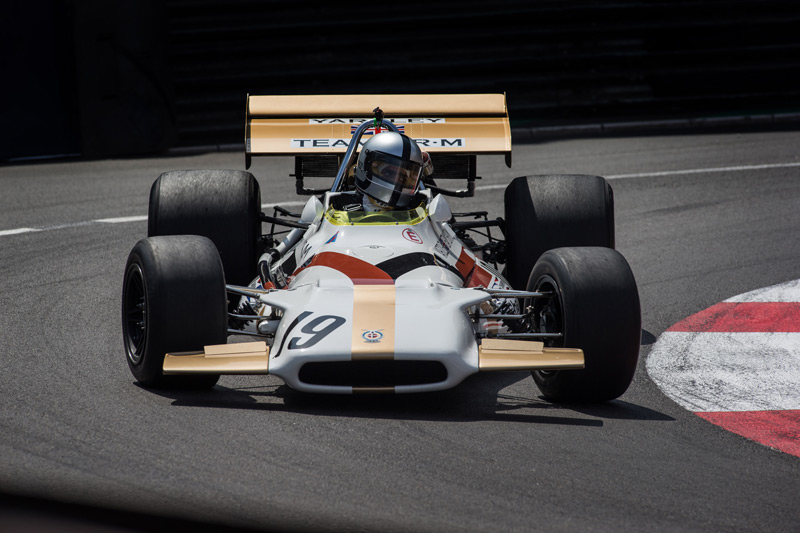
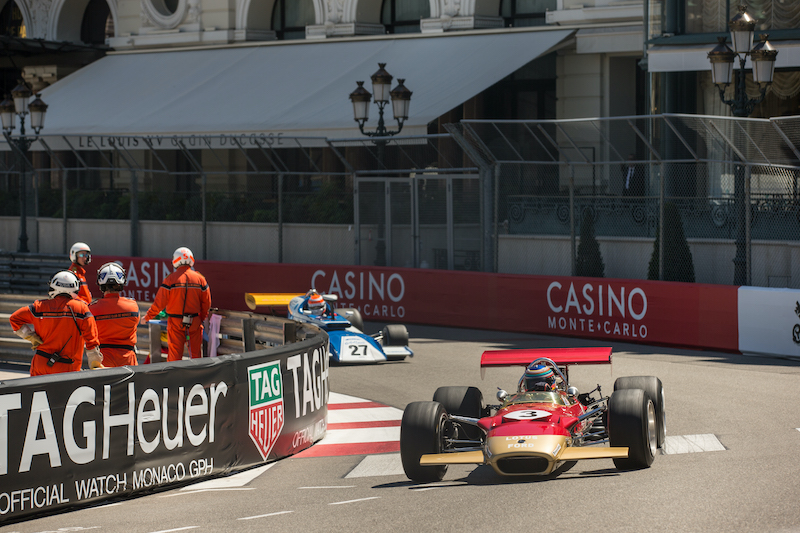
Of course, the familiar faces are always on the grid, but Monaco is and remains a delight for all the senses: the acoustics, visuals and olfactory experience are unique. What wonderful cars were on the grid back then! The clear, simple shape with its air scoops and simple paintwork that, unlike today, every schoolchild could still draw immediately recognizably.
Pre-war Grand Prix cars and voiturettes
The 2021 winner, Patrick Blakeney-Edwards in a Frazer Nash, was unable to qualify for the race due to valve damage. Fritz Burkard in the Alfa Romeo 8C Monza had qualified in seventh place but did not start the race. Michael Birch - who started the race from third on the grid in his Maserati 4CM - had a poor start, but managed to regain his original position at the end of the first lap and began to press second-placed Brad Baker in the ERA R10B.

Baker defended his position and still set the fastest race lap, but was unable to close the gap to leader Paddins Dowling in the ERA R5B in the back-to-back battle.
Front-engined Formula 1 cars before 1961
The German Claudia Hürtgen celebrated an unchallenged start-finish victory in her Ferrari Dino 246 ahead of Marino Franchitti in the Maserati 250 F of Pink Floyd drummer Nick Mason. It was their second victory in the Grand Prix Historique with the former Phil Hill car. Mark Shaw in the Scarab had finished a strong sixth in practice, but retired on the formation lap.

Max Smith-Hilliard was in third position on the grid, but fell victim to the unreliable gearbox of his Lotus 16, which jammed when he engaged first gear, causing him to stall at the start. For most of the race, Tony Wood in the Tec-Mec battled with Joaquín Folch-Rusiñol in the Lotus 16 for third place - a duel that Wood won after Folch-Rusiñol spun after the swimming pool chicane.
Formula 1 cars 1961-65
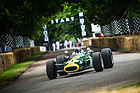
Jim Clark was unfortunately never able to win the Monaco Grand Prix himself. However, his former car - the Lotus 25 - now claimed its fifth success. The race in the 1.5-liter class quickly developed into a duel between Andy Middlehurst in the aforementioned Lotus 25 and Joe Colasacco in the Ferrari 1512, who immediately pulled away from the rest of the field.

Colasacco stuck to the rear of Middlehurst until lap six, when the latter was able to build up a slight lead after a brave lapping of Sid Hole's Cooper T66 at the Portier corner. Colasacco got stuck behind the Cooper for a brief moment, but quickly closed the gap to Middlehurst again and still set the fastest lap, but was no longer able to attack the Lotus.
Front-engined sports car 1952-57
Max Smith-Hilliard in the Lotus 10 had difficulties with the start and lost his third place to Tony Wood. Richard Wilson in the Maserati 250 S had a dream start and took the lead from pole setter Frederic Wakeman in the Cooper T38, but he restored the starting order on the second lap. After the first lap, Martin Halusa, who had started from 22nd place in his Jaguar D-Type due to a penalty, had already fought his way up to ninth place.

Claudia Hürtgen in the Maserati 300 S was in third place ahead of Wood, but was slowed down by a lapped car in the Schwimmbad-Kurve, allowing Smith-Hilliard to overtake. At the end of the eighth lap, the gap between Wakeman and Smith-Hilliard - Richard Wilson had retired after a spin at the Casino - was still 2.5 seconds. But Smith-Hilliard was able to close the gap in traffic and took the lead on the final lap when Wakeman spun in the Saint-Devote corner and ended up only seventh.
Formula 1 cars 1966-72
Adrián Fernández competed in the BRM P153 of his compatriot Pedro Rodríguez, who won the 1970 Belgian Grand Prix. He qualified sixth on the grid but was unable to take part in the race due to a broken drive shaft. The most sought-after man in Formula 1 today, Red Bull engineer Adrian Newey, returned to the Principality in his Lotus 49B for the first time since 2018. He and Tom Hartley Jr. in the March 701 got stuck at the start, but were able to start the race after a delay.

Katsuaki Kubota in the Lotus 72 dropped back to third place, allowing Matthew Wrigley in the March 721G to set off in pursuit of pole setter Michael Lyons and his Surtees TS9. The top three quickly pulled away from the rest of the field. Wrigley made a mistake in the Saint-Devote corner on lap eight, which Kubota took advantage of to take over second place. Lyons' big lead evaporated with a retirement on the ninth lap. This cleared the way for Kubota, who celebrated his second Grand Prix Historique triumph after 2014. Adrian Newey finished the race in fourth place.
Formula 1 cars 1973-76
Toni Seiler in the Shadow DN1 was also one of those who stopped on the grid. Marco Werner in his Lotus 76 overtook Nick Padmore in the Lotus 77 and exited turn one in second place. Briton Stuart Hall made the most of his pole position and immediately shot into the lead in the McLaren M23, which he did not relinquish until the finish. It was his fourth success at home in the Grand Prix Historique.

There was a much closer battle for second place between Werner, Padmore and McLaren M26 driver Michael Lyons, which Padmore won, while Werner retired with gearbox damage on the sixth lap.
Formula 1 cars 1977-80
Famous participants in this group were the current team boss of McLaren and United Autosports Zak Brown, then the boss of the Jumbo Supermarket Group and the Racing Team of Netherland Frits van Eerd, the British GT race winner Lee Mowle. He was joined by two-time winner of the 24 Hours of Daytona and IMSA team owner Wayne Taylor, who drove the Wolf WR4 of his friend and compatriot Jody Scheckter.

Wayne Taylor in the Wolf WR4 of his compatriot Jody Scheckter collided with Harald Becker in the Arrows A3 at the start of his Monaco debut. Stephen Shanly - another debutant who had qualified for an excellent third place on the grid - spun his Tyrrell 010 at the exit of the Piscine chicane, whereupon the race had to be interrupted. But immediately after the restart, the race had to be interrupted again because the Tyrrell 010 of Michael Cantillon and the Lotus 81 of Luciano Biamino stopped on the grid.

When the race started for the third time, Michael Lyons in the Hesketh 308E and Miles Griffiths in the Fittipaldi F5A immediately shot into the top two places. But when Michael Cantillon pushed Martin Overington's Hesketh 308E into the wall in the tunnel, the third red flag also followed. At the fourth attempt, the race was started behind the safety car in order to protect the clutches of the racing cars.

Once again, Lyons and Griffiths left the rest of the field behind them. Nicolas Matile in the March 771 fought a fierce three-way battle for twelfth place with Frits van Eerd in the Fittipaldi F7 and David Shaw in the Williams FW06 - until the March hit the crash barrier at the exit of the Tabac corner five laps before the end and the red flags had to be waved for the fourth time. The race was then declared over and Michael Lyons was declared the winner.
Formula 1 cars 1981-85
Stuart Hall also took his fifth victory in the Principality on the same weekend. In the March 821, he relegated Marco Werner in the Lotus 87B and Michael Lyons in the Lotus 92 to second place - also with a start-finish victory. This time Werner's Lotus held on to the chequered flag, while Michael Lyons came under pressure from a Tyrrell train led by Marino Franchitti in his blue 012.

And what do we learn from all this? The Circuit de Monaco can still host entertaining and exciting races today with cars that were once designed for their size. But with modern racing cars that are two meters wide and five and a half meters long, a race on the narrow track quickly turns into a parade.