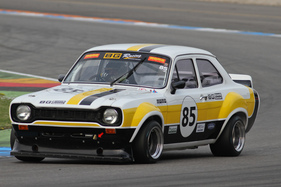
Every spring, fans of historic motorsport flock to Hockenheim to watch racing with historic cultural assets, but also to commemorate racing legend Jim Clark, who lost his life in a Lotus 48 Formula 2 monoposto on April 7, 1968, after a material defect presumably caused him to crash into the trees next to the track.
However, the fact that the mood on the weekend of April 11-13, 2014 was somewhat subdued was not due to the 46th anniversary of the death of the exceptional talent Clark, but to the accident that Al Fleming fell victim to in the Lotus Elan during practice on Friday. He lost control of the lightweight racing car in the Parabolica and overturned. Fleming had been involved in motorsport all his life, for over 50 years without any fatal accidents, but on April 11, 2014, his personal guardian angel was missing and he lost his life.
The Hockenheimring held a minute's silence in his memory, the family encouraged the race management and the organization to continue the races, which is what Al Fleming would have wanted.

Attractive British mix
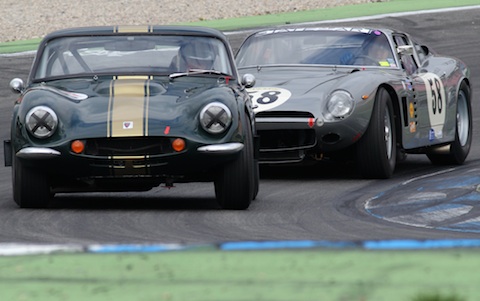
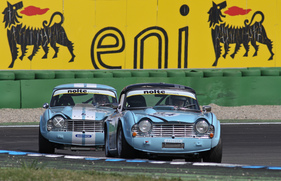
A new addition to the Hockenheim Historics was the "Triumph Competition & British GT" racing series, which, contrary to its name, not only featured vehicles from the Triumph brand, but also a rich potpourri of British sports cars. In the overall classification, four different brands finished in the top five places on both Saturday and Sunday, with Paul Conway in a Morgan +8 coming out on top in the first race and Rainer Vorköpper in a Jaguar E-Type Low Drag coming out on top in the second race.

Rainer Bastuck was also among the front runners in the lightweight Marcos GT with wooden chassis, which was able to put in an excellent performance against the significantly more powerful competitors.

The Triumph TR 250, which Mario Neumann drove to fourth place on Sunday, was also something very special. From the outside, his obviously well-prepared Triumph looks more like a restoration object than a competitive racing car.

In addition to the expected Triumph TR3/4 and MG A/B, the colorful field of around 35 vehicles also included a TVR Tuscan V6 and a Jaguar C-Type.
The variety of accelerated Beetles
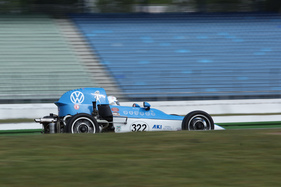
The Formula V (or Vau) actually comes from the United States, although the "V" stands for Volkswagen. At the beginning of the 1960s, young American racing drivers were already practising with inexpensive monoposti, which were largely built using Beetle suspension and engine parts. In the mid-sixties, Formula Vee racing cars made the leap across the Atlantic and soon became a popular entry-level racing series in our part of the world.

The cars came from manufacturers such as Formcar, Beachcar and Apal. Over time, the engines became more powerful and the racing technology more sophisticated. With the engine of the VW 411/412, the racing car formula mutated into the Super Vau, now attracting up to 150 hp and modern suspension designs as well as aerodynamic aids.

At the Hockenheimring, almost 60 of these Formula Vau and Super Vau vehicles, which competed in two rounds as part of a regularity test, could be admired. Most of the vehicles on show had a respectable racing history.

Robert Waschak from St. Gilgen in Austria, for example, brought an Austro Vau built in 1968 to Hockenheim, which had once been driven successfully by Manfred Schurti from Liechtenstein, who later became a Porsche works driver. In 1968, Schurti took 2nd place in the season finale of the Formula Vee Championship. In 1970, he then won several heats of the European Cup with the Hilti-supported racing car and finished sixth overall in the Formula Vee European Cup.
Schurti sold the car to Eugen Baumgartner, who drove the red monoposto in circuit and hill climb races until 1971.
The Austro Vau was restored in the 1990s and has been used in historic racing ever since. Even Schurti got behind the wheel again, at the Salzburgring, and he also left a dedication on the vehicle.
Racing history in motion

No actual race, but interesting demonstration laps were shown by Race Club Germany, which brought formula cars from around 50 years of history to southern Germany. From the ERA from 1936, to the Maserati 4CLT and the Lagnoda 26C from 1948, to new-fangled vehicles such as the Tyrrell 020B from 1992, a wide variety of vehicle concepts and engine designs could be compared by sight and sound.

The cars of the FNT team would have fitted in well in this corso, but the two Formula 1 Toyota cars and a 20-year-old Ligier drove in circles on their own, but still gave an impressive demonstration of how the Formula 1 cars of the pre-V6 turbo era sounded.

Variety and size
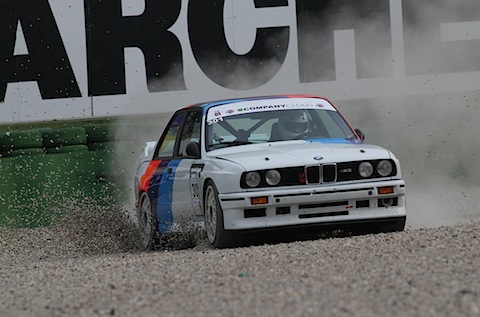
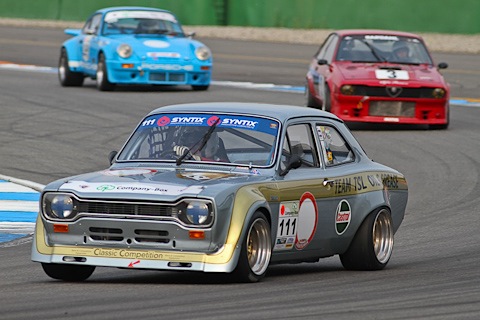
Once again, the largest and at the same time most diverse racing field was provided by the two runners in the Youngtimer Touring Car Challenge, a Dutch racing series. Cars from the sixties, such as the Porsche 904 GTS, Lotus Europa or Shelby Mustang GT350, raced alongside racing cars from the seventies, such as the Sunbeam Lotus, Rover SDI 3500 V8, Renault R5 Turbo or Jide, as well as cars from the eighties, such as the Alfa Romeo GTV 6, BMW M3 or Porsche 964 RS.

However, there was no way around the guest drivers, as Michael and Daniel Schrey in their Porsche 935 K1/K3 were almost unbeatable. However, Michael Kammermann in the BMW M1 Procar took second place in the first race and Daniel Brown in the Ford Escort MK1 took third place in the second race.

Bart Lemaire in the 1972 Trabant 601 RS must have had a scary moment when a Porsche 944 bumped him off the track so hard that he landed on his side. However, three men were enough to get the little car upright again and a new rear-view mirror was fitted during the repair break. Bart was actually in good spirits on Sunday morning that he would be able to start again, but in the end the car turned out to be unfit to race.

However, the two runners were definitely a pleasure for the spectators, as the wide variety of cars was eagerly used and the lap time differences at the front were kept within narrow limits. There was the kind of overtaking and lapping that is unfortunately rarely seen in modern racing.
Shrunken Formula Junior
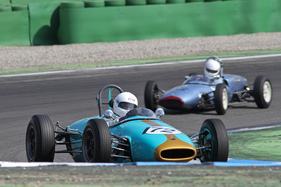
In recent years, the FIA Lurani Trophy races have also been known and loved for their large starting fields and exciting battles for position. However, with 32 starters in the first race and 26 in the second, the field was significantly reduced and the clear gaps at the front were no longer reminiscent of the exciting races of previous years.

Jonathon Hughes clearly won both races in his Brabham BT6, followed by Tonetti and Eberhardt in Saturday's race and Tonetti and Buhofer in Sunday's race.
The historic Formula 2 presented a similar picture, albeit on an even smaller scale. 11 drivers crossed the finish line in the first race, compared to just ten in the second. As usual, Martin Stretton in the March 742 came out on top, with Philip Harper and Hans Peter in second place. Visually and acoustically, however, the Formula 2 racers were certainly impressive.
Brute V8 force
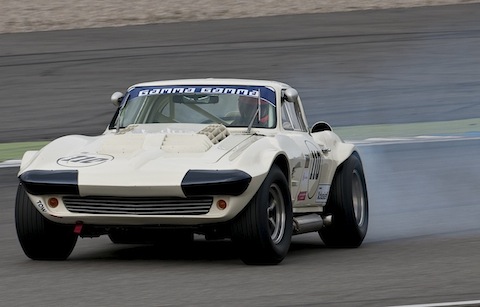
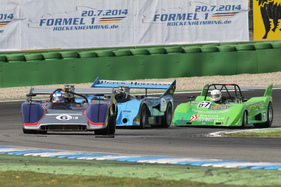
The CanAm cars and Super Sports two-seaters set some of the fastest times at the Hockenheimring. Here too, the spectators had to live with thinned-out starting fields, but visually and acoustically the sports cars were among the highlights. The winner of the first race was Michele Liguori in the Lola T292 DFV, while the second race was won by John Grant in the McLaren M8D. Local hero Peter Hoffmann, who was always among the fastest, retired in both races.

However, the eight-cylinder music only partially made up for the fact that one of the most popular attractions of recent years, namely the battle of the dwarves, had gone astray. The gnomes could only be seen on a smaller scale on the racetrack in the paddock.
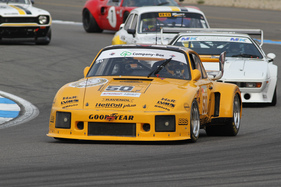
The DRM Klassik Pokal had been widely announced, but the range of cars competing was rather limited and Daniel Schrey took two more victories in his Porsche 935 K1.

Perhaps the most visually attractive car in the field, however, was the Kremer-Porsche 935 K2 driven by Eberhard Baunach.
No Lotus world record
After attempts had been made in previous years to bring as many classic cars as possible onto the race track, a different kind of world record attempt was on the agenda in 2014. On Saturday evening, 437 Lotus vehicles were to drive around the racetrack.

Although the parade looked impressive, it wasn't quite enough. In the end, around 300 vehicles were counted, most of them probably less than 10 years old.
Historic?
In general, some of the 20,000 spectators were amazed at the large number of young vehicles. Three racing fields, namely the BOSS GP, the Lotus Cup Europe and the Special Touring Car Trophy H&R Cup, were equally modern, with the average age of the vehicles being ten years rather than more. Whether the organizers are right about this is questionable, but the young Hockenheim visitors in particular were certainly delighted to see the Lotus Elise and Exige, Mercedes Benz SLS and 21st century formula racing cars moving with relish.

Those who were not afraid of the really loud sounds and big burnouts were shown what makes the quarter-mile races so attractive at the dragster demonstration. A few lightning starts on the home straight were enough to make half the area disappear in clouds of smoke. The demonstration was intended as an appetizer for an upcoming event, and one or two people were sure to be convinced.
However, it remains to be seen whether the "Bosch Hockenheim Historics" event as a whole is heading in a promising direction.