Technology in race cars (15): Lotus 43 - The curse of the 16 cylinders


You have only
1 out of 18
images seen in high resolution




Summary
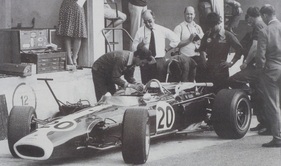
When a new era in Formula 1 began in 1966 with the 3-liter regulations, Lotus wanted to outperform the competition right from the start. However, it would take until the Italian Grand Prix before the Lotus 43 could be used. This was not powered by a tried-and-tested V8 or V12, but by an H16 from BRM, whose construction had been inspired by a powerful Napier aircraft engine. However, Chapman and Co. soon realized that more and better do not always go hand in hand. This article from the series "Technology in racing cars" deals with the Lotus 43 and its 16-cylinder engine.
This article contains the following chapters
- New aggregate state
- Promising beginnings
- Lots of potential - excerpts from the history of the 16-cylinder
- Aiming too high and crashing
Estimated reading time: 6min
Preview (beginning of the article)
The years 1958 to 1978 were the two most creative decades in the history of racing technology. This series portrays the most innovative, pioneering and exotic designs of Formula 1, Indy cars, sports cars and CanAm, and at the same time traces the major lines of development that still have an impact today. The series started with Lotus, one of the most important innovation drivers of these two decades. And the series will also finish with Lotus: With the first ground-effect Formula 1 to win a world championship in 1978, the Type 79. In 1966, the three-liter formula replaced the 1.5-liter cars that had been used in Formula 1 from 1961 to 1965. The possible engine outputs rose sharply, initially up to 360 hp (Ferrari) instead of the previous maximum of 230 hp. The long years of this three-liter formula were to become one of the most technically and sportingly exciting eras in racing history. But the start was bumpy. Only three teams were able to use suitable engines: Brabham with Repco (V8), Cooper with Maserati and, of course, Ferrari (both V12). The other English teams had to make do with bored-out Coventry Climax four-cylinder engines (2-2.5 liters) for the time being.
Continue reading this article for free?
Images of this article