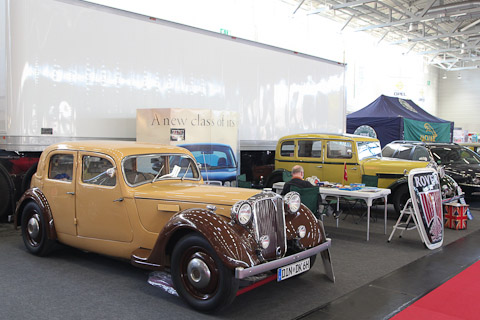
Retro Classics Cologne took place for the second time in Cologne from November 15 to 18, 2018. The first edition in 2017 had suffered from difficult circumstances (keyword: Sunday of the Dead), for 2018 a more religiously compatible date had been arranged and the opening hours had also been adjusted and the duration extended by one day.
Brighter and longer
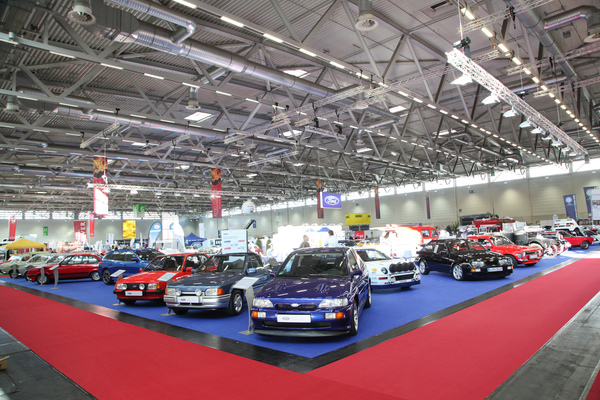
New halls were also moved into for the second edition, meaning that 40,000 square meters of bright and modern space was now available. "Old cars in new halls is better than the other way around," said Karl-Ulrich Hermann at the press conference, pointing in particular to the qualitative growth that had been targeted for the second Retro Classics Cologne. Hall 7, which was also available, had been deliberately omitted in order to be able to offer the most interesting range possible in Halls 6 and 9.

Around 450 exhibitors showcased 1500 high-quality vehicles and all kinds of accessories over four days. And they were well received by the visitors. Four-fifths of them came from the Cologne area (maximum travel distance of 100 km), while the rest traveled from further afield, some from Benelux, Austria, Switzerland and Italy.
Cologne as an engine city
Cologne is the "Silicon Valley" of engine construction, as was said during the opening speech. In fact, the first petrol engine was built in Cologne's Servasgasse around 1865 and Ford chose Cologne as the location for its passenger car production.

"Cologne was once a center of engineers who dealt with mobility," explained Horst Nordmann from the Veteranen Fahrzeug Verband e.V., which was to highlight the importance of Cologne as an engine metropolis with a special exhibition. "There were numerous car manufacturers here, and at the beginning of the last century, the city was a leader in e-mobility; up until 1920, all city vehicles ran on electricity, even the fire department," added Nordmann.
However, this has fallen into oblivion, but this is exactly where the special show "Fahrendes Volk", which also referred to famous racing drivers from Cologne, came in.
Retro elegance with Stutz
More eye-catching than the historic special show of the vehicle association, however, was another one, which also took up considerably more space. Around a dozen cars from the Stutz brand, which is little known in this country, were on display. A variant of practically every model series produced between 1970 and 1989 was on display.

What they all had in common was their certainly idiosyncratic appearance, which can originally be traced back to the well-known designer Virgil Exner, who had already started designing so-called "revival cars" in the 1960s. Retro elements were also mixed with a more modern design language in the Sutz.

The cars from the "Stutz Motor Car of America" company were based on the technology of General Motors products, but had individual bodies and were equipped with a lot of luxury, which made them really expensive. At times, a Stutz cost more than a Rolls-Royce.

No wonder it was mainly the rich and famous who could afford such cars, such as Elvis Presley, Frank Sinatra, Elton Jones and Curd Jürgens. Unsurprisingly, the number of cars produced remained manageable, with around 600 being built in just under 20 years.

The cars and their appearance may not be to everyone's taste, but the gathering of such a large number of Stutz vehicles in Germany was certainly unique.
Ford, they do something
What would a Cologne motor show be without Ford? After all, Ford has been building cars in the city on the Rhine since 1931. Engines have also been developed there over the past decades, and entire model series have also been created in Cologne.

Together with the clubs, Ford celebrated two major anniversaries: 50 years of the Escort and 50 years of the RS. In addition to other Ford models, many Escort variants, starting with the dog bone from 1968, and RS versions, starting with the Ford 15M RS from 1968, were also on display.

Of course, the Capri, partly in RS design in keeping with the motto, was also a must. And the two Ford RS200s were also a natural fit for the anniversary.
The rush of visitors reflected the effort: "It was often packed at our stand," said Thilo Moerke, Chairman of the Ford Oldtimer and Motorsport Club Cologne e.V., "Ford belongs to Cologne, and that's why we were here. We met with huge interest in our vehicles."

Visitors were greeted at the entrance by two Ford rarities, namely a humpback Taunus and a globe Taunus. Jochen Mass, who is never at a loss for a good quote, casually mentioned that the Buckel-Taunus was also called a "pooping dog" back then because of its high rear axle.
Dwarves really big
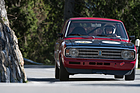
They call themselves dwarves, but at the trade fair in Cologne they made a big impression. An entire starting grid was set up for the small-stroke racing sports cars such as the NSU TT, Fiat-Abarth 695 SS, Mini Cooper Renault 5 or Fiat 128.

Even curbs were built and a pit area with filling station.

The cars in the "Battle of the Dwarves" racing series, which provides excitement and fun at a good half-dozen racing events every year, were able to put on a really good show.

"The only thing missing to make the atmosphere even more authentic was the loud engine noise," said Thorsten Babon, chairman of the association behind the racing cars.
The clubs as salt in the soup
In any case, the clubs were once again responsible for some interesting attractions. The Mercedes Pagoda Club, for example, displayed a Mercedes-Benz 230 SL that had spent several years of its life in Africa. Even the purchase of this Pagoda in Cologne had not been a straightforward affair at the time. The seller at the time rejected the first attempt to buy the car because it had already been sold. If another one came along, he would get in touch again. The very next day, the good man called again. The buyer had backed out because his wife had said that she would never sit in this car. The purchase finally worked out and just one year later the Pagoda was in Benin, in West Africa.

It survived this stay of around one and a half years well and has been driving around Cologne ever since and is still in the first hand. A sale is still not an issue.

To ensure that the African pagoda also looked good, the club procured matching accessories, such as a gorilla and an elephant, and even the stand personnel dressed up in tropical attire. A beautiful picture!

You do see an Adler Trumpf Junior Sport once in a while, for example at a concours or a classic car drive. But three together, extremely rare!
But in Cologne, three of them lined up in three different colors and drew attention to themselves and the Adler Club.

And these were just two examples of club stands, but there were many more, from Abarth to Zastava.
Mainly local dealers
According to the organizers, around 1500 cars were on display at Retro Classics Cologna, most of them of course at dealers' stands. These were mainly of regional origin, but there were of course exceptions.

For example, the Italian company "Ruote da sogno" had found its way to Cologne and Arthur Bechtel, Kienle and Motorworld had also set up their stands.
There were also suppliers from the nearby Netherlands, but the eastern neighbors that could still be seen in Berlin were missing. Prices were at the usual high level, but there were just as many downward swings as upward ones.

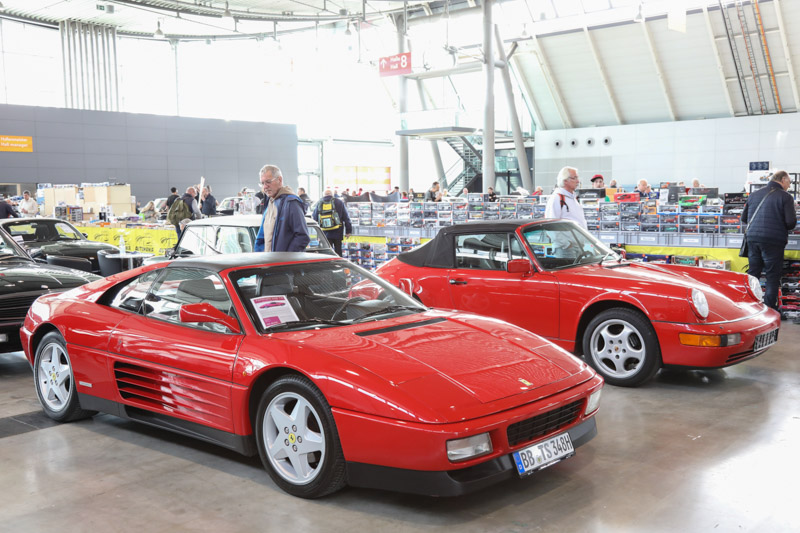
Of course, the modern classics, which are called "NeoClassics" at Retro Classics, were not to be missed. In addition to modern Chevrolet Corvettes and Porsche models, there were also attractive young BMW sports cars to be seen in the new halls.
Déja Vu?
Experienced trade fair visitors wandering through the two spacious halls caught themselves thinking from time to time "I've seen this somewhere before". In fact, some of the photos could have been taken at another trade fair, but the typical visitor to Cologne would hardly have been bothered by this, as he had not normally visited Stuttgart or Essen this year.

The ultimate highlight, which will be remembered for years to come, was missing in Cologne, but perhaps that is too much to ask of a regional classic car fair that no longer wants to be. Nevertheless, there were many small trouvailles, sometimes you just had to approach people to find out more. And this is exactly what a regional fair does much better than the large international events.

For 2019, Hans-Ulrich and Andreas Herrmann are planning to add another hall and are confident that demand will make this possible. On November 14-17, 2019, we will find out whether it has worked out.