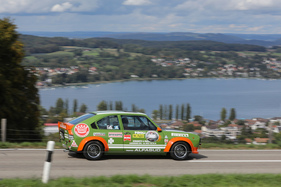
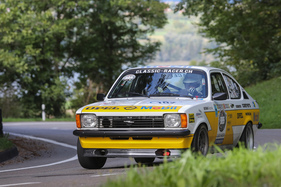
Certainly, many things are compared to Goodwood, but in the case of the Steckborn Memorial Hill Climb, which was held for the fifth time on September 23 and 24, 2023, the comparison is not so far-fetched. Like the Goodwood Festival of Speed, the Memorial attracts surprisingly large crowds (just under 10,000 according to the organization). Like the Festival of Speed, the track climbed a not-too-big hill and measured around 3.2 kilometers in length.

As in England, a large number of vehicles (around 345 racing sports cars, historic cars and motorcycles, according to the organizers) start and, as at the Festival of Speed, future technologies such as the electric car are also on display.
One difference is that the route from Steckborn to Eichhölzli does not pass a castle, although the small town on Lake Constance would also have one to offer, but it is located elsewhere.

The enthusiasm among participants and spectators in eastern Switzerland is hardly any less than that felt at the Duke of Richmond's event. The only difference is that in Steckborn, cowbells were also used to celebrate the riders.
In Steckborn, too, it is hardly about milliseconds, but primarily about being there and showing off historically interesting vehicles. The track itself is by no means undemanding, but the drivers are slowed down by two chicanes and other constrictions. In addition, overtaking is prohibited according to the regulations, although some drivers were unable to avoid leaving slower cars behind them.
Optimal weather conditions
Peter is obviously a fan of Steckborn, as he provided the small town on Lake Constance with largely beautiful autumn weather without posing any insurmountable problems for the engines with high temperatures.

Sunday was a little better than Saturday, but even the first day was at least partly sunny.
A folk festival
Of course, the 3.2 km course length cannot be compared with the Klausen, but the topography in Steckborn ensures that spectators can watch almost everywhere along the mountain course. At the start, the race fans cheered on the drivers, and after the first passage behind the bus-stop chicane, a grandstand allowed spectators to follow the race. Tables and benches were also set up at the second chicane near the Schafgarten to allow spectators to enjoy the race in comfort.
There were also refreshments available in several places so that no one went hungry.
On the meadows along the route, visitors sat down on chairs or picnic blankets they had brought with them to cheer on the "racers". There was a really good atmosphere.

And for those who weren't interested in the racing cars speeding past, there was always the beautiful view of Lake Constance.
Outstanding organization
The Memorial organization, supported by ACS Thurgau, had everything perfectly under control. If there were no minor mishaps on the route, the schedule worked out perfectly without any hectic rush. The impressive number of over 300 vehicles was sent up the mountain twice a day in four fields and then led back down to Steckborn.

While the Corso field drove as a group, the other vehicles started individually, as is customary in hill climbs. The cars were driven at reasonable times so that local residents were not woken from their sleep.
From the former everyday car to the decorated racing car
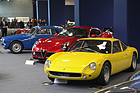
The field of vehicles was more than just rich. It covered around 100 years of automobiles (and motorcycles): The spectrum ranged from the American La France from 1915 to the Porsche 991 GT3 Cup from 2015.

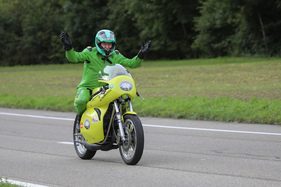
While fields 1, 3 and 4 as well as the motorcycles of field 2 stormed up to Eichhölzli in classic hill climb mode, the Corso in field 2 was a little more leisurely, as they rode up in a group. But it was in the Corso field that visitors were able to see some real gems.

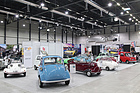
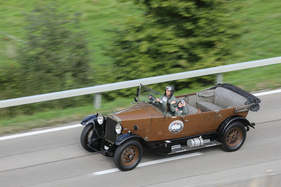
A Bianchi Tipo 20 from 1926, for example, is rarely seen, and a JAWA 600 Roadster from 1940 is certainly one of the rarities. The Corso field showed the typical mix of former everyday vehicles and cars that were already rare in their day.

Examples include the Fiat 500 or the VW Beetle, but also a Spatz 200 or a Maserati Bora.

Race 1 featured near-series cars from Italy, Germany and Great Britain. If you were looking forward to seeing Alfa Romeo Giulia, BMW 2002 or Austin Mini Cooper, you got to see some of these cars here.

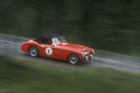
Field 1 also featured two of the most important cars from Steckborn's point of view, namely the Jaguar XK 120, which had already competed in the hill climb from Steckborn to Eichhölzli in the 1950s and even won their class or came second.

The fact that these two cars were back in 2023 is almost a small miracle.

But there were also many other trouvaille to discover that you don't see at every event, such as a Fiat 131 Abarth Rallye from 1977 or an Alfa Romeo Alfasud with Cup racing history.
The touring cars and GT racing cars formed Field 3 together with the US sports cars and a colorful mix of other rarities.

There were also some lesser-known cars to discover here, such as the Matra Djet 5, the AMC Javelin 360 SST or the Datsun 510.

There were also many Ford Escorts, Opel Kadett and BMW 3-series at the start, as well as the almost complete ancestral line of the Chevrolet Corvette, from C1 to C2 and C3 to the C4.

Once again, the various Cobras from the AC/Shelby legacy provided plenty of excitement.
Finally, the last field 4 was dedicated to the more or less thoroughbred racing cars.

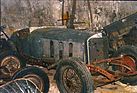
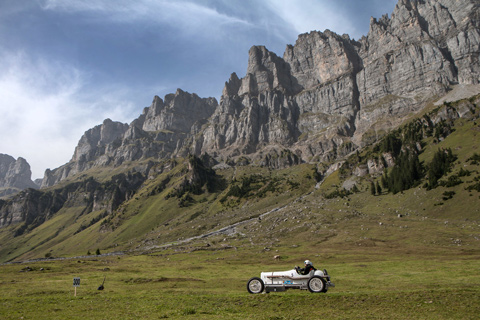
The pre-war cars included a Bugatti 35B, a Maserati 8 CM and two brute American La France.

In addition, two-seater racing cars such as a Lotus 23 or a Sauber C1 thundered towards the finish line.

And as a final bouquet, there were also the formula cars to be seen, a rather rich group of vehicles that included a Martini Mk 28 BMW F2 and a March 713 from 1971.
75 years of Porsche
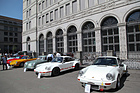
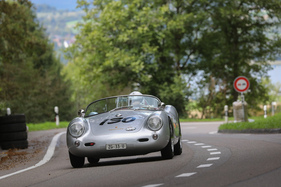
As a special attraction, a Porsche field consisting of over 30 vehicles was put together for the 5th Memorial to mark the 75th anniversary of sports car construction at Porsche.

For example, there was a Porsche Carrera GTS, a Porsche 550 Spyder, several racing 911s and a still young 918 Hybrid, which Le Mans winner Marco Werner piloted up the hill.

The Autobau-Erlebniswelt Romanshorn with Fredy Lienhard supported this field in particular with many vehicles.
Sound of Speed
In addition to the visual enrichment, the racing cars also offered something for the ear. From one to twelve-cylinder engines, you could hear almost everything that the car industry has produced over the last 100 years. The high-bred racing cars were of course particularly impressive, but the motorcycles did not hold back acoustically either.

Only when the procession of electric vehicles passed by did one or two spectators grimace. "You can't hear anything," said the track announcer. In fact, the rolling noises of the heavy and thick-soled electric vehicles were at least as loud as those of the cars, some of which (in the Corso) were barely louder in total.
Quite environmentally friendly
Not only did some of the participating vehicles run on synthetic fuel, the organization also made an ecological environmental promise. In October, in consultation with the forester, at least 350 young native trees will be planted in the Untersee region to enrich nature for generations to come. Perhaps one of the trees will then be able to call itself a Bugatti 35 or Maserati 8 CM ...
The more than 700 photographs of this event have been arranged in five picture galleries, which are made available to interested readers individually:
- Field 1 - Near-series cars from Italy, Germany and Great Britain
- Field 2 - Motorcycles
- Field 2 - Corso
- Field 3 - Touring cars, GT, US cars and Varia
- Field 4 - Pre-war vehicles, "75 years of Porsche" and two/one-seater racing cars