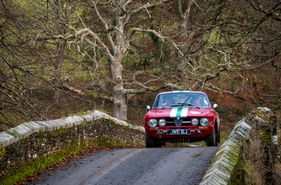
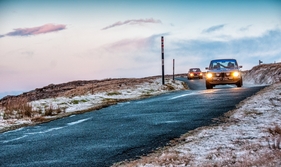

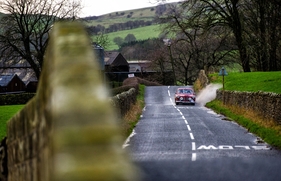
The 20th edition of the Land's End to John O'Groats Classic Reliabilty Trial and Tour (Le Jog) took place in England from December 6 to 9, 2014. From the westernmost point of the English mainland, the four-day rally led over challenging paths and roads to the north-easternmost tip of Scotland.

"Le Jog" is regarded as the toughest classic reliability rally in the whole of Europe and is definitely a "must-do" for every classic car enthusiast who wants to put themselves and their vehicle through these hardships. In 2014, the legendary Le Jog Rally once again impressed with special features for its 20th anniversary and locations that have long been part of Le Jog folklore. To mark the anniversary, the 2014 route was practically the same as the original route of the first event.
Challenging and isolated roads
On the last day of the 2014 Le Jog Rally, the competitors left Kyle of Lochalsh for the final scheduled 12 hours. During these hours, the teams drove more than 526 km before reaching John O'Groats over some of the most challenging and isolated roads in Europe. It was here that victory and defeat were decided. Then Scotland's answer to the Stelvio Pass beckoned - a ride over Bealach Na Ba, also known as the Pass of the Cattle, the highest pass in Britain, a place where the wind never stands still.

The teams tested four timing points before taking on the descent to Applecross on one of the most beautiful roads in Europe, in complete darkness of course. From there, the route continued on narrow roads clinging to steep cliffs, where your heart might slip into your pants if you lean out too far and look down into the depths. The route then led over barren land to Loch Torridon.
Endurance is required
Participants from the previous year were already familiar with the village of Shieldaig and the timing points were somewhat cunningly hidden in inconspicuous places in order to catch all those who were slowly but surely beginning to feel the effects of the very demanding route.
Instead, the route soon led onto the A896, which offered some respite after all the narrow and winding roads of the previous regularity stage. However, this route did not quite offer the relaxation that some might have liked. Even though it is classified as an A road, the dense nature and topography made it another challenging road.
"This is one of the best rallies in the world," said participant Martin Rudolf from Switzerland, "as long as the driver and navigator - there is no co-driver - are just as capable of going full throttle as the car."

Sandwiches and drinks from the garage
After Loch Luichart, almost at Strathpeffer on the east side of Scotland, the 2014 Le Jog Rally turned northwest and headed along the thankfully fast and open A835 to Ullapool to Lochbroom Garage Services, where the owners had stayed to greet the competitors and provide sandwiches and drinks as well as generous facilities for any repairs needed. Two regularity tests followed, both familiar from 2013, which again demanded a lot from the teams with very narrow and winding roads. The second part had over 13 steep bend sections in 6.5 km, which the participants still had to tackle at 04:00 at night!
Bite through or collect penalty points?
A short almost circular loop in Sutherland in the east of Handa Island brought the exhausted teams to Durness, the most north-westerly town in the UK, where they were still a full 8 hours from the finish! A series of route controls kept the teams on their toes across Kyle of Tongue before the penultimate regularity stage of the Le Jog Rally at Skerray. With only five timing points and one loop in the course, teams who were a little short on time were able to skip this part, but incurred hefty penalty points for doing so.

Merciless winds and horizontal rain
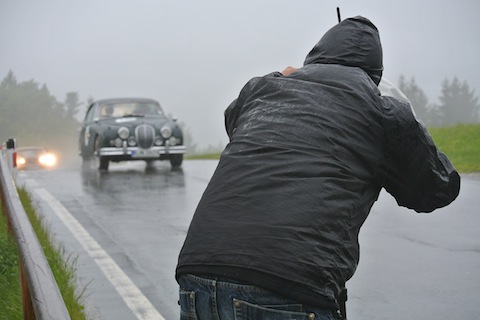
After a fuel stop in Thurso, the final section of a truly epic Le Jog Rally 2014 came into view. The final 28km or so of regularity over some unusually straight roads, passing the Loch of Mey and the Castle of Mey, which was once the Scottish home of Queen Elizabeth and is now regularly visited by Prince Charles. Towards the end, the already exhausted teams had to give it their all once again; the last section led in a loop around a private estate in a final regularity test, which ultimately decided victory or defeat. For the final 6.4 km, the teams were then chased to John O'Groats, where they were finally welcomed at the finish line - in horizontal rainfall and merciless, gale-force winds.

Three times deserved gold
The gold medal went to first-time participants Tomas de Vargas Machuca and Leigh Powley in a 1970 Porsche 911S. With this victory, Powley was able to round off a successful year and his tears of joy as he was received at the finish line by his father Roger were well deserved. Mark Godfrey and Martyn Taylor in a 1965 MG B took the second gold medal, rounding off a year of victories for the pair. The final gold medal went to Karsten Weber and Thomas Koerner in the 1976 Rocket Science-BMW 320 team.
Of course, there are not only winners in such a tough rally; around a third of the participants had to give up. The drive on the roads, some of which are quite primitive, is murderous for the equipment. Navigation is not easy either, and it is advisable to find coordination points while driving. You drive fast and at full throttle a lot.
"My Reliant Scimitar V8 held up very well, only breaking a rear wheel bearing 300 km before the end," says Martin Rudolf. "I would take part again at any time, but it is of course a question of time and cost, although the event can be classified as good value for money; there is a lot on offer and the organization is perfect."
Our picture gallery shows all the breathtaking pictures from the rally, which beautifully show the fun and the impressive landscape at the same time.