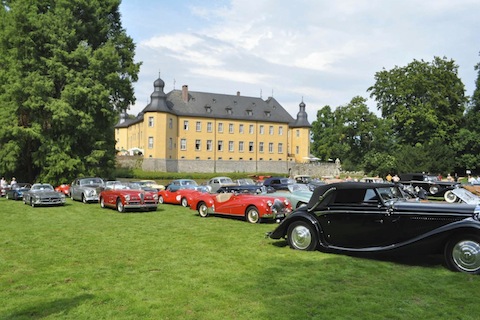
As throughout Europe, the heat did not stop at the gates of Schloss Dyck. The castle park had not seen rain since April. With temperatures of over 35 degrees Celsius, the Classic Days from August 3 to 5, 2018 were absolutely borderline for everyone involved, man and machine.

A spokeswoman from the Rolls-Royce Club Germany: "...we just flowed along. The sun was merciless in the miscanthus field, because there are no trees to provide shade. A foldable shelter from a club colleague was the last resort, as we couldn't use our club tent because everything had to be taken down again and again in the evening to water the botany due to the enormous drought. Lawns turned into steppes, dust spread and bales of straw were banned from the site due to the excessive risk of fire. The cars in the fields were parked in groups at large distances to prevent a small fire from turning into a large fire."
Long-distance record car
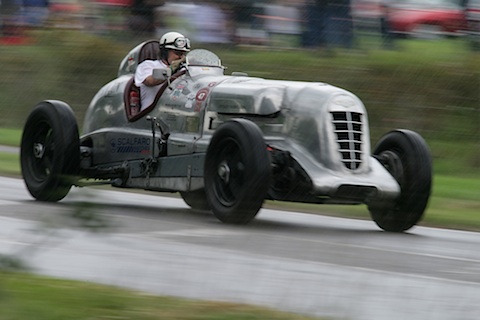
For the first time, one of the most important cars from the Brooklands Museum could be seen and heard in action on the European continent: The 24-liter Napier-Railton long-distance record-breaking car from 1933. Built by driver John Cobb and designed by Reid Railton, the car was created in one of the workshops on the site of the track at the time. It made its debut there in August 1933 - exactly 85 years ago. On this anniversary, the car was driven on the continent for the first time. The Napier-Railton was good for a number of records, including the 24-hour record in Bonneville USA with an average speed of 150.6 miles per hour or 240 km/h.

At Brooklands in 1935, he set the eternal lap record with 231 km/h. An incredible piece of motorsport history from a place steeped in history - what could be a better fit for the 13th Classic Days?
The special with 24 exhaust pipes
Chris Williams brought two very special treasures with him from England: Both are modified Bentleys, so-called Specials. "Mavis" proves just how special a Special is.

The Packard Bentley with the female name "Mavis" - a one-off with an American Packard patrol boat engine from the Second World War. With a displacement of 42 liters, the car's V12 engine produces 1,495 hp at 2,700 Nm. The car was presented to the world public for the first time in England in 2010. Built on a 1930 Bentley 8-liter chassis, the car has 24 exhaust pipes.
Bentley with boat engine
The man with the bowler hat also brought his second "baby" with him: A Napier Bentley is a vintage racing car that was built as a one-off by David Llewellyn in 1968. The car was built on a Sunbeam chassis. After a serious accident, it was rebuilt on the chassis of an 8-liter Bentley from 1929. It has a 24-liter Napier Sea Lion engine. This 12-cylinder W-shaped boat engine is derived from a Napier Lion aircraft engine. The engine develops around 550 bhp (410 kW).

The W12 engine has three rows of four very thick, short exhaust pipes, one of which protrudes directly from the left-hand side of the vehicle. The engine noise is often compared to that of a biplane from the First World War. The car has belonged to Chris Williams since 1999 and the Classic Days are very much looking forward to the loud Bentley duo from his garage.
Bullit at Dyck Castle
Another theme was "Hollywood". Just like in the movie "Bullit", Steve McQueen's green Ford Mustang Fastback and the Dodge Charger R/T engaged in a "chase".

The '67 Shelby GT 500 "Elenor", which was seen with Nicolas Cage in the movie "Just 60 Seconds", was also involved. On her heels were two US police cars with flashing blue lights and sirens.

Would you rather have Jägermeister on your car than in your stomach?
Walter Röhrl drove a Brun-Porsche 962 in the famous Jägermeister colors.

Eckehard Schimpf brought some of the famous orange-colored cars to the Schlosspark. Walter Röhrl even had himself chauffeured in an electric car. His laughter shows his enthusiasm for electric cars, which he recently announced in an interview: "The sound is like on a golf course, so much for Formula E. It's crazy to build a racing car to race in the city. They should be on the racetrack with sound, then I know I'm at a race and not at a blind event!"

RS birthday party
Ford celebrated the 50th anniversary of their RS model range.

In addition to the Capri RS and the Escort RS 1600 from 1968, the Sierra RS Cosworth and the Escort RS Cosworth as well as other models were also on site.
Pikes Peak in the Schlosspark
Volkswagen made Pikes Peak its own. The Twin Golf, which had already tried to win the Race to the Clouds, as Pikes Peak is also known, in 1987 with two 1.8-liter 4-cylinder engines from the Golf ll GTI 16V, was brought up to speed. But Jochi Kleint was stopped a few bends before the finish with a defect in the 652 hp monster.

However, Kleint was able to complete his laps at Schloss Dyck without any problems and the brute sound of the bi-motor car thrilled the numerous spectators.
This year, however, the Wolfsburg team took back the victory they had lost at Pikes Peak, albeit electrically. The electric carbon speedster, driven by Le Mans winner Romain Dumas, sprinted the 12.42 miles (19.99 km) up the mountain in an incredible 7:57.148 minutes. Volkswagen has already set two records with the electric racing car, which took just eight months to build. On June 24, Romain Dumas not only improved the previous record for electric racing cars at the 2018 Pikes Peak International Hill Climb, but also set a new all-time record of 7:57.148 minutes at the world's most famous hill climb.

Just three weeks later, the 40-year-old Frenchman set a new electric record of 43.86 seconds in the I.D. R Pikes Peak at the traditional Goodwood Festival of Speed. Dumas was 3.48 seconds faster than the previous record holder Jonny Cocker in 2013 at the legendary motorsport event in southern England.
Former fire engines at racing speed
The American-LaFrance faction really kicked up the dust with their high-capacity machines.

The cars are so difficult to steer that even the metal gloves of a knight's armor are necessary to avoid breaking an arm.
Incidentally, you have hardly ever seen so many of these former fire engines assembled (and on the track) in Europe.
Horch in motion and posing
Audi Tradition used the 150th birthday of August Horch for a very special appearance at the Classic Days. While three Horchs from the 1920s and 1930s completed a special run on the race track, others shone as "Jewels in the Park" on the museum island directly in front of Schloss Dyck, including a 1937 Horch 853.

As a sports coupé with bodywork by Erdmann & Rossi from Berlin, it remained a one-off. It is a reconstruction of the private car of the famous racing driver Bernd Rosemeyer, who had a fatal accident in 1938 while driving a record-breaking Auto-Union racing car.
DTM of today among the legends of yesterday
One week before his race appearance in the DTM comeback at Brands Hatch, 2013 DTM Champion Mike Rockefeller drove an Audi RS 5 DTM around the 2.8-kilometer circuit through the park on Saturday and Sunday.

"It was my first time here and certainly not the last," said Rockenfeller. "The Classic Days with Schloss Dyck as an impressive backdrop are a really cool event. I left a lot of rubber on my donuts and signed plenty of autographs afterwards."
The savior with the hat
The "Marlboro man", also always in a cowboy hat, Arturo Merzario was among the old guard in an Alfa Romeo Tipo 33TT12. His chair bore the name of the man with seven lives: Niki Lauda. After two kidney transplants and a heart operation, he now also had his lungs replaced. Arturo Merzario was the first to help the Austrian to a second life when he pulled the Ferrari driver from his burning wreck at the Nürburgring.

As Roger Benoit so aptly wrote in "BLICK": "Anyone who has ever sat in a car burning at 800 degrees for almost a minute, as Lauda did on August 1, 1976, knows his second birthday after February 22, 1949."
Later, his brother Florian and his wife Birgit (one kidney each), a donor lung from Germany and Professor Walter Klepetko (thoracic surgery) were also added to the list of lifesavers. The "zwischengas team" would like to take this opportunity to wish Niki Lauda all the best and a speedy recovery.
Yes, it was hot at Schloss Dyck, but it is certainly not the heat that most visitors will remember.

-an-den-Classic-Days-2014.jpg)