Fall and winter time is trade fair time. The 36th "Auto e Moto d`Epoca" in Padua marked the start of the trade fair season once again. Around 130,000 visitors were counted in Italy last weekend. The slogan of this year's fair was: L`auto accende la passione - The car ignites passion.
Many brands were missing
Unfortunately, not many manufacturers followed this invitation. Porsche was again well represented. They were joined by Bentley, Ford, Pagani, Seat, Alpine and McLaren. The latter, however, only with current cars. Why the British racing car manufacturer never brings its most beautiful sports car ever, the F1, is somehow incomprehensible.

There was nothing at all to be seen from the Italians at the factory. Manufacturers have gone into full austerity mode and since politics has electrified mobility, they no longer even dare to show their own past at Italy's biggest trade fair.
Ferrari provides a ray of hope
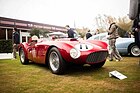
The special exhibition with the various Ferrari Barchettas from the 1950s was sensational. Simple, fast and beautiful, the "Barchette" appeared at the end of the 1940s: lightweight racing spiders, with no hood or frills, just a tiny windshield to keep air resistance as low as possible.

An efficient recipe with which they set the tone in the heroic years of the Mille Miglia, the Targa Florio and many other races of the time.
Models that tell stories
The "oldest" of the Barchette exhibited in Padua was the Ferrari 166 Mille Miglia with touring bodywork from 1950, which belonged to Gianni Agnelli, was then sold to Belgium and subsequently driven in a race by Olivier Gendebien. When the car was owned by the great Ferrari collector and former Formula 1 driver Jacques Swaters, it was exhibited at the MoMa in New York and the National Gallery in Berlin as an example of Italian design. In 2015, the car was one of the big stars of the Villa d'Este beauty contest. It is also a very special model, partly because it has to do with the origin of the nickname "Barchetta".

In view of the rounded shapes of the 166 MM, which was exhibited at the Turin Motor Show in 1948, Agnelli stated: "This is not a car, but a boat (barchetta in Italian)!" This comment was immediately recorded by sports journalist Giovanni Canestrini (one of the creators of the Mille Miglia race) and then adopted by Bianchi Anderloni (designer of the Touring coachbuilding company in Milan) to designate the convertible version of the 166 MM built for the 1949 Mille Miglia race. Since then, the term "barchetta" has gone down in motorsport history to designate the entire category of racing convertibles and has recently been used again for exclusive, limited-edition models.
Lots to see at the Fiera too
In addition to masses of model cars, books, memorabilia and spare parts, a further 5000 or so cars occupied the area of the Fiera in Padua. Some of them were very rare specimens. First and foremost was the ALCA Volpe microcar from 1947, next to which the Messerschmitt and the Isetta looked like a large limousine. You don't see a Ford-SIATA 208S convertible every day and a Lancia Fulvia Zagato convertible isn't on every street corner either.

The Mariani Colombo from 1954 can compete visually with a Maserati A6GCS, only in terms of performance it is somewhat inferior to its bigger brother with the Lancia engine. And who has heard of the LMX Sirex, a visually successful sports coupé weighing just 950 kg with a plastic body and a Ford 6-cylinder May-Turbo engine?

Worthwhile trip to the south
Apart from the espresso, the gelati and the sinfully expensive pasticcerias, there really was a lot to see in Italy again. the trade fair is well worth the trip and if the weather is still reasonably good, the historic city center also has a lot to offer.