


At the end of June 2024, the 8th Beijing-Paris Rally came to an end after 37 days of driving, with very different results for the participants.
While Mario Illien was informed of the disqualification of his white and the other two (blue and green) Ford Escorts at the car inspection before the start (they then drove "out of competition" in the "Evolution class"), the Lucerne pairing Carlos Rieder/Urs Schnüriger ultimately took a clean third place with their Ford. Respect!
When one makes a journey... (Matthias Claudius)
If you have already experienced everything and believe that the crazy things in life are still ahead of you and must be realized at all costs, then take part in the Beijing-Paris Rally. You leave your well-protected, well-structured home ... and go on a big journey. Things happen to you there that you could never have imagined!

For example, you may suddenly notice that your engine is misfiring. After a long search, you finally find the cause - a damaged plug. No problem, the thing costs less than a franc in the shops. But: you're at the Beijing-Paris rally and of course you don't have this plug with you. "Fortunately, I have a colleague in England who comes from Hong Kong and didn't need a visa to enter China. He got on the plane and brought us the spare part and additional plugs as well as a new control unit," says Mario Illien, bringing this part of the story to a close. The journey continued.
But such escapades can be taken even further: "We filled up our Escort, after driving 150 meters it stalled and the search for the cause began. The wires were hot, the fuse blew and I discovered that the flywheel's inductive sensor was drawing current. The search for the short circuit began...", Illien describes the next incident. At night, everything was dismantled in a parking lot - and always under time pressure to reach the ferry to Baku across the Caspian Sea in time, which was 3000 km away via normal roads. The solution: organize a truck, convince the driver to take the distance under his wheels and load up the Ford Escort. The rally team drove straight there through the desert. The ferry was reached in good time, then not only a workshop was found, but also the cause of the defect: The flywheel sensor was damaged and this led to a high current flow, which is why the fuse then blew. The journey then continued to the finish without any further problems.

And then there was another breakdown in Henry Rohrer and Markus Schelbert's green Escort on the third-to-last day: shortly before the day's finish, the clutch release bearing failed. Of course, the spare parts store they had brought with them was again missing just such a part. A competitor generously provided a replacement clutch release bearing, but it was a Volvo part. "In the pouring rain in a parking lot, we had to remove the gearbox, adjust the part and install it," says Illien, describing this interlude. By 03:00 in the morning, the roughest part was back together and after a short night's sleep, the work was finished early in the morning and the journey continued.
Arrived
All in all, the engine pope is happy to have reached the destination in Paris together with his son Luca, the whole team with the three Ford Escorts accident-free. Despite the eventful circumstances, he draws a positive conclusion: "It was incredibly nice to experience all this with my son, to travel through countries that you would otherwise never visit, and to be able to count on great camaraderie among the participants. Then he smiles and adds: "And arriving at the stage finish with black hands and faces every evening."

Illien has also learned a few lessons from the Beijing-Paris adventure. The three Ford Escorts will now be completely dismantled in England and the electronic fuel injection, which led to disqualification, will be converted back to carburetors. This is a special chapter for Mario: "Last January, after the Badawi Trail and many problems with the carburetors, we spent three days on the chassis dynamometer and experimented with different jetting and adjustments. We just couldn't get a clean fuel supply with the Weber carburetors and then decided to install the injection system due to time pressure." At the time, there were Escorts with mechanically controlled injection systems, but not those with electronic control. Illien is nevertheless convinced by the engine. Jondel in England built the engines, while Illmor supplied the pistons and connecting rods in addition to various adaptations and technical expertise. "We were fast on the road and also had a great chassis," he beams.

After Beijing-Paris, Mario Illien can imagine driving one or two exotic rallies. "There are opportunities to do this in Siberia or Mongolia," he says, looking to the future and sticking to his statement: "Compared to Beijing-Paris, a Mille Miglia is a coffee run."
The other approach
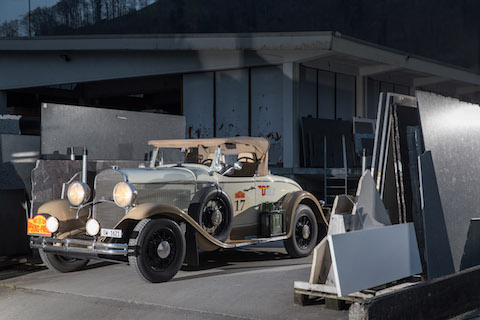
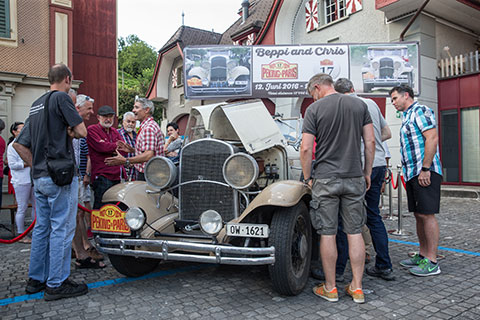
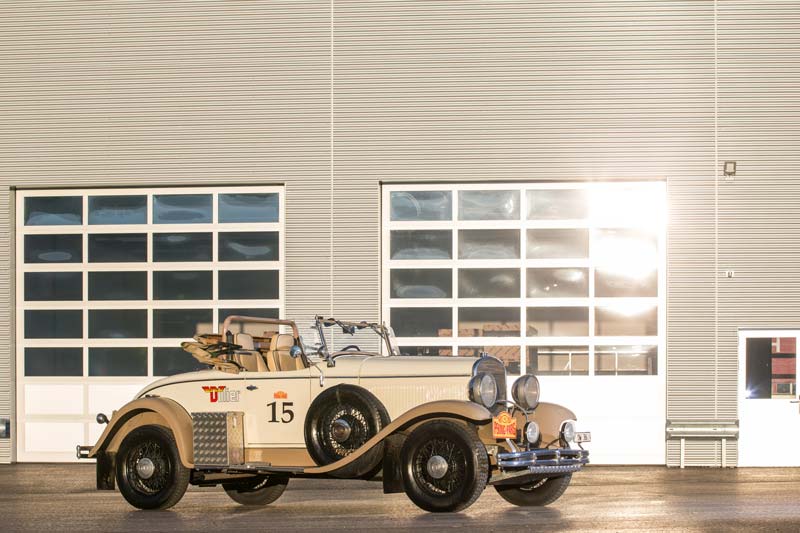
Carlos Rieder from Lucerne chose a different approach to Mario Illien for the 2024 Beijing-Paris Rally. The electrical engineer studied for a long time in advance which vehicle would be best suited to the marathon distance. He decided to focus on simplicity rather than racing technology. In the end, the choice fell on a 1931 Ford Model A Coupé. "The simplicity of the car's design convinced me, as did the standard engine and the robustness of the car as a whole," says Rieder, explaining the reasons for his decision. The car was prepared at Fischer Classic in Rain, a suburb of Lucerne. "This decision was also absolutely right, because good and serious preparation is the be-all and end-all for successfully completing such a tough rally; Marcel Moser is a true artist," praises Rieder.

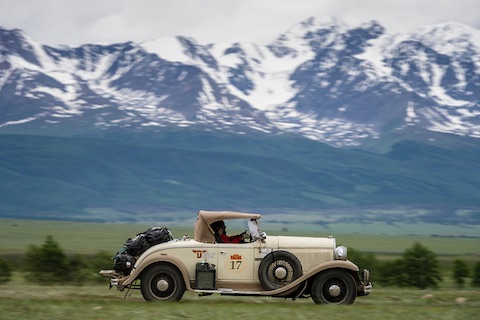
The pairing of Carlos Rieder/Urs Schnüriger brought their Ford Model A Coupe from Beijing to Paris without any major problems. "The engine of our car had little power, we knew that and drove accordingly cautiously. We drove relatively slowly through Mongolia, always on sight, over the dusty tracks. This paid off. We 'only' had two defects. Once we lost a shock absorber, another time the air filter cover flew off," Rieder describes the "breakdown highlights" and continues: "The one with the shock absorber cost us a lot of time. We had to drive around 30 kilometers without the shock absorber, which was only possible at a slow pace. But the service team that accompanied the rally team was perfectly equipped. They even carried a mobile welding unit, which was used to repair the shock absorbers."

Rieder/Schnüriger always kept an eye on the rankings and were amazed to finish so far ahead. "The narrow-chested performance of our Ford sometimes worried us, especially when there was another pass ahead of us. But we managed to save our narrow lead for third place all the way to Paris," concludes Rieder and is proud "to have reached every checkpoint within the required time".
"The Ford is now going to the rehab clinic," adds Rieder, "where it will be carefully reconditioned so that it is ready to go again next year." He is completely "flashed" by this rally and has already submitted the entry for next year, even though it is the toughest thing he has ever experienced in terms of "cars".
For Carlos Rieder, it is important that not only the preparation of the car is essential, but that the chauffeur can also make a decisive contribution: "I decided to complete the IgF vehicle restoration training beforehand, at the tender age of a 'silver back'," he explains with a smile and adds: "I learned a lot that helped me during the rally - I can recommend it to anyone."
The other winners
Of course, every participant who can finish such a mammoth rally is a winner. Nevertheless, there are of course also the "real" winners.

Andy Buchan & Mike Sinclair won overall in their 1928 Bentley 4 1/2 Litre Le Mans, followed by Alex Vassbotton and Bas Gross in a 1933 Alvis Fire Fly 12/70. Third place went to the aforementioned Rieder/Schüriger in a 1931 Ford Model A Coupe.

In the "Classic Category", Matt Bryson and Miek Pink came out on top in the 1974 Leyland P76, followed by Lars and Annette Rolner in the 1974 Porsche 911 S and Kevin and Cole Bradburn in the 1969 Porsche 912.
Credits: Ford Escort in rallying
Building a Ford Escort as a rally car is certainly not wrong. Both the rear-wheel drive Mk1 (also known as the dog bone) and Mk2 can boast great successes in rallying.
From 1970, Ford entered the Escort RS1600, a 1.6-liter four-cylinder with an advanced four-valve cylinder head from Cosworth. "The Flying Finns", as Hannu Mikkola and Timo Mäkinen liked to be called, were soon successful. Mikkola won the Safari Rally in 1972, Mäkinen claimed victory in the Hong Kong Rally and British veteran Roger Clark won the RAC Rally.

Mäkinen's last victory at the 1975 RAC was also the first success for a second-generation Ford Escort, which, in addition to a fundamentally new body design, was characterized above all by a more powerful 1.8-litre engine. The new Scandinavian "rally animal" Björn Waldegard took victories in the Safari Rally, in Greece and at the RAC in 1977. The following year, he added another success to his palmares with a victory in the Sweden Rally.
The high point for the Escort of the second series came in 1979. The competition with the Lancia Stratos, Fiat Abarth 131 or Saab 900 Turbo was powerless against the rear-wheel drive car from England that year. Ford celebrated the constructors' title, with drivers Mikkola (Portugal, New Zealand, RAC) and Waldegard (Greece and Canada) taking five victories in a total of 12 rallies. Waldegard took the crown and became World Rally Champion in 1979 - not bad either!