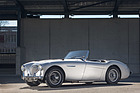
The Austin-Healey 100 is quite compact, especially if you apply modern standards. It is 383.5 cm long, 152.4 cm wide and has a wheelbase of 228.6 cm. Even a first-generation Mazda MX-5, which is actually smaller, is around 15 cm larger in terms of dimensions, and this with an even slightly shorter wheelbase.
But back then, when the Austin-Healey 100 was shown to the public for the first time, this was not an issue. After all, it was primarily the performance in combination with the price that was of interest.

Incidentally, the comparison with a Mazda MX-5 created almost 40 years later is not entirely far-fetched, as both were committed to the British roadster tradition and offered an easy-to-maintain four-cylinder engine as a drive. But even with all the technical improvements of the 1960s to 1980s, it would probably not be so easy for an MX-5 to overtake the Austin-Healey 100.
High-speed driving in the prototype
The Austin-Healey 100 was officially unveiled at the Earls Court Motor Show in London in October 1952, but Donald Healey and his son had already invited the well-known journalist and test driver John Bolster to try out the sports car, which was still called the Healey Hundred at the time and was dressed by Gerry Coker. As Bolster was busy in Paris at the time, it was decided to carry out the test drive in Belgium/Ostend and on the famous Jabbeke "test track".
The roadster that was driven was one of the few prototypes that existed at the time and largely corresponded to the version that was officially presented in London. One exception to the later series was the gearbox, as Bolster was still able to shift four gears. However, he pointed out in his test report in the magazine "Autosport" that first gear was actually unnecessary and that he had even started off in second gear during the acceleration measurements.
Because the test drives were carried out on the unclosed road, many attempts were necessary until the traffic conditions allowed a good measurement. Bolster wrote in his article that the car survived the many journeys beyond 160 km/h without any stress symptoms.
Bolster reached an average of around 106 miles per hour from both directions with the windshield down, i.e. 170.5 km/h. He accelerated the car from 0 to 60 miles per hour (96 km/h) in 10.5 seconds, and it took 37.2 seconds for the Healey to reach 100 MPH (160.9 km/h). This was sporty performance, but it did not come at the price of poor low-speed comfort. The Healey behaved exemplary in all situations, was described as not particularly noisy and managed 25 miles per (British) gallon (the equivalent of 11.3 liters per 100 km).
Bolster also praised the handling, saying it was largely neutral. And the British car expert also mentioned that the sports car cornered with little body roll and that even the comfort was adequate for a car of this type.
So there was hardly anything to criticize and accordingly Bolster noted: "This is certainly the most important new model that we have seen for some time".
Only three forward gears
Only a short time later, Donald Healey's sports car was officially unveiled in London.

An agreement had been reached with Austin early on and the car was now officially called the Austin-Healey 100. This collaboration was no coincidence, as Donald Healey had used many standard parts from the Austin spare parts shelf to keep the costs of his new roadster low.

This was particularly true of the engine from the discontinued Austin A90, which was given a second life with the Healey.
Automobil Revue reported in detail from the motor show in Great Britain at the end of October 1952:
"With this new design, the experienced sports car builder Donald Healey, whose earlier model fitted with a Riley 2.4-liter engine is also well-known in Switzerland, enters the Austin fold, having also made a name for himself in the USA with the international "Nash-Healey" coachbuilt by Pinin Farina from Turin.
With the new sports model, which only received its combined name during the first days of the London exhibition and of which only a few prototypes currently exist, England received a new high-performance vehicle whose low price of 850 pounds (excluding VAT) caused surprise. This was mainly due to the simple basic design and the use of unchanged Austin series parts such as the A90 engine and gearbox, steering and front suspension. The chassis, consisting of welded longitudinal beams and reinforced with a cross brace, is particularly torsionally rigid thanks to an associated torpedo. The rear axle, which is guided by long semi-elliptic springs and a Panhard transverse stabilizer, corresponds to the so-called underslung design, in which the longitudinal chassis members are located under the rear axle.
The 2.66-litre four-cylinder engine delivers 91 brake horsepower at 4000 rpm, but can rev much faster. The four-speed gearbox is supplemented by the Laycock-De-Normanville high-speed gearbox, and in this version the prototype reached 180 km/h during tests on the Belgian Jabbeke-Aeltre road.
The two-seater, open roadster body is one of the most beautiful ever designed in sports car construction and is in no way inferior to even the sleekest Italian models. Nevertheless, the interior width is very generous. Special mention should be made of the windshield, the lower edge of which can be pulled forward so that the windshield rests almost horizontally on the bodywork and serves as a wind deflector.
The Austin-Healey "Hundred" will probably be built in larger series and in cooperation between the two companies. In the export countries, including Switzerland, the Austin organizations will be responsible for sales."
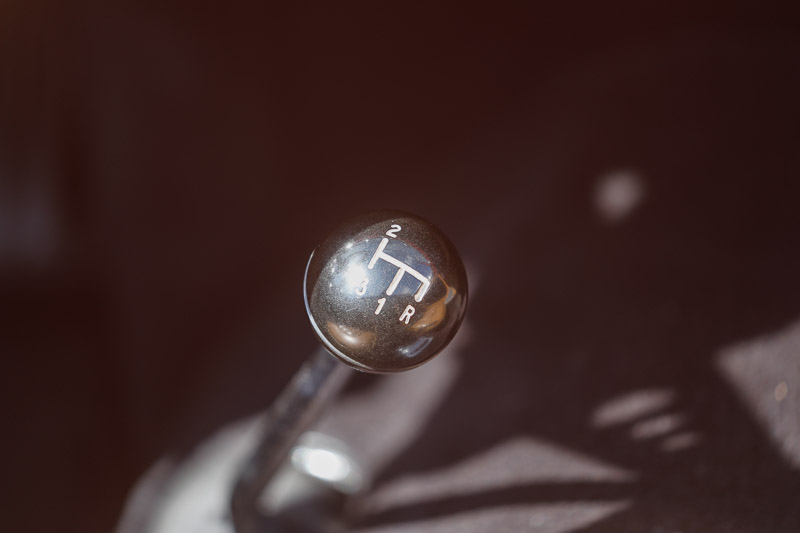
At the London show, there was still talk of four gears, but for series production, first gear was then locked to protect the tightly dimensioned differential and the car was delivered with three gears (plus overdrive). Accordingly, first gear was then located at the rear, where second gear was normally found, second gear was then at the front left in the plane next to it and third gear behind it. All gears were synchronized.
Aimed at the American market
Of course, Healey and Austin wanted to sell the new sports car primarily in the USA, where enthusiasm for British roadsters was high at the time. The results of the test drives carried out by the American magazine "Road & Track" in the summer of 1954 were correspondingly important. The production car with three gears (and overdrive) achieved an average top speed of 102.3 MPH (164.6 km/h) and accelerated from 0 to 60 miles in 11.7 seconds. The quarter mile was completed in 18.1 seconds. Fuel consumption leveled off between 20 and 27 miles per gallon (8.7 to 11.8 liters per 100 km).

The test car, which weighed 1120 kg with a full tank (kerb weight 975 kg) and cost USD 2985 in the USA, convinced the editors in all aspects: "Summed up, the Austin-Healey 100 is an exceptionally good all-around sports car - one which will satisfy the desires of a large number of enthusiasts who want moderate price, good look, high performance and reliability." (In summary, the Austin-Healey 100 is an exceptionally good all-around sports car - one which will satisfy the desires of a large number of enthusiasts who want moderate price, good look, high performance and reliability).

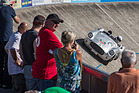
To strengthen the reputation of his sports car, Donald and his son Geoffrey Healey entered it in racing early on. In the 1953 24 Hours of Le Mans, for example, they achieved excellent 12th and 14th places. Speed records were broken on the Bonneville salt lake with an aerodynamically optimized Healey. And with the Type 100 S, a special model optimized for racing was built for amateur racers.
The efforts paid off, with buyers on both sides of the Atlantic clamoring for the compact Austin-Healey 100.
Between 1953 and 1955, 10,030 Austin-Healey 100 BN1s were built, followed by the technically improved but externally hardly changed BN2 variant with four gears. The Austin-Healey then received two additional cylinders.
Can still impress today
You sit low and secure in the early Austin-Healey 100 BN1. The bucket seats provide sufficient lateral support and the controls are within easy reach. The synchronized three-speed gearbox shifts precisely and smoothly, and the car is surprisingly tame for a vehicle that is now over 70 years old.

Even the newcomer to classic cars gets on well with it, as was demonstrated during the photo drives, once they have made friends with the large steering wheel positioned close to the upper body. And found out that the doors can only be opened from the inside and with a wire pull. And that the indicators are not operated by a lever to the right of the steering wheel, but by a switch on the hub.

The soft top is lowered in no time at all, especially if you can count on four hands. The all-round visibility is then perfect and you can also hear some of the not-so-loud, but quite melodious sounds of the Austin four-cylinder engine.

This large-volume engine shapes the character of the car. It is elastic and delivers plenty of torque, so there is no need for a fourth gear, especially as the electrically selectable overdrive can be used at higher speeds.

Cornering is a pure joy thanks to the precise and smooth steering and clear dimensions, and you can always keep up effortlessly in traffic. The classic tires prevent overly tight rolling.

It's easy to understand why the early Austin-Healey was the dream of many Odltimer enthusiasts for decades. Only in recent years has it been displaced in buyers' favor by more modern sports cars, just like its competitors from back then, which is reflected in falling market prices. Thanks to the many mass-produced components and the comparatively large production volume, maintenance costs are kept within limits and the early Austin-Healey 100 is certainly one of the most likeable classic cars of all.
We would like to thank the Touring Garage for the opportunity to take the Austin-Healey 100 for a photo drive.