

It seems that the cars the author reports on are getting younger and younger. Perhaps because interest in pre-war cars has declined, or perhaps because supposed or alleged "future classics" and hypercars can be found more and more frequently at classic car events. So it's been a few years since I reported on a really old car. Back then, when the 1894 Benz Victoria from PS.Speicher was registered as the oldest car in Germany. So it's time to take another look at a really old car. I discovered one of these by chance at Sascha, a dealer whose last syllable of his surname is identical to the company name and who often has interesting cars "beyond the mainstream" on offer. In a good mood, he introduces me to his new arrival, an Austin 7. Now it's time to take a closer look at the old lady.
Old lady with style
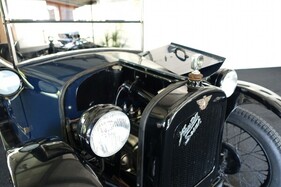
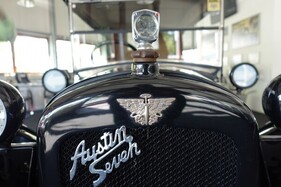
You can't tell she's almost 100 years old. According to its registration, it is an "open passenger car" and was first registered on July 1, 1927. There is no doubt that it has held up very well for its age with its dark blue bodywork, black fenders and black soft top. "Cool little convertible", you think spontaneously.

But let's approach it with the respect it deserves. As far as the Austin 7 is concerned, it should generally be noted that the small car - incidentally, it is the second "Seven" - was built in this development stage for a decade until 1932 in several body versions. It was extremely successful at the time, not only on the British market. There were various licensed models, for example from Dixi (later BMW) and in France it was available as the Rosengart LR 2. Sometimes a different body was placed on the ladder frame of the "Seven". One example of this is the Austin 7 from the stock of Autoworld Brussels, which was "dressed" by the Swallow Sidecar Company, from which the Jaguar brand later emerged.

We are naturally interested in the car's technical data, based on the information in the official German papers. On the outside, the car, which is only 2.64 meters short and 1.17 meters wide, but still 1.69 meters high, looks quite dainty. One involuntarily associates the term "childlike" with this car. The "19-inch wheels" on which it stands do nothing to change this. These are in fact very narrow wire wheels with tires in the nowadays unusual dimension 3.50-19.

The data for the Austin 7's in-line four-cylinder engine is also rather modest: With a displacement of 747 cc, it delivers 8 kW (the equivalent of almost 11 hp) at 2400 rpm, which should enable the car, which weighs just 430 kg, to reach a top speed of 65 km/h. This may be true, but the driver will probably ask himself the anxious question of whether the obstacle can be overcome by his own engine power before tackling larger inclines.

Toy and vehicle in one
Unlike the Victoria mentioned above, the direction of travel is not indicated by a red trowel, but by flashing orange arrows on the right and left.

The author wonders whether the dealer really wants to sell this likeable little car, as it would be a highly recognizable "mascot". In any case, the sight of it simply puts you in a good mood, if only because it looks almost like a toy compared to today's cars.

An anecdote from 1929 also fits in with this: when car manufacturer Lucien Rosengart saw an attractive lady getting out of a large Packard while sitting in his Austin 7-licensed LR 2 in front of a gourmet temple in Paris, he asked her why she was driving such a truck. She asked back why he was making cars for children and playing with them. Incidentally, the lady in question later married Rosengart.
A Volkswagen from England
However, to classify this little car as merely "cute" would not do justice to its historical significance. Rather, it stands in a line with other vehicles that shaped mass motorization, such as the much larger Ford T and other continental European variants of the "Volkswagen" theme. According to the Austin Seven Club Germany, an impressive 290,000 Austin Seven were built. Mass production meant that the sales price could be reduced to such an extent that it approached that of a fully equipped motorcycle with sidecar. With the appearance of cars such as the Austin 7, the previously popular "cycle cars" also largely disappeared from the market. It should not go unmentioned here that Colin Chapman's first Lotus, the Lotus Mark I of 1948, was based on an Austin 7.
Due to a lack of time, there was no test drive. There is probably also a certain amount of respect for the old technology. After all, second gear is not supposed to be where you expect it to be, even if you - what else! - intermediate throttle. In any case, the sprightly old lady Austin 7 is to be wished many more fulfilled automotive years. Perhaps the song "My little Baby" from 1929 will be played in her honor. It's about the Austin Seven, of course.





_RM.jpg)