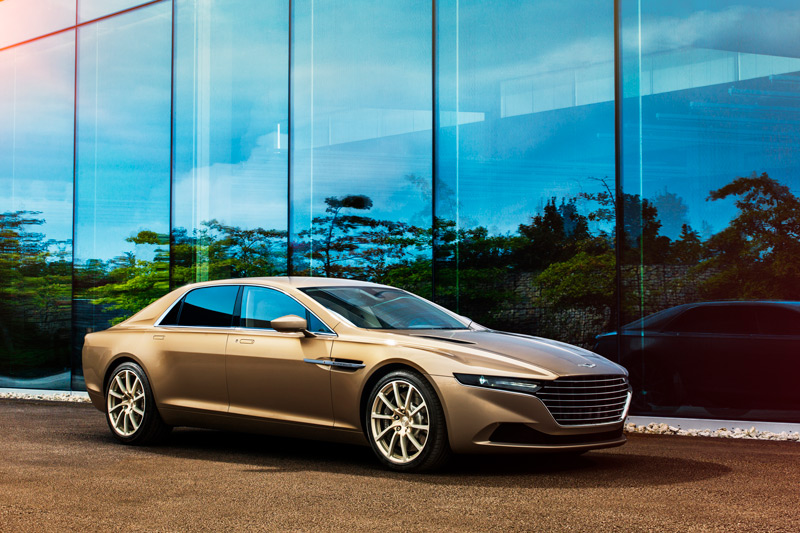
In April 2009, Porsche presented the Panamera in Shanghai, at the IAA Aston Martin, independent of Ford again since 2007 and owned by Prodrive owner David Richards, two Kuwaiti investment companies and a minority shareholding by Ford, followed suit with the Rapide.
The first signs of the model had already been seen earlier: In September 2008, Aston Martin had announced that it would revive the Lagonda name, in the past always associated with the construction of four-door cars. And shortly before that, it had become known that a contract had been agreed between Aston Martin and Magna Steyr in Graz, which provided for the construction of up to 2000 vehicles per year. This figure still seemed unrealistic at the time, as Aston Martin had only celebrated building 13,000 cars since 1955 in 2007.

The four-door sports car
But while the old idea of the four-door finally took shape at Porsche with the Panamera, after it had been taken up several times only to be shelved again and again, four-doors had a certain tradition at Aston Martin. However, the manufacturer from Newport Pagnell used the name Lagonda for this purpose, but the proximity to Aston Martin was never concealed and, on the contrary, was even highly desirable.

However, the success of these four-door cars was usually a mixed bag, because although the cars had a high reputation as a gentleman's express, as a four-door, "serious" saloon these cars usually received little recognition from the intended clientele.

Those of standing and financial strength put their trust in conservative, established car manufacturers, not in the flighty brand that had gone bankrupt no fewer than seven times in its hundred-year history.

Perhaps Aston Martin was not even aware of this when the company once again decided to use the name Lagonda. Because, contrary to expectations, the car that was ultimately shown in Frankfurt was not called Lagonda, but Aston Martin Rapide.
Aston Martin, rethought and implemented
A modular system makes sense for a small series manufacturer, but the development costs seem horrendous. However, Aston Martin decided to go down this route after the DB 7, which is based on the floor assembly of the Jaguar XJ-S, and to create a platform for future models.

The "vertical-horizontal vehicle platform" VH made it possible to realize different versions of the superstructure as well as the track and wheelbase on the same basis with little effort. This floor assembly is based on extruded aluminum, which is joined by riveting and gluing. This process, which involves much lower tooling costs than a classic sheet metal structure and is particularly suitable for medium-series vehicles due to the higher production intensity, was first used in the Lotus Elise from 1995. This in combination with a plastic body.

At Aston Martin, however, the body is made of aluminum. This platform celebrated its premiere in 2003 with the DB 9 and it was the Rapide that ended this chapter in 2020 when production was discontinued.

The company had launched a great success with the new Aston Martin. With the restructuring of the company and a significant financial injection from Ford under the leadership of Dr. Ulrich Bez, it was possible to reposition the brand and significantly increase unit sales.
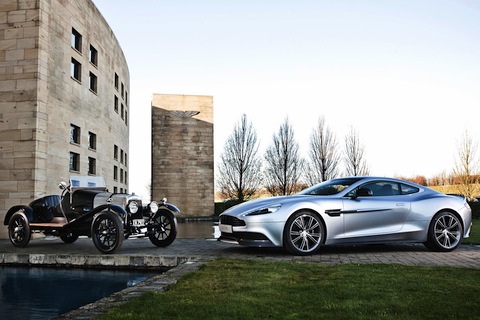
From 2004, the new factory in Gaydon, which was built in the immediate vicinity of the Ford-managed development center for Jaguar and Land Rover, also served this purpose. Since then, the old halls in Newport Pagnell have been dedicated to Aston Martin's historic models.

A hot iron in the fire
With the Rapide, Gaydon hoped to take a slice of the sporty saloon pie. The concept of the car, designed by Aston Martin's head of design Marek Reichmann, was relatively simple: the DB 9 was to be fitted with two additional seats and doors and lose as little of its sporty character as possible in this transformation process.

There are only four individual seats in the car, and in our early example from 2011, these are actually real sports bucket seats - both front and rear. Although there is a tailgate, the trunk of the Rapide will hardly be big enough to take large family luggage on vacation.

In addition, the rear doors are relatively narrow and getting in requires some sportiness from the passengers. For this reason, the Rapide has rightly struggled to establish itself as a directional saloon.

And even if four-door sports cars were able to celebrate a certain degree of success elsewhere, it became clear from the middle of the second decade of the 21st century at the latest that the future of four-door cars in the luxury segment was more likely to be found among SUVs.

Porsche had already presented the first Cayenne in 2002. At Bentley, the Bentayga followed in 2015, while the Rolls Royce Cullinan made its debut in 2018. Since then, these models have been bestsellers for the respective manufacturers. At Aston Martin, it took until 2020 for the DBX, the Aston Martin SUV, to go into series production. As the first Aston Martin five-seater in history, it ultimately replaced the Rapide this year.

Low - wide
First of all, the Rapide has the same effect as its two-door brothers despite its additional doors. Anyone with an interest in cars will instantly recognize it as an Aston Martin. Here it benefits from the radical implementation of the four-seater theme. On the surface, it is even possible that it will not be recognized as such at first.

The long wheelbase, on the other hand, is more striking. This makes the car, which is initially very crouched, look relatively imposing. With its dark paintwork and black interior, our 2011 specimen also appears somewhat unapproachable, not unattractive and yet surrounded by an air of secrecy.
If you take a seat in the Rapide, you will notice the analog gauges some 15 years after its launch. This is the last incarnation of what has been considered good in over 125 years of automotive history and has had to give way to TFT screens within a few years. The information provided needs no further explanation and is self-explanatory.

The controls here also do without touchscreens and the like. The air conditioning is controlled by a rotary pushbutton, a solution that we've only just got used to and has since been taken away again, with a few exceptions - what a shame!

The Rapide has an automatic transmission. Contrary to initial assumptions, this is not a dual-clutch transmission, but probably the best torque converter automatic transmission in recent history and the first ever with six gears, the ZF 6HP 26 Touchtronic II. From model year 2014, the updated eight-speed version was used in the Rapide.

Its characteristics are quickly described: It shifts gears barely noticeably and can be manually influenced very quickly if required using steering wheel paddles. The torque converter bites hard when required and never gives the slightest feeling of sluggishness. Ultimately, gearboxes like this have probably also led to the fact that hardly any customers demand them today and - as a logical consequence - manufacturers no longer offer manual transmissions in cars of this caliber. Gear selection in the Rapide is carried out using pushbuttons in the center of the dashboard. A classic gear selector lever or a solution such as that found in Mercedes with a steering column lever would perhaps be more to hand here. Nevertheless, the solution is elegantly implemented.
No whispering wind
Anyone familiar with Jaguar's former V12 can say goodbye to the idea of the Aston Martin AML11 engine as a whisper engine at the first press of the ignition key in the Rapide. The all-light alloy V12 engine roars to life, awakening with a powerful rumble. The exhaust emits a sonorous snorkel into the environment, a sound that disappears when the D gear is engaged. It remains to be seen whether we really like this solution with an exhaust flap. When the Rapide picks up speed, the soundscape calms down, which suits the car well.

When rolling at urban speeds and rolling over manhole covers and road patches, it goes without saying that the stiff high-speed tires with their low cross-section can't be world champions when it comes to rolling comfort. Nevertheless, the Rapide doesn't simply shake you about, even if this is undoubtedly no S-Class.

The rolling noise may also be somewhat more audible in the interior than in a chauffeur-driven sedan. However, the engine adds a pleasant voice to the chorus. At the end of the town, it takes the lead and raises expectations in terms of driving dynamics.
The Rapide does not disappoint. The steering is precise and the rather long car is easy to place on the road. The tendency of the wide tires to follow every track is kept within narrow limits, and the car responds very willingly to inputs on the steering wheel, accelerator and brakes. The Rapide thus confirms the assumption that its focus is really on a very sporty grand tourer rather than a dignified saloon.

Sitting flat, with relatively outstretched arms, you look out of the cab over the long hood and quickly forget that there is another row of seats behind you. Perhaps a shorter DB 9 is a little more agile, or even the smaller entry-level model from back then, the V8. But the fact that the Rapide helps you to steer into the bend in a controlled manner via the rear axle with this targeted load change when you ease off the accelerator is a real joy to drive.

It makes no noise whatsoever from the tires, God forbid, the good manners of a British luxury car are on display here - or the discretion of an agent in His Majesty's service.
Yes, it is possible to drive the Rapide like a hooligan, but it takes a long time to actually look like one. If you come from the classic side and look at the stated 470 hp with awe, you may well be right to do so. On the other hand, those who are also interested in more recent cars will take note of this performance, but will hardly be blown away by it. Here, time has passed over the now 15-year-old car in leaps and bounds. In addition, Aston Martin itself responded to customer demand and the competitive environment with the updated Rapide S from 2013, increasing the power output to initially 550 hp and finally to 552 hp. The last series of the Rapide, the Rapide AMR from 2018, even achieves 580 hp.

A sports car with utility value and everyday capabilities? The Aston Martin Rapide makes it possible, even if the coupé saloon is of course neither a station wagon nor an SUV. But it really is wonderfully elegant.
We would like to thank the Odltimer Galerie Toffen for the opportunity to take a photo.



_RM.jpg)